LG to Boost Native Honeybee Population to 4 Million
Collaborating with Master Kim Daerip and Beecomfriends for Ecosystem Restoration
Supporting Farms and Empowering People with Disabilities through Bee Population Growth
Strengthening Biodiversity Conservation Efforts Centered on Hwadam Forest
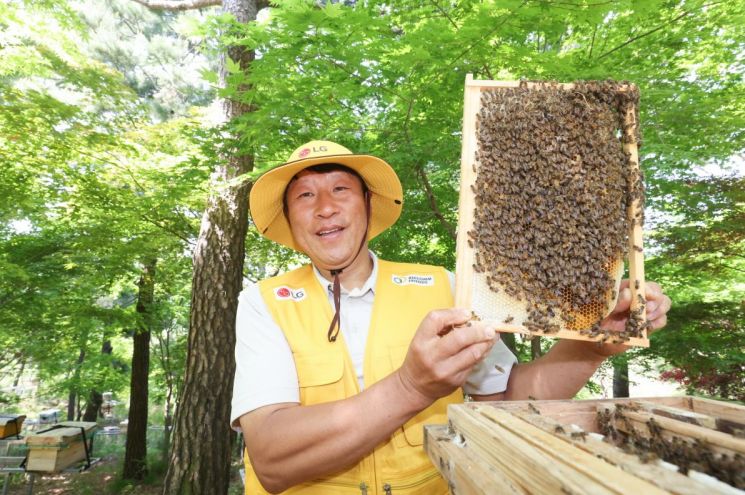
LG is taking steps to restore the ecosystem by increasing the population of native honeybees, which are at risk of extinction. On May 19, LG Evergreen Foundation announced that it has established a native honeybee habitat on Jeonggwangsan Mountain, near Hwadam Forest Arboretum in Gwangju, Gyeonggi Province, and is launching a project to increase the population to 4 million by 2027.
For this project, LG has partnered with Kim Daerip, the first certified master of native beekeeping, and the social enterprise Beecomfriends. The goal is to start with 1 million bees this year, double the population to 2 million next year, and reach 4 million by 2027, more than doubling the number each year. Hwadam Forest, located near the habitat, is rich in nectar-producing plants, providing an environment where the bees can settle stably. LG also plans to expand the planting of nectar trees and wildflowers in the area.
Native honeybees play a crucial role in supporting the growth of indigenous plants such as wild pear trees through pollination. However, due to the spread of sacbrood disease in the 2010s, more than 98% of the native bee population disappeared, putting them on the brink of extinction. In addition, climate change has caused billions of honeybees to disappear each year, making the expansion of their population an urgent priority for ecosystem restoration.
The newly established habitat will be centered around the "Halla Native Bee," a selectively bred variety of native bees. Kim Daerip has dedicated 40 years to increasing the native bee population and holds nine related patents, including those for artificial swarming technology and queen bee management devices. LG plans to focus on ensuring that the initial 1 million bees introduced by June successfully settle into the habitat.
Once the population expansion is complete, the honeybees will be provided free of charge to farms affected by beekeeping losses. Beecomfriends, the collaborating social enterprise, supports beekeepers with developmental disabilities and plans to strengthen its efforts to help people with disabilities achieve independence through this project.
An LG official stated, "This project is not simply about protecting insects, but about contributing to the restoration of balance in Korea's ecosystem," adding, "We will take the lead in creating a sustainable ecosystem for biodiversity and nature conservation."
Meanwhile, LG Evergreen Foundation has previously worked on protecting natural monuments such as cranes, spoonbills, and storks, installing artificial birdhouses, and supporting wildlife reintroduction projects. The foundation is also focused on preserving native species such as the Korean pond turtle, Korean spotted barbel, and fireflies, with Hwadam Forest at the center of these efforts. In January of this year, Hwadam Forest was designated by the Korea Forest Service as a national institution for the conservation of rare and endemic plants.
© The Asia Business Daily(www.asiae.co.kr). All rights reserved.

















