Explanation of the National Audit Petition at the 'Young Doctors Forum' on the 17th
"Opaque Procedures Revealed in Last Year's Dismissed Administrative Lawsuit"
To Resigned Residents and Medical Students: "Now is the Time to Return and Study"
Former Board of Audit and Inspection Chairman Jae Hyung Choi expressed confidence that procedural illegality in the process of increasing medical school enrollment quotas could be revealed through an audit by the Board of Audit and Inspection.
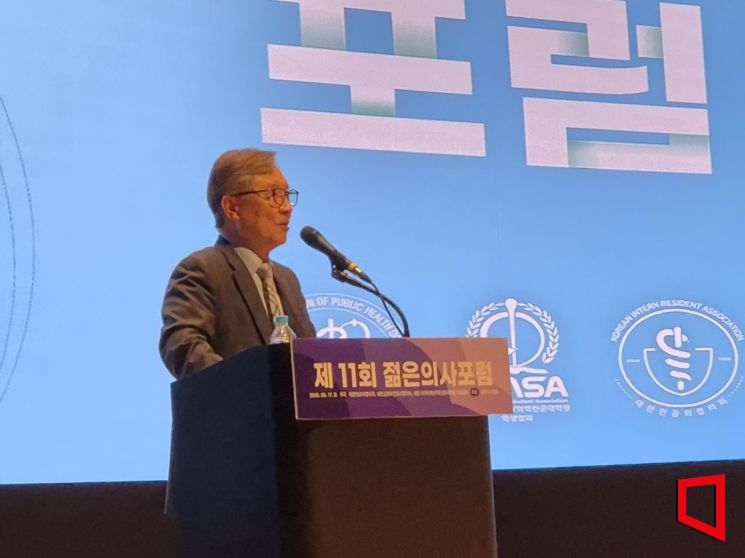 Former Board of Audit and Inspection Chairman Jae Hyung Choi is speaking at the '2025 Young Doctors Forum' held at COEX in Gangnam-gu, Seoul on the 17th. Photo by Tae Won Choi
Choi, who is representing the resigned medical residents as their legal counsel, attended the '2025 Young Doctors Forum' held at COEX in Gangnam-gu, Seoul on the 17th. He said, "Although the administrative lawsuit filed by the medical community against the government last year to suspend the enforcement of the policy was dismissed, it was acknowledged that the process was opaque, such as the absence of meeting minutes." He added, "An audit by the Board of Audit and Inspection could point out such issues as procedural flaws in the quota increase process."
The Korean Medical Association announced at a regular briefing the previous day, "Regarding the government's unilateral push to increase the quota by 2,000, we plan to request an audit by the Board of Audit and Inspection through the national audit petition system to hold the government accountable for illegality, abuse of administrative power, and losses to the national treasury and health insurance finances." The main points of the audit request include: ▲ procedural illegality in the policy decision process, ▲ distortion in the process of consulting with experts, ▲ unjustified orders to commence work, ▲ causing waste of taxpayers' money and finances, and ▲ causing harm to essential medical services and the collapse of the medical ecosystem. The association stated that it seeks to correct hastily implemented healthcare policies and demand accountability from misguided policymakers through the audit.
Choi emphasized, however, that the audit by the Board of Audit and Inspection would not evaluate whether the scale of the 2,000-person increase in medical school quotas is appropriate. He explained, "Based on my experience working at the Board of Audit and Inspection, whether an increase of 2,000 is appropriate is not subject to the Board's judgment. The audit will focus on procedural issues and whether there was sufficient human and material preparation for education at the time of the increase."
He also noted that the Korean Medical Association's national audit petition is similar to the audit request previously passed by the National Assembly. In February, an agenda item led by the opposition party and passed at a plenary session called for an audit by the Board of Audit and Inspection into the process of increasing medical school quotas. This included the process of determining the scale of the increase and the government's response to the failure of residents and medical students to return to their posts.
The reactions of the resigned medical residents to Choi's explanation were mixed. A former resident at a training hospital in Seoul, referred to as A, said, "Although the opaque procedures were pointed out in the previous administrative lawsuit, it ultimately did not lead to any meaningful outcome. Regardless of the result, I don't think there will be any significant change regarding the increase in medical school quotas or the current situation between the government and the medical community." In contrast, B, a former resident at a training hospital in Chungnam, said, "If we see even a broad reversal of the deterioration in healthcare, it will encourage more active discussions about the future within the medical community."
Meanwhile, at the forum, Choi urged both the resigned residents and medical students to return to the medical field and their schools, respectively. He said, "It is important not to miss the opportunity to learn and to study hard while you can. Improving medical policy will take a long time, but you cannot stop studying until everything is resolved," he appealed.
The forum was co-hosted by the Korean Intern Resident Association, the Korean Medical Students Association, and the Korean Public Health Doctors Association, and was attended by about 1,000 residents and medical students.
© The Asia Business Daily(www.asiae.co.kr). All rights reserved.
![Clutching a Stolen Dior Bag, Saying "I Hate Being Poor but Real"... The Grotesque Con of a "Human Knockoff" [Slate]](https://cwcontent.asiae.co.kr/asiaresize/183/2026021902243444107_1771435474.jpg)
















