A Satirical Look at Korea's Education Fever
Why Ji Eun Cho Wrote "Seoul Mothers"
"Academic Background Is Not What Matters Most"
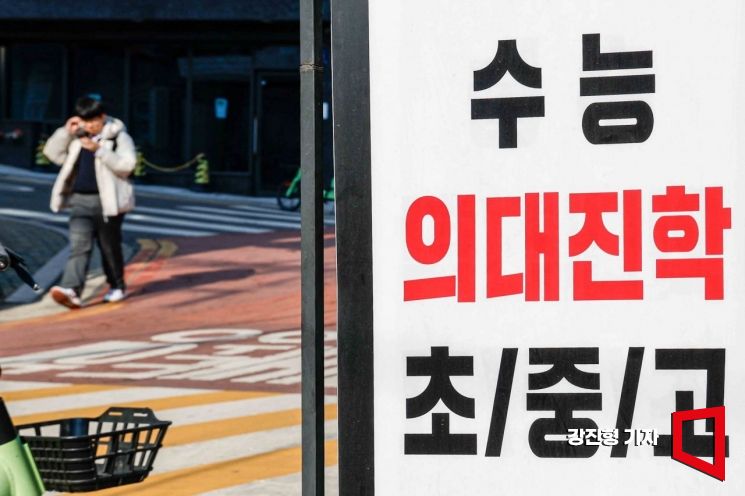 A promotional display related to medical school admissions for elementary, middle, and high school students stands at an academy located in the Daechi-dong academy district of Gangnam-gu, Seoul. Photo by Kang Jinhyung
"Even if you are lonely or sad, you have to endure. Because at the end of this road, there is medical school. There is Seoul National University. The winner takes it all. No one remembers second place..."
The novel "Seoul Mothers" unfolds around three mothers living in Geummyo Apartment. Although their backgrounds and credentials are all different, they share one thing in common: a desperate determination to send their children to prestigious universities.
Ji Eun Cho, Professor at the Department of Asian and Middle Eastern Studies at the University of Oxford, sharply satirizes South Korea's excessive zeal for education and its academic elitism in her recently published novel "Seoul Mothers." The novel is set in Geummyo Apartment in Daechi-dong, Gangnam-gu, Seoul. Reminiscent of Daechi-dong, this setting is depicted in the novel as "the front line of elite education in Korea."
In an interview with Asia Economy on May 24, Professor Cho discussed the background behind satirizing the aspect of Korean society that is obsessed only with university entrance exams and academic credentials in "Seoul Mothers." She said, "Everyone studies desperately, but no one really thinks about the purpose of studying," and added, "I wanted to convey the message that 'family' is more important than studying or success."
Although establishing a direction in life is more important than academic credentials, Professor Cho observed that Korean mothers tend to overlook this. She said, "The word 'academic background' has little meaning in English and is rarely used in practice," and continued, "In Korean society, academic background has become a standard for dividing social classes. Even if you graduate from Harvard, that title can become a new burden in the future. In the end, what matters is not which school you attended, but what dreams and passions you live with."
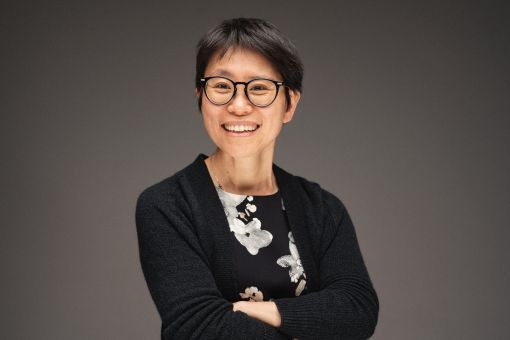
She identified the biggest problem in Korean education as an educational structure that has failed to keep pace with the changing times. Professor Cho said, "Even though the era of artificial intelligence (AI) has arrived, there is still an obsession with test scores and a stubborn adherence to standardized educational methods," and added, "While other fields such as K-content have achieved global status, it is regrettable that education alone remains stuck in the past."
Regarding English education, she pointed out that parents are excessively fixated on the "timing" of learning. She said, "The average age at which Korean children are exposed to English is four, much earlier than the global average of 7.5 years. Nevertheless, their overall communication skills, especially in speaking and interaction, are relatively low. What matters is not 'at what age you are exposed to English,' but 'how enjoyable that exposure can be.'"
Professor Cho said that foreigners are astonished by the intensity of Korea's educational fervor. She described the reality of "sadang-orak" (if you sleep four hours, you pass the exam; if you sleep five hours, you fail), which appears in her book, as a uniquely Korean "funny yet sad" story. She added, "Overseas, there is hardly any expression like 'a child who studies well.' In Korea, doing well on tests is equated with being good at studying, but truly talented children find it difficult to thrive in such an environment."
The fierce competition for university entrance in Korea leads directly to the burden of private education expenses. According to the "2024 Survey on Private Education Expenses for Elementary, Middle, and High School Students" released by the Ministry of Education and Statistics Korea, the total amount spent on private education last year reached 29.2 trillion won, setting a new all-time high for the fourth consecutive year. Private education expenses for infants and toddlers are also significant. According to the Ministry of Education's "2024 Pilot Survey on Private Education Expenses for Infants," in the third quarter of last year (July to September), households with infants and toddlers spent about 815.4 billion won on private education. The average monthly private education expense per child was 332,000 won, and for those attending English kindergartens, the average monthly expense was 1,545,000 won.
The "Daechi Mom" content created by comedian Lee Suji, which satirizes the intense educational reality of Daechi-dong, also reflects this situation. She said, "'Daechi Mom' content is very similar to the characters depicted in the novel," and added, "It shows remarkable powers of observation regarding the reality of Korean education."
Professor Cho believes that this reality is also linked to the low birth rate problem. She said, "Parents are financially strained by private education expenses, which leads them to avoid having children," and added, "The low birth rate and the private education issue are closely connected." She also said, "Before the age of 10, learning through play and experience is far more helpful than sitting at a desk and studying." Professor Cho, whose educational philosophy centers on "letting children do what makes them happy and joyful," advised mothers that "conversation" is the most important form of education above all else. She emphasized that frequent and deep communication with children is the starting point of education.
© The Asia Business Daily(www.asiae.co.kr). All rights reserved.


















