Changing Consumer Attitudes in Japan Amid Soaring Rice Prices
Continuous Sell-Outs of Korean Rice Lead to Additional Exports
As rice prices in Japan continue to soar, the market for imported rice is also becoming increasingly active. On May 16, the Yomiuri Shimbun reported that although Japanese consumers have traditionally shown a strong preference for domestically produced rice, the recent surge in rice prices is prompting many people to consider imported rice as well.
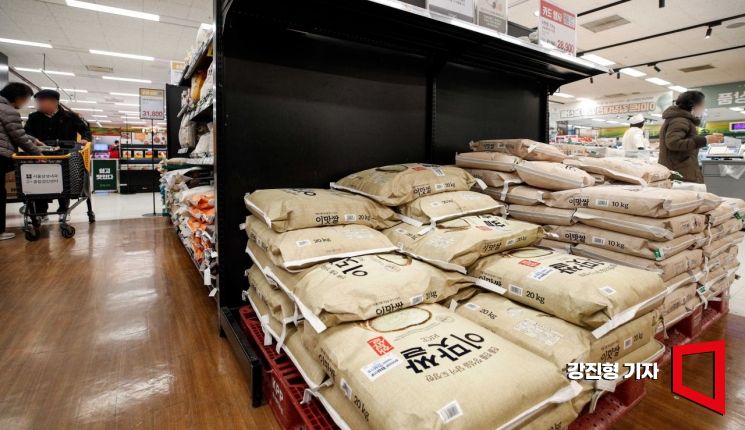 Korean rice imported into Japan is also selling out continuously. According to Nonghyup International, the Japanese branch of NH Nonghyup Trade, 10 tons of Jeonnam Haenam brand rice imported to Japan earlier this month sold out about ten days after sales began. The photo is not related to the specific content of the article. Photo by Kang Jinhyung
The popularity of imported rice is clearly reflected in market demand. Aeon, Japan's largest supermarket chain, has decided to begin selling California-grown rice from the United States starting in June. Even with a tariff of 341 yen (approximately 3,290 won) per kilogram at the time of import, the rice can be sold at a price about 10% lower than that of Japanese rice. Matsuya Foods Holdings, known for its gyudon (beef bowl) chain Matsuya, is already using American rice in about 80% of its stores.
As demand for imported rice increases, local traders and wholesalers are actively working to expand rice imports. Kanematsu, a general trading company, has increased its planned rice imports from 10,000 tons to 20,000 tons and is considering importing rice not only from the United States but also from Taiwan and Vietnam. Shinmei, a rice wholesale distributor, has already received reservations for the sale of about 20,000 tons of rice scheduled to be imported by July.
Korean Rice Exports to Japan Expected to Reach Highest Level Since 1990
The newspaper also reported that a shift in consumer attitudes is behind these changes. In a survey conducted by the Japanese Consumers' Co-operative Union in March among 6,342 people, 77.8% cited "domestic production" as the most important factor when purchasing rice, but 33.1% answered "low price." The response rate for "low price" increased by 1.8 percentage points compared to the survey conducted in October of the previous year.
 So what is the reason behind the soaring rice prices in Japan? The reasons are complex. The biggest factor is poor crop yields caused by abnormal weather conditions. The record-breaking summer heatwave in 2023 disrupted rice growth, leading to a decrease in the production of high-quality rice. Pixabay
Meanwhile, Korean rice imported into Japan is also selling out continuously. According to Nonghyup International, the Japanese branch of NH Nonghyup Trade, 10 tons of Jeonnam Haenam brand rice imported to Japan earlier this month sold out about ten days after sales began. Previously, in March, the company imported 2 tons of Korean rice and sold it last month through online shopping malls and supermarkets in Shin-Okubo, Tokyo's Koreatown.
An official from NH Nonghyup Trade stated, "For this month's local sales, the direct sales outlet of Hadano Nonghyup in Kanagawa Prefecture, with whom we have built a close relationship, joined the distribution network, further expanding our reach," and added, "Depending on the situation, we are currently working to export about 100 tons of rice to Japan by the end of this month." This means that Korea's rice exports to Japan are expected to reach their highest level in 35 years since statistics began in 1990. Until last month, NH Nonghyup Trade had coordinated exports of 22 tons, but as the response in Japan improved, it is increasing its planned shipments. According to the Korea Agro-Fisheries & Food Trade Corporation (aT), Korea exported around 10 tons of rice to Japan each year in 2011?2013 and in 2016.
So what is the reason behind the soaring rice prices in Japan? The reasons are complex. The biggest factor is poor crop yields caused by abnormal weather conditions. The record-breaking summer heatwave in 2023 disrupted the growth of rice plants, leading to a decrease in the production of high-quality rice. According to data from Japan's Ministry of Agriculture, Forestry and Fisheries, the price of new rice for the 2024 harvest rose by 48% compared to the previous year, reaching the highest level in 31 years, largely due to the reduced harvest caused by the heatwave. While the total production volume was similar to or slightly below the average year, declines in quality and regional crop failures fueled supply instability. In addition, although the Ministry of Agriculture, Forestry and Fisheries announced that last year's rice harvest increased by 180,000 tons from the previous year to 6.79 million tons, only 2.21 million tons were purchased by major collection companies such as agricultural cooperatives. This represents a decrease of 230,000 tons compared to the previous year. It is a strange situation where production has increased but distribution volume has decreased.
Furthermore, in August 2024, when the Japan Meteorological Agency warned of the possibility of a major Nankai Trough earthquake, citizens began stockpiling rice as an emergency measure, which also contributed to the price surge. Around August of last year, household rice purchases increased by 29% compared to the average, and as a result, market inventories were depleted before the new autumn crop became available, causing prices to skyrocket. Minister of Agriculture, Forestry and Fisheries Taku Eto pointed out, "Rice stockpiled somewhere caused the shortage," and, in addition to household stockpiling, blamed speculative forces, although he could not provide clear evidence. In addition, Yoshiyaki Watanabe, honorary president of Niigata Food and Agriculture University, stated in the weekly magazine Shukan Bunshun, "It is difficult to accurately ascertain production volume because the number of rice statistics surveyors has decreased." The number of surveyors, which once reached tens of thousands, has been reduced due to budget constraints, and now overall production is estimated from small samples. There has also been criticism that the government has failed to keep up with changes in the distribution structure due to the increase in direct online transactions.
Meanwhile, the Yomiuri Shimbun reported that as rice prices remain high, there is a trend among farmers to expand rice cultivation, and major distributors are already making advance purchases from farmers even before the rice has ripened. Since the second half of last year, rice prices in Japan have remained high, prompting the government to release rice from reserves starting in March this year, but prices have yet to stabilize. According to a survey by the Ministry of Agriculture, Forestry and Fisheries, the average retail price of rice (5 kg) at supermarkets nationwide from April 28 to May 4 was 4,214 yen (about 40,000 won), double the price from a year ago. As the release of reserve rice has not produced results at the retail level, the Japanese government has decided to implement additional measures such as easing bidding conditions.
© The Asia Business Daily(www.asiae.co.kr). All rights reserved.


















