U.S. Security and Foreign Affairs Think Tank Report
Bill Proposed to Allow Warship Construction by Allied Nations
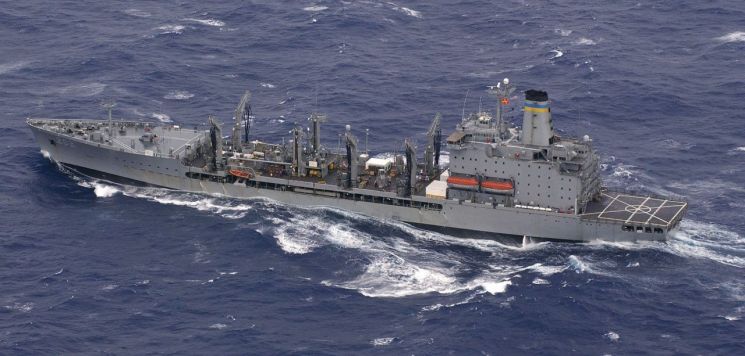 Hanwha Ocean's second MRO (Maintenance, Repair, and Overhaul) project for a US Navy vessel, the 'USNS Yukon'. Photo by Hanwha Ocean Yonhap News
A U.S. think tank has analyzed that the United States, which is currently engaged in a power struggle with China, could expand its naval forces by cooperating with South Korea and Japan, the world's second and third largest shipbuilding powerhouses.
The Center for Strategic and International Studies (CSIS), a leading U.S. think tank in security and foreign affairs, stated in a report released on May 15 (local time), "Naval power is absolutely critical in the event of a military conflict in the Indo-Pacific region, but the current U.S. shipbuilding industry faces structural limitations such as insufficient production capacity, cost overruns, and delivery delays."
The Donald Trump administration has recognized the decline of the U.S. shipbuilding industry as a serious military security issue. According to the U.S. Navy's 2024 report, the construction schedules for major warships are delayed by one to three years, and the industry is experiencing severe maintenance backlogs. In contrast, China, which is challenging the world's leading power, accounted for 51% of global commercial and military shipbuilding in 2023, making it the world's largest player in this sector.
The researchers who authored the report proposed cooperation with South Korea and Japan, the world's second and third largest shipbuilding nations and U.S. allies, as a short-term solution to these problems. Specific measures for cooperation include: outsourcing MRO (maintenance, repair, and overhaul); acquiring U.S. shipyards; joint production of modules; and purchasing warships from allied nations.
Regarding South Korea, the researchers noted, "South Korea emerged as a commercial shipbuilding powerhouse in the 1970s to 1990s," adding, "It still has excellent automation-based technological capabilities, and its ability to build warships has been proven." As for Japan, they assessed, "Japan has high quality standards and a high level of automation," and "it is competitive in high value-added vessels."
Related discussions are also active in Washington. In February, two bills, including the "Naval Readiness Act," which would allow the construction of U.S. Navy warships by allied countries such as South Korea, were introduced by Republican Senators Mike Lee and John Curtis. The United States has protected its shipbuilding industry by legally requiring U.S. Navy warships to be built exclusively in domestic shipyards, but there have been criticisms that such regulations have led to the industry's decline. The proposed bills aim to relax these regulations and allow warship construction by allied nations.
In Japan's case, foreign media such as NHK and TV Asahi have reported that Japan recently proposed strengthening Japan-U.S. shipbuilding cooperation as a bargaining chip in negotiations with the United States. In addition to already well-known bargaining chips such as agricultural products, Japan is reportedly considering a "Japan-U.S. Shipbuilding Golden Age Plan," a shipbuilding package that includes expanding ship repair capabilities, strengthening supply chains, and cooperating on the development of icebreakers for Arctic navigation.
© The Asia Business Daily(www.asiae.co.kr). All rights reserved.
![Clutching a Stolen Dior Bag, Saying "I Hate Being Poor but Real"... The Grotesque Con of a "Human Knockoff" [Slate]](https://cwcontent.asiae.co.kr/asiaresize/183/2026021902243444107_1771435474.jpg)
















