Largest Monthly Net Outflow Since March 2020 (-$11.04 Billion)
Global Investor Sentiment Contracts After U.S. Reciprocal Tariff Announcement
Bond Net Inflows Continue... Increased Incentive for Arbitrage Trading
Foreign capital in the domestic securities market shifted to a net outflow for the first time in three months. Although bond funds saw an increase in net inflow, a significant withdrawal of foreign capital from the stock market, triggered by the shock of U.S. tariff announcements, led to an overall net outflow.
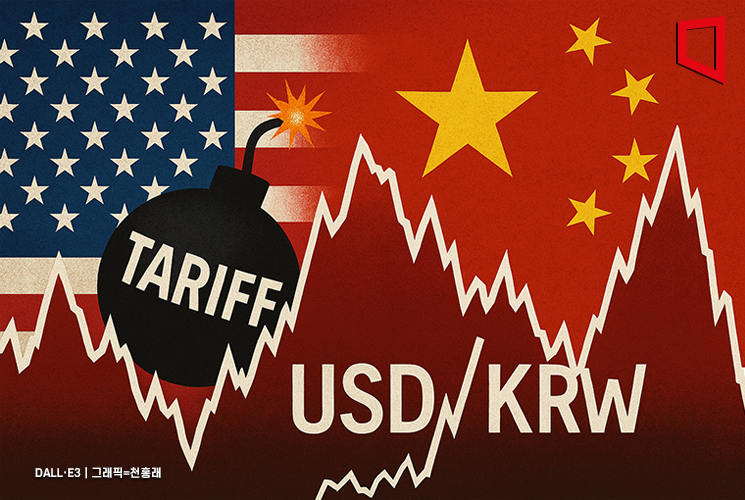
According to the "Trends in International Finance and Foreign Exchange Markets after April 2025" released by the Bank of Korea on the 16th, foreigners recorded a net outflow of $1.7 billion from the domestic stock and bond markets in April.
Stock funds saw a net outflow of $9.33 billion. This is the largest monthly net outflow in over five years, since the $11.04 billion net outflow in March 2020. An official from the Bank of Korea explained, "After the announcement of reciprocal U.S. tariffs in early April, global investor sentiment contracted sharply, leading to an expanded net outflow." In contrast, bond funds in April saw a net inflow of $7.63 billion. This was due to an increased incentive for arbitrage trading and continued demand for mid- to long-term bonds, which led to an expanded net inflow.
The won-dollar exchange rate stood at 1,421.0 won per dollar at the end of last month, down from 1,472.9 won at the end of March. The volatility rate in April was 0.67%, a significant increase from 0.29% in the previous month. The won-dollar exchange rate climbed to a yearly high of 1,484.1 won on April 9, influenced by weakened investor sentiment due to escalating U.S.-China trade tensions. However, it dropped sharply afterward, affected by the postponement of reciprocal U.S. tariffs and expectations of progress in U.S.-China trade negotiations.
© The Asia Business Daily(www.asiae.co.kr). All rights reserved.
![Clutching a Stolen Dior Bag, Saying "I Hate Being Poor but Real"... The Grotesque Con of a "Human Knockoff" [Slate]](https://cwcontent.asiae.co.kr/asiaresize/183/2026021902243444107_1771435474.jpg)
















