Providing Welfare Information Booklets and Checklists
for Early Detection and Support of At-Risk Households
Seodaemun-gu in Seoul is strengthening its proactive welfare policies by producing and distributing the "Move-in Household Crisis Family Discovery 3-Piece Set" to address welfare blind spots and build a more efficient welfare safety net.
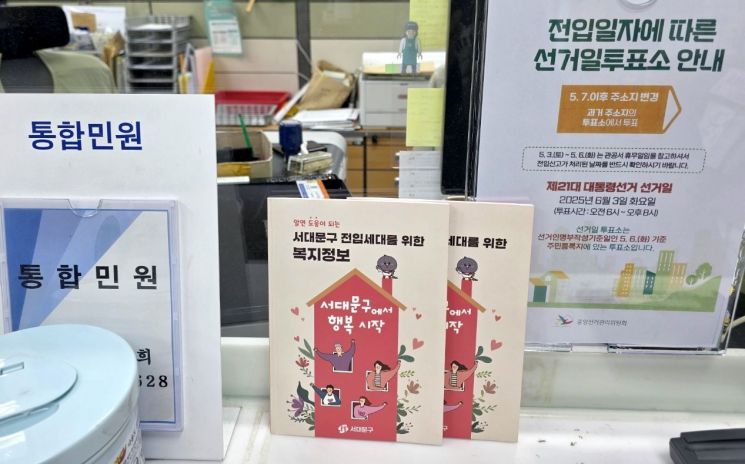
Noting the annual move-in and move-out rate of 15 to 20 percent, the district has newly introduced a welfare information booklet, a crisis warning sign checklist, and a clear file printed with welfare information in order to actively identify and support potential at-risk households from the very beginning of their move-in process.
The information booklet contains practical information by category, such as basic livelihood security, emergency welfare support, housing welfare, and support for children, youth, seniors, and people with disabilities, along with a self-diagnosis checklist. The crisis warning sign checklist is used by neighborhood leaders and welfare patrol teams during home visits or patrols to help them recognize and respond to early signs of crisis.
The clear file is printed with signs of at-risk households?such as overdue rent, accumulated mail, unemployment, and isolation?along with contact information for reporting. It is distributed to real estate agencies, landlords, and tenants. Through this, the district aims to improve residents' access to welfare services and enable the local community's human network to serve as a detection sensor for households in crisis.
Hwang Myunghwa, head of the Life Care Division of Seodaemun-gu, stated, "One of the reasons residents in crisis situations do not receive appropriate support is a lack of information," adding, "We expect that this booklet will make it easier for people to find and apply for the welfare services they need."
Lee Seongheon, mayor of Seodaemun-gu, emphasized, "Residential instability, such as overdue rent or frequent moves, is often a sign of welfare crisis," and stressed, "We will dedicate ourselves to providing tailored welfare information and to discovering and supporting at-risk households accordingly."
Meanwhile, the mayor has been recognized for strengthening the welfare delivery system through innovative welfare policies such as "visiting health and welfare services," "public-private cooperation and welfare resource linkage," and "prevention and management of solitary deaths," emphasizing that welfare cannot be completed by systems alone but must be easily accessible and usable by residents.
© The Asia Business Daily(www.asiae.co.kr). All rights reserved.

![Clutching a Stolen Dior Bag, Saying "I Hate Being Poor but Real"... The Grotesque Con of a "Human Knockoff" [Slate]](https://cwcontent.asiae.co.kr/asiaresize/183/2026021902243444107_1771435474.jpg)















