Joint Research by IBS Korea Virus Research Institute and Genome Editing Research Center Published in "Science"
Expected to Serve as a 'Biobank' for Early Virus Detection and Therapeutic Research
A team of Korean researchers has successfully established organoids (organs-in-a-dish) derived from bats native to Korea, building the world's largest experimental model that enables proactive responses to emerging and re-emerging viruses and future pandemics.
On May 16, the Ministry of Science and ICT announced that a joint research team from the Korea Virus Research Institute (KVRI) and the Genome Editing Research Center at the Institute for Basic Science (IBS) has successfully developed bat organoids, which are three-dimensional organ-like structures that mimic the cellular composition and function of bat organs. This new research platform allows for the analysis of viral infection characteristics and immune responses.
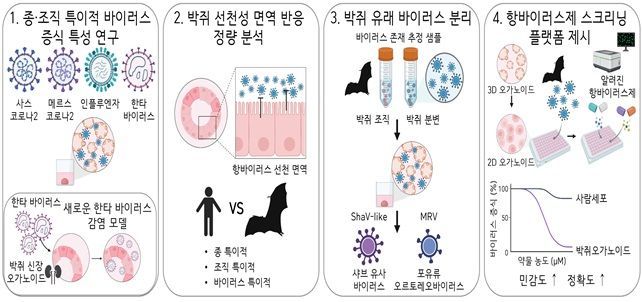 The process of identifying the specific infection patterns and proliferation characteristics of bat-derived zoonotic viruses such as COVID-19 (SARS-CoV-2, MERS-CoV) using bat organoids. Provided by the research team
This research was made possible through interdisciplinary collaboration between the KVRI, which conducts basic research in infectious diseases, and the Genome Editing Research Center, a leader in organoid research based on genome editing technology. The results were published on the same day in Science (IF 44.7), the world's most prestigious academic journal.
Bat viruses: A potential pandemic threat, but limited in vivo models
Approximately 75% of infectious diseases originate from animals. In particular, bats are known to be natural reservoirs for numerous high-risk zoonotic viruses, including SARS-CoV-2, MERS-CoV, Ebola, and Nipah. This is why bat-derived emerging and re-emerging viruses are considered potential threats for causing high-risk epidemics or pandemics.
As a result, there is a growing need for research that can identify the proliferation and transmission characteristics of bat-derived viruses early and enable proactive responses. However, in vivo models for studying bat-derived viruses are currently extremely limited. In fact, most existing in vivo models are restricted to general cell lines or organoids derived from single organ tissues of certain tropical fruit bat species.
To address this, the IBS research team established multi-organ organoid in vivo models?specifically, airway, lung, kidney, and small intestine organoids?from five species of insectivorous bats belonging to the families Vespertilionidae and Rhinolophidae, which are widely distributed in Korea, Northeast Asia, and Europe. This has laid a new foundation for research on bat-derived viruses.
Using bat organoids, the researchers identified the specific infection patterns and proliferation characteristics of bat-derived zoonotic viruses, including coronaviruses, influenza, and hantaviruses. By infecting bat organoids with various zoonotic viruses, they quantitatively confirmed the innate immune responses that occur depending on the bat species, organ, and virus type. This demonstrated that bat organoids can serve as an important research platform for elucidating virus-immune interactions.
"Significantly expanding the precision and effectiveness of infectious disease research"
The team also succeeded in isolating and culturing two types of variant viruses from wild bat fecal samples. This achievement indicates that bat organoids closely replicate the actual bat organ environment, providing higher physiological relevance and sensitivity than conventional cell models.
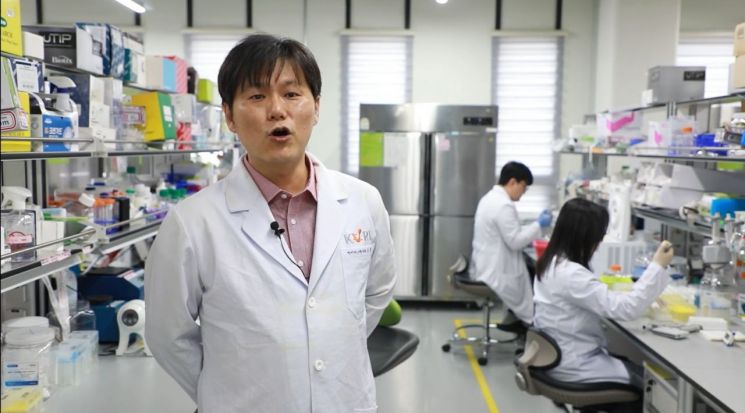 Senior Researcher Hyunjun Kim of the Korea Virus Research Institute (KVRI) at the Institute for Basic Science (IBS) is explaining the significance of the research. Photo by IBS
The researchers further improved the original three-dimensional bat organoids by developing a two-dimensional culture method, expanding the platform's suitability for high-throughput antiviral drug screening. While three-dimensional organoids are difficult to automate due to their irregular shapes and sizes, and require considerable time for analysis and evaluation, the two-dimensional platform developed by the team spreads organoid-derived cells into a uniform cell layer on a flat culture plate, making experiments easier and analyses faster.
Hyunjun Kim, Senior Researcher at the IBS Korea Virus Research Institute and first author of the study, stated, "With this platform, we are now able to conduct virus isolation, infection analysis, and drug response evaluation simultaneously, which was previously difficult with cell line-based models. The ability to experiment with pathogens in an environment closer to the natural host will greatly expand the precision and effectiveness of infectious disease research."
Bongkyung Koo, Director of the IBS Genome Editing Research Center and corresponding author, emphasized, "Being able to quantitatively track the infection response of bat tissues to viruses will mark a significant turning point in research on the pathological mechanisms of zoonotic diseases." Youngki Choi, Director of the Korea Virus Research Institute and corresponding author, commented, "The world's largest bat organoid biobank established in this study is of great significance as a standardized bat model resource for global infectious disease researchers."
Meanwhile, the IBS Korea Virus Research Institute (KVRI), which played a key role in this research, is a national hub for basic research in infectious diseases established in 2021. The institute plays a pivotal role in strengthening national virus research capabilities and expanding inter-institutional cooperation, covering everything from viral outbreak and transmission to infection, immunity, analysis, and response.
© The Asia Business Daily(www.asiae.co.kr). All rights reserved.
![Clutching a Stolen Dior Bag, Saying "I Hate Being Poor but Real"... The Grotesque Con of a "Human Knockoff" [Slate]](https://cwcontent.asiae.co.kr/asiaresize/183/2026021902243444107_1771435474.jpg)

















