Average Broad Money (M2) Balance in March at 4,227.8 Trillion Won
Down 0.1% from Previous Month
Demand Deposits Rise, but Demand Deposit Savings Accounts Decline
The amount of currency in circulation declined for the first time in 23 months. This was due to a reduction of over 7 trillion won in demand deposit savings accounts, as local governments began executing their budgets.
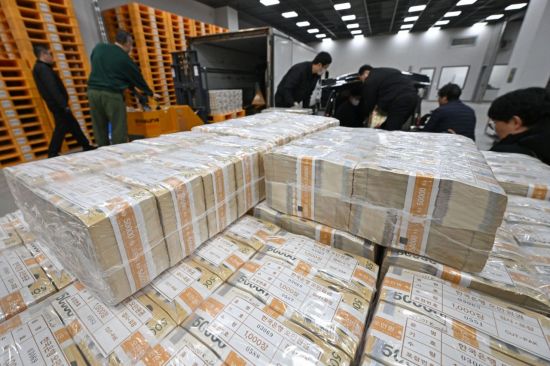 Cash transportation company officials are conducting the release of Lunar New Year funds to be supplied to commercial banks at the Bank of Korea headquarters in Jung-gu, Seoul.
According to the Bank of Korea on May 15, the seasonally adjusted average balance of broad money (M2) in March 2025 was recorded at 4,227.8 trillion won. This represents a decrease of 3.8 trillion won (0.1%) compared to the previous month. M2 is a broad money indicator that includes narrow money (M1)?such as cash, demand deposits, and demand deposit savings accounts?as well as money market funds (MMF), time deposits and installment savings with maturities of less than two years, beneficiary certificates, and repurchase agreements (RP).
M2 had increased for 22 consecutive months from May 2023 to February 2025, but has now turned to a decline.
By financial product, beneficiary certificates increased by 8.6 trillion won from the previous month, mainly due to short-term bond-type products that offer relatively higher returns compared to deposit interest rates. Demand deposits increased by 5.5 trillion won, as companies deposited funds at the end of the quarter to manage their financial ratios.
In contrast, demand deposit savings accounts decreased by 7.2 trillion won, mainly due to budget execution by local governments. Other liquid assets also fell by 5.7 trillion won, primarily led by a decrease in foreign currency deposits as a result of overseas investments and payment of import settlements. Financial bonds decreased by 4.8 trillion won, as banks had less incentive to raise funds due to a slowdown in loan growth and reduced issuance at the end of the quarter.
By economic sector, the money supply held by households and nonprofit organizations increased by 9 trillion won from the previous month, mainly in time deposits, installment savings, and demand deposits. In contrast, corporations saw a decrease of 8.9 trillion won, primarily in other liquid assets and MMFs. Other financial institutions and other sectors also saw decreases of 6.3 trillion won and 100 billion won, respectively.
The average balance of narrow money (M1) stood at 1,279.6 trillion won, down by 2.5 trillion won (0.2%) from the previous month, as demand deposit savings accounts declined.
Financial institution liquidity increased by 0.2% from the previous month to 5,777.8 trillion won, while broad liquidity rose by 0.3% to 7,236 trillion won.
© The Asia Business Daily(www.asiae.co.kr). All rights reserved.

















