Explained Directly at Online Briefing on the 15th
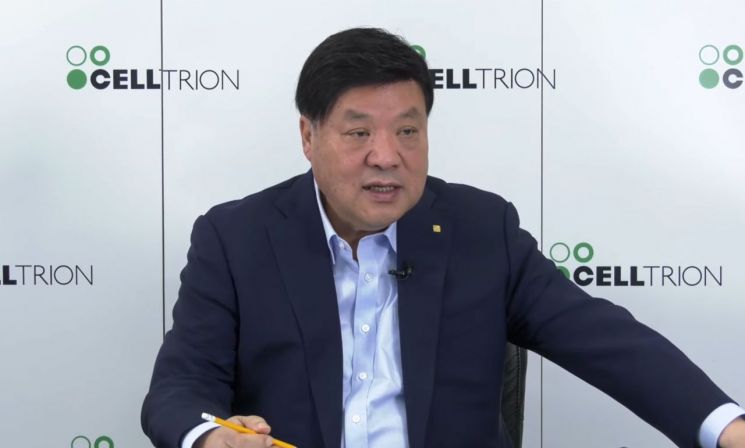 On the 15th, Seo Jungjin, Chairman of Celltrion, spoke at an online meeting held regarding the U.S. government under Donald Trump's policies on drug price reductions and pharmaceutical tariffs. Photo by Celltrion YouTube screen capture
Seo Jungjin, Chairman of Celltrion, has taken a direct stance in response to market concerns over changes in U.S. pharmaceutical policies such as drug price reductions and the imposition of tariffs. He stated that these policy changes could actually strengthen the competitiveness of Celltrion’s core products, which are biosimilars (biopharmaceutical generics).
On the 15th, at an online meeting held regarding the U.S. government under Donald Trump’s policies on drug price reductions and pharmaceutical tariffs, Chairman Seo said, “There is no reason for the entire Korean pharmaceutical and biotech industry to be shaken by this issue,” and emphasized, “Celltrion is fully prepared, and these changes could actually present an opportunity.”
High Drug Prices in the U.S. Due to Distribution Structure... Opportunity for Biosimilars
Chairman Seo first addressed the pressure to lower drug prices from the Donald Trump administration, stating, “None of the biosimilars that Celltrion supplies to the U.S. are priced higher than in Europe,” and made it clear that “the U.S. government’s drug price reduction policy is unlikely to have any direct impact on Celltrion.” He pointed out that the high drug prices in the U.S. stem from the so-called “middleman” structure involving PBMs (Pharmacy Benefit Managers), insurance companies, and wholesalers, saying, “The root of the problem lies in the intermediary distribution structure.”
In particular, Chairman Seo explained that biosimilar products are already being sold at discounts of up to 90% compared to original drugs, and that the continued high market share of original products is due to the structure in which intermediary distributors capture the profits. He believes that “if the U.S. government pursues structural reform, it will actually work in Celltrion’s favor.”
Regarding concerns over tariffs, Chairman Seo stated, “Celltrion has already secured inventory for the U.S. market sufficient for 15 to 21 months,” and added, “No matter what form of tariffs are introduced, there will be no impact on sales until the end of 2026.” Currently, Celltrion produces active pharmaceutical ingredients (APIs) domestically, while finished products are manufactured through contract manufacturing organizations (CMOs) in Europe and the U.S. Chairman Seo said, “Whether or not to invest in a U.S. plant will be carefully decided by the end of the year, after tariff policies are clarified.” At present, Celltrion has completed CMO contracts for 3 million vials (glass containers for injections) in the U.S., and has secured options to expand up to 6 million vials. Regarding plans to build an API plant, he said, “We will approach this cautiously.” According to Chairman Seo, building a 100,000-liter plant in Korea would cost 1.3 trillion won, but constructing it in the U.S. could sharply increase the cost to about 2 trillion won.
Previously, President Trump announced that itemized tariffs on pharmaceuticals would be announced within two weeks.
"Sales Target of 5 Trillion Won for 2025... No Change"
Regarding business outlook, Chairman Seo emphasized, “We are targeting 5 trillion won in sales this year, up from 3.5 trillion won last year, and this target remains unchanged.” Despite some delays in the U.S. market penetration of the autoimmune disease treatment Zympentra, he expects that the expansion of the overall product lineup will be sufficient to offset this. Chairman Seo forecasted, “While our EBITDA (Earnings Before Interest, Taxes, Depreciation, and Amortization) margin was around 25% in the first quarter, it will improve to over 40% by year-end,” and added, “Our performance this year will improve in a curve as time goes on.”
In addition, Celltrion has also begun full-scale development of new drugs based on multi-antibody and conjugation technologies in addition to biosimilars, stating, “A total of 13 new drug projects are underway with the goal of becoming routine from 2025 to 2035,” and forecasting, “After 2025, both performance and profitability will improve significantly.”
Chairman Seo stressed, “Despite the fact that most Korean pharmaceutical companies do not export therapeutic drugs to the U.S., stock prices are falling across the board in response to U.S. policy changes due to a lack of market information,” and urged for accurate awareness of the facts.
© The Asia Business Daily(www.asiae.co.kr). All rights reserved.

















