Free Factory Sites and Triple Productivity in the US...
The Korean Government, Dependent on Exports, Must Also Respond
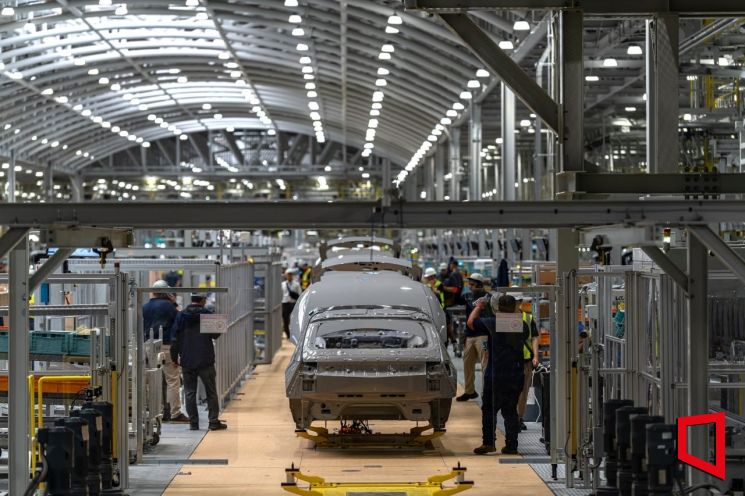
President Trump is dropping indiscriminate tariff bombs around the world. Hyundai and Kia appear to be among the companies in Korea that will suffer the most. Suddenly, they must pay a 25% tariff on their cars. Trump says that to avoid the tariffs, they should build cars in the United States. Hyundai, with a serious expression, announced that it would comply. However, there are rumors in the auto industry that Hyundai is secretly pleased.
Why are there suggestions that Hyundai, supposedly in crisis, is actually quietly happy? Let's break it down. One of the most important factors when building a factory is land. How much did the site for the Hyundai Motor Group Metaplant America (HMGMA), which held its completion ceremony in April, cost? The answer is zero. The state of Georgia provided land four times the size of Yeouido free of charge on a lease basis.
At the completion ceremony, HMGMA President Kwon Ohchung said, "Currently, we are operating facilities to produce 100,000 vehicles, but when we secured the site, we made sure there was enough space to produce up to 500,000 vehicles." There is no need to look for new land or build infrastructure to increase production. Hyundai can simply add new production lines at HMGMA. In other words, the factory site is free.
Key factors determining a factory's competitiveness include infrastructure such as electricity, roads, and water, as well as their usage fees. Take electricity, for example. According to the Organisation for Economic Co-operation and Development (OECD), as of 2023, the industrial electricity rate in the United States is $80.5 per megawatt-hour (MWh). In contrast, Korea's rate is $122.1, which is 51.7% higher than the US. Another major component of production cost is wages. In 2024, the average wage for Hyundai workers is about 124 million won. In 2024, the average wage at the US Big Three automakers is $84,000, or about 117.6 million won. Wages at HMGMA are certainly lower than those at the Big Three. In simple terms, wages are actually cheaper in the US. Furthermore, to sell cars made in Korea in the US, they must be shipped across the Pacific Ocean, which requires significant time and money. Even at a glance, it is more profitable for Hyundai to manufacture and sell more cars in the US.
Looking even closer, it seems Hyundai may not just be smiling, but actually celebrating. The US plant is also more productive. Hyundai says 880 workers are needed to produce 100,000 vehicles at the Metaplant. At the Ulsan plant, three times as many workers are required. This is thanks to the latest equipment, such as robots.
Looking to the future, producing in the US is likely to be even more advantageous. For example, infrastructure costs such as electricity in Korea are likely to keep rising. This is largely due to the suspension of nuclear power projects. For now, Korea Electric Power Corporation (KEPCO) is absorbing the losses to keep prices down. However, there is a limit to how long this can last. KEPCO's debt has reached 146 trillion won. In the end, electricity prices will inevitably have to rise to reflect costs.
The same applies to transportation infrastructure. The cost of building one kilometer of the Gyeongbu Expressway was 100 million won. Now, the cost of building one kilometer of expressway exceeds 30 billion won. The state of Georgia has extended the highway right up to the factory. Furthermore, it has announced plans to build a new airport near the plant. The construction cost of Muan Airport, which opened in 2007, was 300 billion won. Building a new airport now would require funds in the trillion-won range. No matter how large a factory is built in Korea, such treatment is hard to expect.
In fact, Hyundai has long wanted to manufacture more cars in the US. For example, in 2019 and 2021, the company tried to produce the Palisade in the US, but was thwarted by union opposition. This time, however, the union appears to have no grounds to block expansion of the US plant. At the HMGMA completion ceremony, Chairman Chung Euisun said, "Hyundai Motor Group did not come here just to build a factory, but to put down roots." Hyundai can take root in the US and reach new heights. However, if large manufacturers move abroad, the roots of the Republic of Korea Inc., which depends on exports, will be shaken. Now it is not the union, but the government that must come up with a solution.
© The Asia Business Daily(www.asiae.co.kr). All rights reserved.

















