Briefing on Performance-Based Compensation Systems in the Financial Sector
Lotte Insurance Management Assessment
"Expected to Conclude as Early as the End of This Month"
The financial supervisory authorities are considering measures to sanction the boards of directors and management of financial companies if they are found to have neglected to reclaim performance-based bonuses in situations where performance has sharply declined and such bonuses should be clawed back.
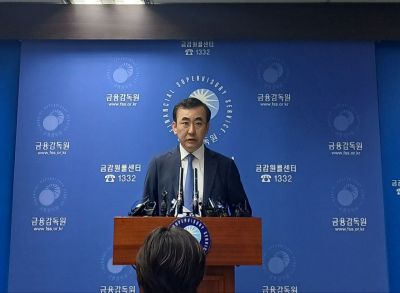 Sehun Lee, Senior Deputy Governor of the Financial Supervisory Service, speaks at the "Briefing on Current Issues Including the Performance-Based Compensation System across the Financial Sector" held on the 15th at the FSS headquarters in Yeouido, Seoul. Photo by Chaeseok Moon
On May 15, Sehun Lee, Senior Deputy Governor of the Financial Supervisory Service, announced this at the "Briefing on Current Issues Including the Performance-Based Compensation System across the Financial Sector" held at the FSS headquarters in Yeouido, Seoul.
Lee stated, "If losses occur due to poor management decisions and a compensation system focused on short-term results, responsibility will be pursued," adding, "For example, if management insists on the existing profit-centered compensation system without reviewing risk factors in real estate PF investments and losses occur, the management will be sanctioned."
According to the FSS, the total amount of performance-based compensation paid to employees of financial companies in 2023 was 1.0645 trillion won, down 8.8% from 1.1677 trillion won in the previous year. By sector, the figures were 660.3 billion won for financial investment, 159.1 billion won for banks, 142.6 billion won for insurance, and 59.8 billion won for specialized credit finance. The average performance-based bonus per person was 139 million won, a decrease of 28.5% from 194 million won in the previous year. CEOs received 380 million won, other executives 200 million won, and those in charge of financial investment operations 900 billion won. CEO salaries were about 4.2 times higher than those of general employees.
Looking at CEO performance-based bonuses by sector: holding companies paid 1 billion won, banks 600 million won, insurance 420 million won, financial investment 420 million won, specialized credit finance 320 million won, and savings banks 400 billion won.
The problem is that there are no clear standards for reducing or clawing back bonuses if performance deteriorates during the typical three-year deferral period for performance-based compensation. Financial companies have been setting bonuses based on profitability indicators rather than soundness, leading employees to engage in excessive business activities to boost short-term results.
The Enforcement Decree of the Act on Corporate Governance of Financial Companies stipulates that more than 40% of performance-based compensation must be deferred for at least three years. Some financial companies have violated the rules regarding the deferral period and ratio. For example, Company A, a securities firm, paid the entire performance-based bonus in a lump sum to several real estate PF employees, who were approved as financial investment operations staff, without deferring any portion. According to the FSS, the delinquency rate for real estate PF across the entire financial sector surged from 2.7% at the end of 2023 to 3.42% at the end of last year, an increase of 0.72 percentage points. If bonuses are paid in a lump sum as in the case of Company A, excessive bonuses may be paid to employees even if the delinquency rate for real estate PF rises and performance worsens.
In reality, due to inadequate internal regulations regarding bonus adjustment and clawback, the amount actually reclaimed last year was only 90 million won. Although the amount subject to performance-based compensation adjustment last year was 576.5 billion won, the actual amount adjusted was only 56.8 billion won (9.9%).
Furthermore, it was found that there is a widespread practice of assigning high scores to profitability indicators and low scores to soundness or consumer protection indicators in the performance evaluation process. In the case of Savings Bank C, 100% of the score was assigned to profitability, and other indicators were not even considered.
The FSS announced plans to strengthen supervision of performance-based compensation systems across the entire financial sector going forward. The agency will examine whether the duration of investment (such as guarantee or contract periods) for businesses likely to pursue short-term results, such as real estate PF, matches the deferral period for performance-based compensation. The FSS will also check whether internal regulations clearly define procedures for adjusting or clawing back bonuses in cases where losses occur at the time bonuses are paid.
Meanwhile, Lee stated that the management assessment of Lotte Insurance, which was recently embroiled in controversy over the early redemption option (call option) for subordinated bonds, is expected to be completed as early as the end of this month. He also said that detailed plans for capital regulations related to insurers' basic capital will be announced in the second half of the year. The FSS is formulating a plan to enhance capital regulations for the insurance sector, focusing on making the Insurance Capital Standard (K-ICS) a mandatory compliance requirement (prompt corrective action criterion).
Regarding Fubon Hyundai Life, Heungkuk Fire & Marine Insurance, Shinhan Life, Tongyang Life, Heungkuk Life, and Meritz Fire & Marine Insurance, where the maturity date for early redemption or repayment of subordinated bonds or hybrid capital securities is approaching, Lee commented, "We believe there will be no significant issues with either refinancing or repayment."
Lee also stated that the revision of best practice guidelines for risk management of overseas alternative real estate investments in sectors other than financial investment will be completed as soon as possible. He added that the FSS plans to encourage appropriate loss recognition through periodic evaluations of alternative investment fund assets by external professional institutions.
© The Asia Business Daily(www.asiae.co.kr). All rights reserved.

















