Lee Donggeun, KEF Vice Chairman, Discusses Major Labor Issues
Amendment to Articles 2 and 3 of the Trade Union Act "Not Legally Sound"
"4.5-Day Workweek Not Suitable Due to Low Labor Productivity"
Lee Donggeun, Executive Vice Chairman of the Korea Employers Federation (KEF), stated on the 14th, "The amendment to Articles 2 and 3 of the Trade Union Act, commonly referred to as the 'Yellow Envelope Act,' is not legally sound and cannot truly be considered as serving the interests of workers."
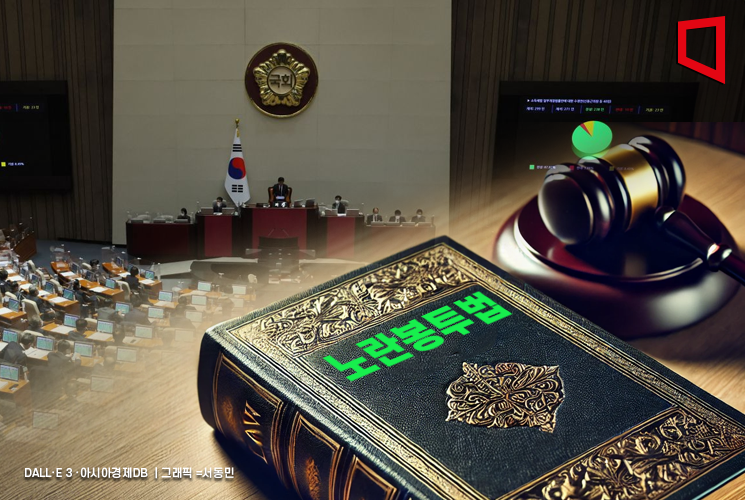
On this day, Lee met with reporters at a restaurant in Jung-gu, Seoul, to discuss major labor issues. He said, "The amendment could disrupt the industrial ecosystem, which is structured around parent companies and the relationships between principal contractors and subcontractors. As a result, subcontracted workers could potentially lose their jobs."
The amendment to Articles 2 and 3 of the Trade Union Act was one of the campaign pledges of Lee Jaemyung, the presidential candidate of the Democratic Party of Korea. Since the beginning of this year, Democratic Party lawmakers such as Park Hongbae, Kim Taeseon, and Park Jeong have successively proposed the amendment. The main points are to expand the definition of 'employer' and the concept of labor disputes in Article 2, and to limit the liability for damages by each responsible party in Article 3.
The amendment had previously passed the National Assembly twice during the 21st and 22nd sessions, led by the Democratic Party. However, former President Yoon Sukyeol exercised his veto (request for reconsideration), citing concerns that frequent strikes by unions could cause confusion at industrial sites and that the specific standards of the amendment were ambiguous.
The business community has consistently opposed the amendment. First, it is considered unreasonable to expand the definition of 'employer' to include 'anyone who has substantial control or influence over the working conditions of the worker, regardless of whether an employment contract has been signed.'
Lee stated, "Industries such as automobile manufacturing, shipbuilding, and construction operate through multi-level collaboration with partner companies. For example, Hyundai Motor Company works with as many as 4,000 partner companies, and these companies sign labor contracts with subcontracted union workers, who are then subject to labor laws."
He continued, "If the definition of 'employer' is expanded in this structure, Hyundai would have to engage in collective bargaining with countless subcontracted unions. If negotiations break down due to conflicts of interest, resulting strikes could collapse the industrial ecosystem." He added, "In the worst-case scenario, if companies no longer have an incentive to do business with certain subcontractors, both the subcontracting firms and their workers could face difficulties."
He also emphasized that limiting liability for damages infringes on property rights. Lee said, "Effectively blocking employers from claiming damages for illegal union actions not only encourages illegal strikes but also makes civil damages impossible, thereby violating constitutionally protected property rights. This could turn industrial sites into lawless zones."
The KEF also pointed out the potential negative effects of the proposed amendment to the Labor Standards Act, which would reduce the statutory workweek from 40 hours to 36 hours (a 4.5-day workweek). Under the current low labor productivity, this could further erode corporate competitiveness, increase labor costs, and deepen the polarization between large and small-to-medium-sized enterprises.
As of 2023, Korea's labor productivity stands at $44.4, which is lower than major OECD countries such as Japan ($49.1), France ($66.8), and the United States ($77.9). It also falls short of the OECD average of $56.5. Except for some countries like France, most maintain a 40-hour workweek.
Lee stated, "There may not be a significant difference between a five-day and a 4.5-day workweek, but the problem lies in making this mandatory. Companies should be allowed to operate flexibly by day of the week, and the basic 40-hour workweek should not be altered." The related bill is currently pending in the National Assembly.
Regarding the extension of the statutory retirement age to 65 in connection with continued employment for older workers, he said, "Under a seniority-based wage system, extending the retirement age increases the cost burden on companies and makes it difficult to hire new employees. Flexibility in employment and a reform of the wage system must be prerequisites."
The issues of extending the retirement age and reemployment after retirement were also mentioned in presidential campaign pledges. Kim Moonsu, the presidential candidate of the People Power Party, pledged 'voluntary extension of retirement age by companies,' while Lee Jaemyung pledged to 'pursue extension of the retirement age through social consensus.'
© The Asia Business Daily(www.asiae.co.kr). All rights reserved.


















