Choi TaeWon Calls for "EU-Style Economic Alliance"
Lee Jaemyung Agrees, Democratic Party Considers FTA
Academic Circles Also "Strongly Support" Korea-Japan Economic Cooperation
The Korea Chamber of Commerce and Industry (KCCI) is advancing a plan to establish an alliance focused on economic cooperation between countries such as Japan. The organization is preparing to commission a related research study and is considering officially presenting the proposal to the next administration after it takes office.
According to the business community on May 16, the KCCI has recently begun research on a framework for economic cooperation covering trade and industry as a whole, following Chairman Choi TaeWon’s remarks on the "need for a national alliance system." The KCCI is currently in the initial phase of conducting a preliminary survey to select specific industries and areas for cooperation, and plans to commission expert analysis through a research institute.
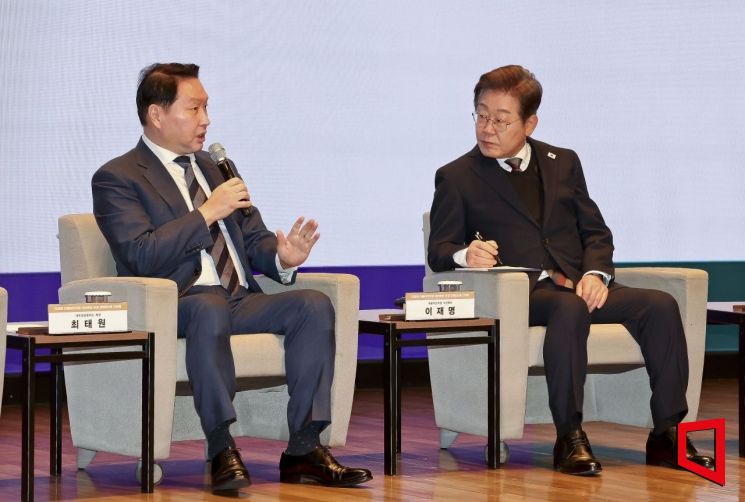 Choi TaeWon, Chairman of the Korea Chamber of Commerce and Industry, is speaking at the meeting of the heads of five major economic organizations with presidential candidates held on the 8th at the Korea Chamber of Commerce and Industry in Junggu, Seoul. Photo by National Assembly Press Photographers Group
The results of this research are expected to be submitted in the form of a policy proposal after the inauguration of the next government. Internally, the KCCI is also considering a strategic approach linked to its role this year as the host country for ABAC (APEC Business Advisory Council).
Previously, at the launch ceremony of the National Assembly Future Industry Forum in April, Chairman Choi stated, "We need an economic cooperation body similar to the European Union (EU) model," adding, "We can cooperate with ASEAN (Association of Southeast Asian Nations) as well as Japan." He particularly emphasized the potential for cooperation with Japan in areas such as semiconductor materials, parts, and equipment, medical facilities, and clean hydrogen.
Political circles are also accelerating discussions on a Korea-Japan economic community. The Democratic Party of Korea’s Central Election Committee is reportedly reviewing ways to pursue a Korea-Japan Free Trade Agreement (FTA). At the meeting of the heads of five major economic organizations on May 8, Democratic Party presidential candidate Lee Jaemyung and Chairman Choi both agreed on the need to create an economic community with Japan and other countries.
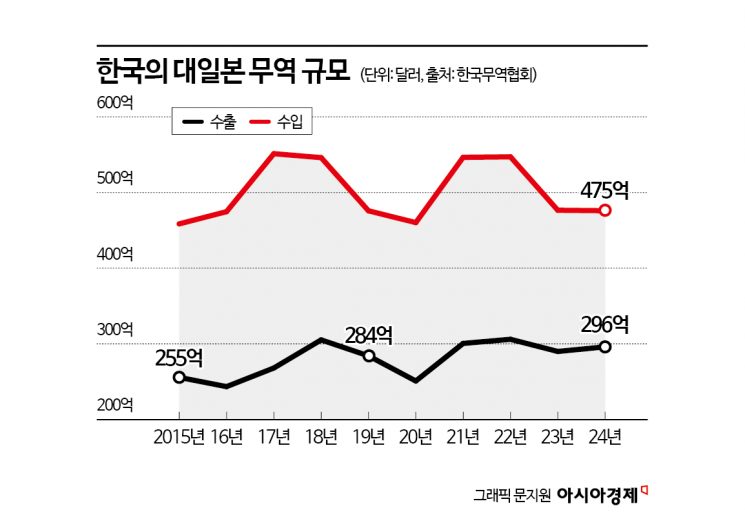
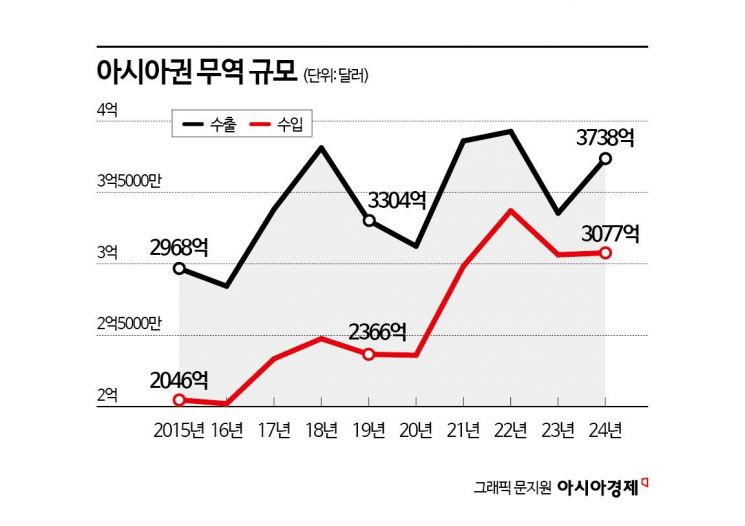
The concept of inter-country economic cooperation has gained support from trade experts and has sparked academic discussions. Heo Jeong, Professor of Economics at Sogang University and President of the Korean Association of International Trade and Commerce, analyzed that "cooperation among Korea, China, and Japan can generate significant synergy from a supply chain perspective," and that such cooperation could benefit all three countries. He also saw strong potential for collaboration in the service, shipbuilding, and gas sectors.
Some experts noted that economic cooperation could help mitigate the impact of increased trade uncertainty caused by tariff policies initiated by former U.S. President Donald Trump. Kim Taehwang, Professor of International Trade at Myongji University, emphasized that "U.S. protectionism is likely to intensify for the time being," and that cooperation with geographically close Japan could provide trade advantages.
However, there are concerns that consistent, long-term policy implementation is necessary to make such cooperation a reality. In the past, negotiations between Korea and Japan have been suspended due to historical disputes and sensitive items. Koo Kibo, Professor of Global Commerce at Soongsil University, advised, "Whenever the government changes, previous discussions have been disregarded," stressing the need for a pragmatic approach that considers economic benefits.
© The Asia Business Daily(www.asiae.co.kr). All rights reserved.



















