Started with the Act on Employment of Military Welfare Beneficiaries in 1961
Unanimous Constitutional Court Ruling of Unconstitutionality in 1999
"When a Fraction of a Point Decides Success or Failure... Bonus Points Violate Equality"
Will the military service bonus point system be revived? As both ruling and opposition presidential candidates have pledged to introduce a system that provides benefits for military service experience, there are expectations that a similar system may be reintroduced. The military service bonus point system, a subject of heated debate in terms of fairness and the right to equality, raises the questions: when was it created, and why did it disappear?
The military service bonus point system is a policy that grants additional points to those who have completed military service in recruitment exams for public officials and public institutions. The purpose is to protect and compensate young people who suffer disadvantages in career and employment opportunities due to their military service.
The military service bonus point system originated in July 1961 with the enactment of the "Act on Employment of Military Welfare Beneficiaries." This law, which aimed to give priority employment to discharged soldiers, was established by the Supreme Council for National Reconstruction, which seized power immediately after the 5·16 military coup. The law mandated that discharged soldiers be given priority employment in the following: ▲national and local government agencies, ▲enterprises dealing with institutions receiving government subsidies, and ▲companies employing 20 or more people.
Later, in 1984, with the revision of the "Act on the Honorable Treatment of Persons of National Merit" (National Merit Act), the military service bonus point system was given a more concrete structure. Discharged soldiers received a 3-5% bonus in recruitment exams for grade 6 or lower national and local government officials and technical officials. In December 1997, the "Act on Support for Discharged Soldiers" was also enacted. This law stipulated that when recruitment exams are held by ▲public officials, ▲national and public schools, ▲private schools with five or more staff, and ▲companies or organizations with 20 or more employees, discharged soldiers would receive bonus points.
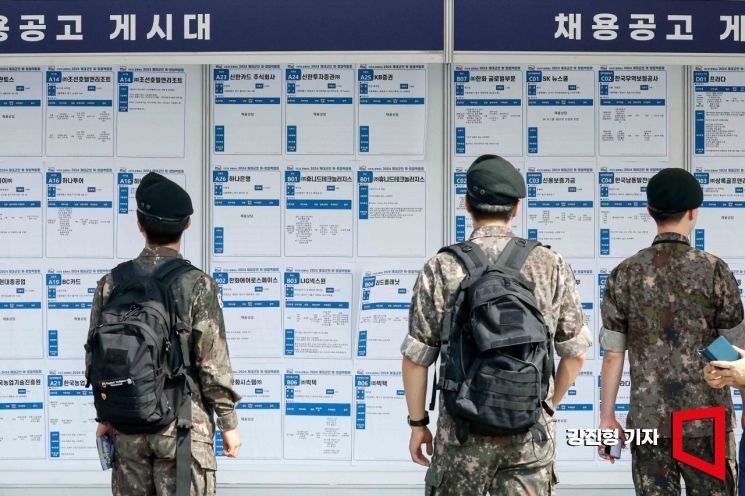 On September 10 last year, participants were looking at the job posting board at the '2024 Veterans Employment and Startup Expo' held at the Peace Plaza of the War Memorial of Korea in Yongsan, Seoul. The photo is not related to the article content. Photo by Kang Jinhyung aymsdream@
As criticism grew... Constitutional Court ruled the military service bonus point system unconstitutional in 1999
After the financial crisis, public criticism of the military service bonus point system intensified. As unemployment rose, public sector jobs, which were relatively stable, became increasingly popular. The bonus point system began to be seen as a critical barrier to women and people with disabilities entering public office. In response, in July 1998, six individuals?including female university students and male individuals with disabilities preparing for the grade 7 and 9 civil service exams?filed a constitutional complaint, arguing that the system infringed on their constitutionally guaranteed rights to equality, to hold public office, and to freely choose their occupation.
They argued, "In situations where admission is determined by a margin of just a few points, awarding discharged soldiers an extra 3 or 5 points per subject can have a decisive effect on the outcome. Those who do not receive bonus points may, in some cases, fail even with perfect scores, resulting in an unfair deprivation of opportunities and harsh consequences for them."
They also stated, "In reality, women and people with disabilities face significant tangible and intangible discrimination, as well as social prejudice and cold treatment, making it extremely difficult for them to find jobs suitable to their abilities. The military service bonus point system makes it even harder for these socially disadvantaged groups?women and people with disabilities?by excluding them from the job market simply because they have not fulfilled a military duty that they are not even eligible to perform, thereby threatening their livelihood."
Indeed, when the Constitutional Court investigated the 1998 grade 7 national civil service exam, it found that out of 99 successful candidates, 72 (72.7%) were discharged soldiers who had received bonus points. Only 6 people (6.4%) passed without bonus points.
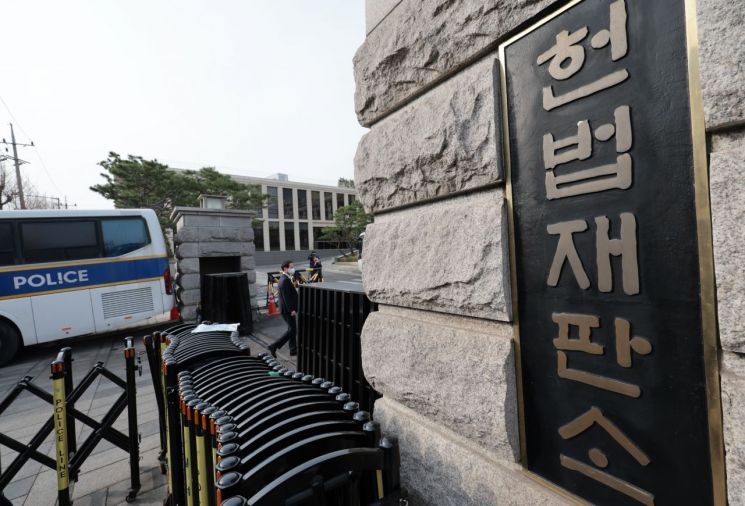
The Constitutional Court acknowledged the need to support the social reintegration of discharged soldiers, but also stated, "In a reality where the outcome is determined by only a few points, awarding 3% or 5% of the perfect score per subject as bonus points has a decisive impact." In December 1999, the nine justices unanimously ruled the military service bonus point system unconstitutional.
The Constitutional Court pointed out that "the system preferentially guarantees employment opportunities for discharged soldiers, while depriving and encroaching on the employment opportunities of those who are not discharged soldiers." While over 80% of Korean men are eligible to become discharged soldiers, only a very small fraction of women qualify, and those exempted from military service due to illness or disability cannot receive the bonus points even if they wish to serve.
Since then, there have been several legislative attempts to reintroduce the military service bonus point system in the political sphere, but all have failed. Currently, Kim Moonsoo, the People Power Party's presidential candidate, has included both the military service bonus point system and the Women's Hopeful Service System in his pledges, while Lee Jaemyung, the Democratic Party's candidate, has included 'reflecting military service experience in salary grades' among his top ten pledges. In the current National Assembly, Han Kiho, a People Power Party lawmaker, has proposed the "Act on Support for Military Service Fulfilling Individuals."
© The Asia Business Daily(www.asiae.co.kr). All rights reserved.


















