Gwangju Honorary Citizenship Press Conference
Confirmed X-ray of Shoulder-to-Hip Penetrating Wound
Yoon Sangwon, Impressive Leadership and Role Model
"If I Could Go Back, I Would Guard the Provincial Office"
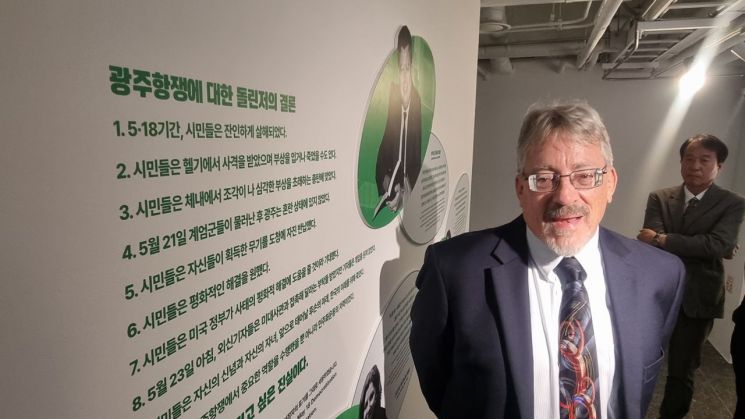 On the afternoon of the 14th, David Dollinger is explaining his exhibition titled 'Dollinger's Conclusion on the Gwangju Uprising' at Jeonil Building 245. Photo by Min Chanki
"On May 27, 1980, I should have been sitting in the South Jeolla Provincial Office. If it could have prevented the deaths of citizens, it would have been a meaningful sacrifice."
On the afternoon of the 14th, during a press conference for Gwangju Honorary Citizens held in the medium conference room on the fourth floor of Jeonil Building 245, David L. Dolinger, who was a member of the civilian militia during the 5·18 Gwangju Uprising, said, "After seeing an X-ray photo at Gwangju Christian Hospital in May 1980, showing a wound that penetrated from the left shoulder to the right hip, I became convinced that there had been helicopter gunfire. At that time, buildings in Gwangju were not very tall, so such gunfire must have come from a helicopter," he argued.
He witnessed a military helicopter as soon as he entered downtown Gwangju on May 21, 1980. Dolinger recalled, "A friend who was walking with me pulled me into a shop, saying we needed to get off the street."
He specifically explained that the bullets used by the military at that time were dumdum bullets, which are banned under international law. Dumdum bullets are characterized by the lead core exploding inside the human body.
David Dolinger entered Korea in 1978 as a member of the US Peace Corps and worked at a public health center in Yeongam, South Jeolla Province. The US Peace Corps is a federal agency established by John F. Kennedy to send young Americans to developing countries to share skills and knowledge. President Kennedy established it in 1961, saying, "Let us devote two years of our lives to service and contribute to world peace."
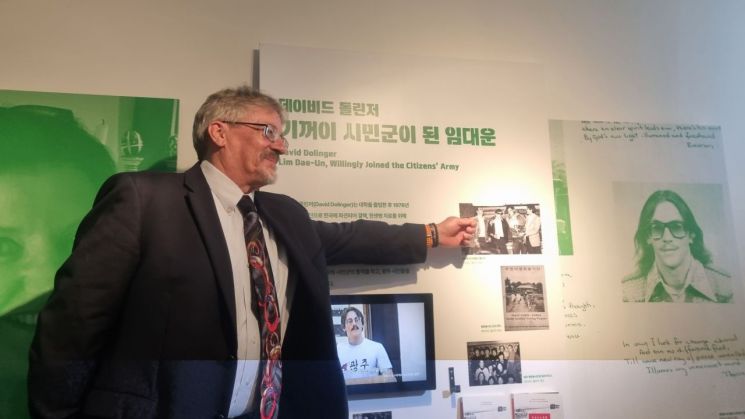 On the afternoon of the 14th, David Dollinger is explaining his photograph on display at Jeonil Building 245. Photo by Min Chanki
Dolinger visited Gwangju on May 16, 1980, to attend a wedding and witnessed the protests, and heard about the situation from other Peace Corps volunteers. On May 21, 1980, the day of the mass shooting by martial law troops in front of the old South Jeolla Provincial Office, he helped foreign correspondents with interpretation and assisted in transporting the wounded at the old South Jeolla Provincial Office and Chonnam National University Hospital.
He remembered the late Yoon Sangwon as "a leader of the provincial office's command group, whose charisma and leadership stood out." Dolinger said, "When I first met him at the provincial office, he asked me, 'You are also a citizen of Gwangju. Please tell the world about what is happening in Gwangju.' He persuaded the citizens around us, and thanks to him, the Peace Corps volunteers were cared for by the people of Gwangju. Yoon was a role model," he explained.
On May 24, 1980, he stayed up all night at the provincial office, monitoring radio communications with one retired soldier and two university students, preparing for a possible surprise attack by the military, who were communicating in English. The retired soldier had a daughter, and the university students had dreams; all of them shared the goal of creating a better future. Dolinger said, "At that time, the citizens of Gwangju willingly gave up and sacrificed their own lives for a better future and change for the next generation."
When asked by a reporter, "If you could go back to May 1980, what would you do?" Dolinger replied, "I always feel that what I have done so far has never been enough. On the last day of the provincial office resistance, when the martial law troops entered, I believe I should have been sitting in front of the provincial office. Perhaps I could have prevented many deaths," he said, shedding tears.
He added, "I do not want to see again the violent scenes, deaths, and corpses I saw that day. I regret not going to the provincial office that day. If there was someone I could have helped, I think it would have been okay if I had died then."
Dolinger assessed that the protests by the citizens of Gwangju in May 1980 were peaceful. He said, "The protests by the citizens at that time were peaceful, and all city institutions functioned normally. The violence inflicted by the military on the citizens was brutal. It is absurd to distort Gwangju as a 'riot.'"
He also said, "I was deeply moved when I saw citizens running to the National Assembly when martial law was declared last December. The sight of citizens heading to the National Assembly was the very spirit of Gwangju," he added.
Meanwhile, on this day, David Dolinger, the American who brought the story of the 5·18 Democratization Movement to the world, was named an honorary citizen of Gwangju. The city of Gwangju awards this honor to domestic and foreign individuals and overseas Koreans who have contributed to the development of the city or raised its profile.
Dolinger is an American who was dispatched to Korea in 1978 as a US Peace Corps volunteer and was working at Yeongam Public Health Center in South Jeolla Province when he witnessed the 5·18 Democratization Movement in May 1980. During the uprising, he also served as an interpreter for foreign journalists, assisted with their reporting, and directly interviewed the wounded in hospitals, making significant contributions to informing the world about the 5·18 movement.
© The Asia Business Daily(www.asiae.co.kr). All rights reserved.
![Clutching a Stolen Dior Bag, Saying "I Hate Being Poor but Real"... The Grotesque Con of a "Human Knockoff" [Slate]](https://cwcontent.asiae.co.kr/asiaresize/183/2026021902243444107_1771435474.jpg)

















