Cho Hee-dae Special Prosecutor Act Referred to Subcommittee by National Assembly Judiciary Committee on May 14
Court Organization Act and Constitutional Court Act Amendments Also Sent for Review
Concerns Raised: "Can Judges Stand Firm Against Those in Power?"
Led by the Democratic Party of Korea, several bills aimed at putting pressure on the judiciary?including the Cho Hee-dae Special Prosecutor Act, amendments to the Court Organization Act, and amendments to the Constitutional Court Act?were referred to a subcommittee within the National Assembly Legislation and Judiciary Committee.
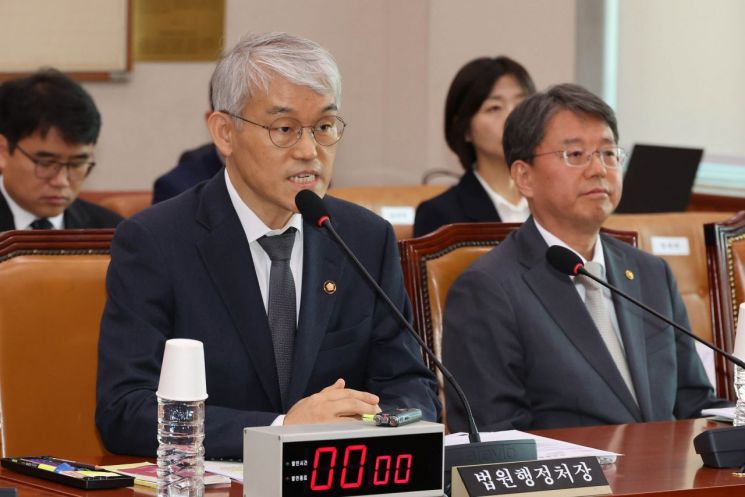
On May 14, the National Assembly Legislation and Judiciary Committee referred the bill on the appointment of a special prosecutor to investigate alleged judicial abuse by Chief Justice Cho Hee-dae and others (the Cho Hee-dae Special Prosecutor Act) to the bill review subcommittee. The subcommittee also received a partial amendment to the Constitutional Court Act, which would allow for constitutional complaints against Supreme Court rulings, as well as an amendment to the Court Organization Act to increase the number of Supreme Court justices.
The decision to refer the bills to the subcommittee was put to a vote due to objections from People Power Party lawmakers. Of the 14 committee members present, 11 voted in favor and 3 opposed, so the motion passed.
Democratic Party lawmakers proposed these bills, which are seen as applying pressure on the judiciary, after the Supreme Court decided to remand the case involving Lee Jae-myung, the Democratic Party's presidential candidate, who was accused of violating the Public Official Election Act.
Chun Dae-yeop, Director of the National Court Administration, responded to People Power Party lawmaker Kwak Kyu-taek's question about the amendment to the Constitutional Court Act, asking whether it would make the Supreme Court subordinate to the Constitutional Court. Chun stated, "As you pointed out, I can say that this is inconsistent with the constitutional provision that designates the Supreme Court as the highest court."
Chun also said, "When it comes to cases of great public interest, whether the judge is a Supreme Court justice or a lower court judge, I believe it is fair to say that all judges will review and consider the records of such cases more thoroughly and carefully than any other case."
Regarding concerns about pressure on the judiciary from the Cho Hee-dae Special Prosecutor Act and the amendments to the Court Organization Act, Chun stated, "The concerns shared by myself and many other judges are not for the sake of any particular Chief Justice."
He added, "In order for us (judges) to fulfill our role as the 'salt of society,' we must not fear external pressure from those in power and must do our duty through our rulings. However, if such matters lead to post-trial investigations or prosecutions, there is a fear that it will become difficult to confidently protect the basic rights of the people in opposition to those in power."
Meanwhile, on the same day, the Legislation and Judiciary Committee also passed an amendment to the Public Official Election Act that removes the requirement of an 'act' from the elements of the crime of disseminating false information. If this bill passes the National Assembly plenary session, Lee Jae-myung?who received a remand decision from the Supreme Court for violating the Public Official Election Act?could receive a dismissal of charges (due to the abolition of the relevant legal provision) in that case.
© The Asia Business Daily(www.asiae.co.kr). All rights reserved.

















