The 6th Seminar of the Institute of Regional Development at Chonnam National University
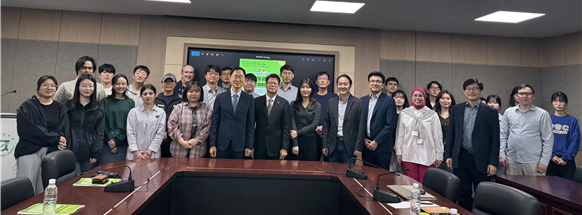 Chonnam National University Regional Development Institute recently held the 6th seminar on Climate Crisis Response and Energy Transition in collaboration with the Carbon Neutrality Support Center in Buk-gu, Gwangju, and the 4th phase BK21 Education and Research Team of the Department of Economics at Chonnam National University, under the theme "The Impact of Climate Change on Gwangju's Economy." Provided by Chonnam National University
An academic seminar was held at Chonnam National University to specifically analyze the impact of climate change on the regional economy and to discuss practical response measures at the local level. This seminar is regarded as a meaningful platform for academically connecting the two complex issues of the regional economy and the climate crisis, while also providing an opportunity to consider sustainable development strategies for the Gwangju area.
The Institute of Regional Development at Chonnam National University announced on May 14 that it recently co-hosted the 6th seminar on Climate Crisis Response and Energy Transition under the theme "The Impact of Climate Change on Gwangju's Economy," in collaboration with the Carbon Neutrality Support Center in Buk-gu, Gwangju, and the 4th phase BK21 Education and Research Team of the Department of Economics at Chonnam National University.
This event was organized to analyze the economic impacts of climate change, which have previously been discussed mainly at the national level, from a regional perspective, and to develop response strategies tailored to local realities. The organizers expected that an analysis based on quantitative data, focusing on the industrial structure and energy consumption patterns of the Gwangju region, would make a substantial contribution to future policy directions.
The seminar consisted of two presentations and a comprehensive discussion. In the first presentation, Byun Jangseop, a research professor, gave a talk on "The Economic Impact of Climate Change on Gwangju's Key Industries." Professor Byun presented an analysis showing that if the current levels of technology and policy remain unchanged, Gwangju's main industry, the automobile industry, could experience a decrease in production of up to 1.5017 trillion won by 2050 due to inter-industry linkages. This result quantitatively demonstrates the serious impact that a passive response to the climate crisis could have on the region's industrial base.
In the second presentation, Idmitri, a research professor, spoke on "The Impact of Climate Change on Household Electricity Consumption in Gwangju." Professor I estimated that, due to rising temperatures, residential electricity consumption in the Gwangju area is expected to increase by about 34.2 GWh from 2021 to 2040, and by about 42.6 GWh between 2041 and 2050. This predicts a structural expansion of electricity demand in response to changes in living environments, such as increased demand for cooling.
The comprehensive discussion that followed included An Jiyeong, manager at the Gwangju-Jeonnam branch of the Bank of Korea, Ko Beomseok, deputy director of the Gwangju Climate and Energy Promotion Agency, Lee Suyeol, professor at the School of Business Administration at Chonnam National University, and Jeon Wooyoung, professor at the Department of Economics at Chonnam National University. They discussed the intersection of the regional economy and energy policy from various perspectives.
The panelists emphasized that, while responding to climate change may initially pose a burden on the regional economy, in the long term, the development of eco-friendly technologies could lead to reduced production costs and price stabilization. They also suggested that, by utilizing institutional frameworks such as the implementation of the Special Act on Distributed Energy Promotion, the expansion of distributed power supply and direct electricity trading could have a positive impact on the regional economy.
Bae Junghwan, director of the Institute of Regional Development (professor at the Department of Economics, Chonnam National University), stated, "This seminar reaffirmed that responding to the climate crisis is an urgent and important task not only at the national level but also at the regional level." He added, "The Institute of Regional Development will continue to make practical contributions to the local community through research on various social issues such as the regional economy, climate change, and sustainability."
© The Asia Business Daily(www.asiae.co.kr). All rights reserved.

















