KRW 25 Billion to 105 Billion in Support by 2030 for Tangible Public Outcomes
Focus on Three Major Game Changers, Twelve National Strategic Technologies, and Pioneering New Technological Fields
Ten research teams, including the 'Hyperconnected Scalable Super Quantum Computing Strategic Research Team,' have been selected as 'Global TOP Strategic Research Teams.'
The Ministry of Science and ICT and the National Research Council of Science & Technology (NST) announced on May 14 that a total of 10 'Global TOP Strategic Research Teams' have been newly selected, comprising five national strategy teams and five future challenge teams.
The 'Global TOP Strategic Research Team Support Program' has been promoted since last year to establish a mission-oriented collaborative system that breaks down barriers between government-funded research institutes, supporting these institutes to deliver large-scale achievements that the public can experience.
This year, the program classified and selected teams into two categories: 'national strategy teams,' which focus on developing technologies necessary to lead the global technological hegemony race in three major game changers and 12 national strategic technologies, and 'future challenge teams,' which aim to develop challenging technologies through collaboration between research institutes and universities that are difficult for industry and academia to tackle alone.
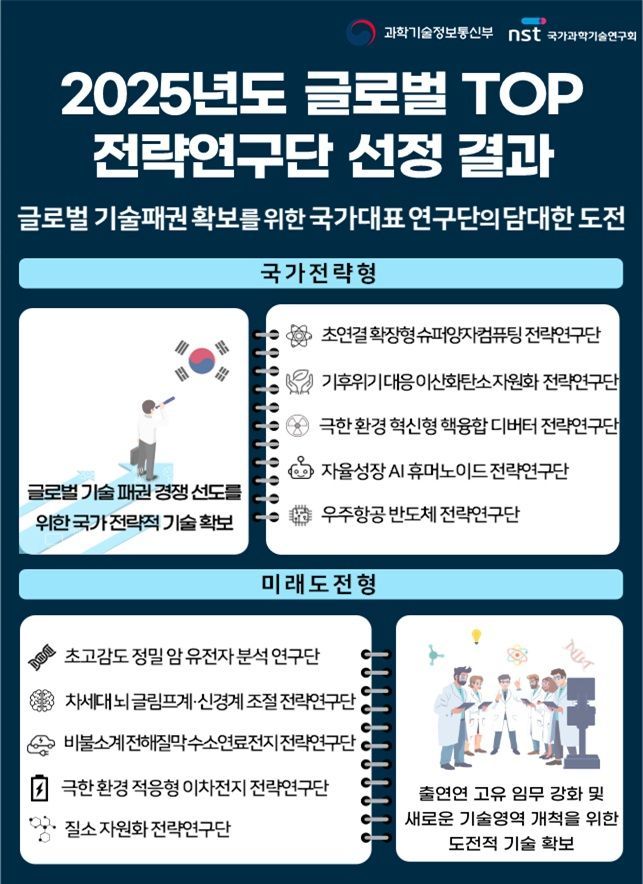
The five national strategy research teams are: ▲Hyperconnected Scalable Super Quantum Computing Strategic Research Team ▲Climate Crisis Response CO2 Resource Utilization Strategic Research Team ▲Extreme Environment Innovative Nuclear Fusion Divertor Strategic Research Team ▲Autonomous Growth AI Humanoid Strategic Research Team ▲Aerospace Semiconductor Strategic Research Team.
The five future challenge research teams selected are: ▲Ultra-sensitive Precision Cancer Gene Analysis Research Team ▲Next-generation Brain Glymphatic System and Nervous System Regulation Strategic Research Team ▲Non-fluorinated Electrolyte Membrane Hydrogen Fuel Cell Strategic Research Team ▲Extreme Environment Adaptive Secondary Battery Strategic Research Team ▲Nitrogen Resource Utilization Strategic Research Team.
The 'Hyperconnected Scalable Super Quantum Computing Strategic Research Team' aims to develop multi-core quantum processors based on superconducting and photonic technologies, where Korea has strengths, and to realize long-distance connections between quantum computers through quantum memory and quantum signal conversion-based interconnects. Four government-funded research institutes, including the Korea Research Institute of Standards and Science (KRISS), are participating, and the team will receive 15 billion KRW per year, totaling 75 billion KRW by 2030.
The 'Climate Crisis Response CO2 Resource Utilization Strategic Research Team' aims to develop and package innovative carbon capture and utilization (CCU) technologies based on carbon-free energy (CFE), and to establish and commercialize the world's first modular integrated process. Seven government-funded research institutes, including the Korea Research Institute of Chemical Technology (KRICT), are participating, with 20 billion KRW per year and a total of 100 billion KRW to be provided by 2030.
The 'Extreme Environment Innovative Nuclear Fusion Divertor Strategic Research Team' aims to develop an innovative nuclear fusion divertor, a core and essential device for nuclear fusion power generation. Three government-funded research institutes, including the Korea Institute of Fusion Energy (KFE), are participating, with 20 billion KRW per year and a total of 100 billion KRW to be provided by 2030.
The 'Autonomous Growth AI Humanoid Strategic Research Team' aims to develop humanoid skin with human-level high sensitivity, a humanoid platform with both agile lower body and precise upper body, a humanoid-specialized brain that implements the human cerebrum and cerebellum structure, and an autonomous growth system where intelligence grows on its own. Three government-funded research institutes, including the Korea Institute of Machinery and Materials (KIMM), are participating, with 21 billion KRW per year and a total of 105 billion KRW to be provided by 2030.
The 'Aerospace Semiconductor Strategic Research Team' aims to develop seven types of space-grade semiconductor and module technologies for communication, power, imaging, and memory, where Korea has technological strengths, and to secure space heritage through actual space verification. Four government-funded research institutes, including the Electronics and Telecommunications Research Institute (ETRI), are participating, with 21 billion KRW per year and a total of 105 billion KRW to be provided by 2030.
The 'Ultra-sensitive Precision Cancer Gene Analysis Research Team' aims to develop ultra-sensitive cancer gene analysis technology and personalized precision monitoring technology based on blood tests for three major solid cancers?lung, colorectal, and gastric cancer?as well as blood cancers. Three government-funded research institutes, including the Korea Institute of Materials Science (KIMS), are participating, with 5 billion KRW per year and a total of 25 billion KRW to be provided over the next five years.
The 'Next-generation Brain Glymphatic System and Nervous System Regulation Strategic Research Team' aims to develop the world's first next-generation technology for revolutionary treatment and management of degenerative brain diseases through the newly emerging paradigm of brain glymphatic system regulation. Two government-funded research institutes, including the Korea Institute of Oriental Medicine (KIOM), are participating, with 5 billion KRW per year and a total of 25 billion KRW to be provided over the next five years.
The 'Non-fluorinated Electrolyte Membrane Hydrogen Fuel Cell Strategic Research Team' aims to develop an eco-friendly perfluoroalkyl substances (PFAS)-free electrolyte membrane for hydrogen electric vehicles that can operate for more than 10 years, focusing on hydrogen electric vehicles. Four government-funded research institutes, including the Korea Institute of Energy Research (KIER), are participating, with a total of 25 billion KRW to be provided by 2030.
The 'Extreme Environment Adaptive Secondary Battery Strategic Research Team' aims to develop secondary batteries that operate stably in extreme environments such as high temperature, low temperature, and radiation. Three government-funded research institutes, including the Korea Basic Science Institute (KBSI), are participating, with a total of 25 billion KRW to be provided by 2030.
The 'Nitrogen Resource Utilization Strategic Research Team' aims to propose a new nitrogen fixation paradigm based on nitric oxide (NO) instead of ammonia (NH3), develop new nitrogen fixation process technology and essential compounds and materials based on it, and establish electrochemical processes to achieve carbon neutrality. Three government-funded research institutes, including the Korea Institute of Machinery and Materials (KIMM), are participating, with a total of 25 billion KRW to be provided by 2030.
The Ministry of Science and ICT evaluated the scientific and technological necessity and excellence of 77 proposals received after the call for proposals in December last year, formed an expert evaluation committee for in-depth review, and shortlisted 16 projects (nine national strategy teams and seven future challenge teams) last month. After further consulting to refine mission objectives and implementation systems, the final evaluation and selection of high-quality R&D plans took place from May 7 to 9.
Minister of Science and ICT Lee Sangim stated, "Government-funded research institutes, as national R&D institutions, are once again embarking on a bold challenge to lead large-scale national missions that are difficult for industry and academia to undertake, and through this, to secure global initiative in strategic technologies. We will continue to provide institutional and financial support so that these institutes can establish themselves as hubs for concentrating national industry-academia-research capabilities around national missions."
NST Chairman Kim Youngsik emphasized, "The Global TOP Strategic Research Teams are a key foundation for fulfilling the national responsibility of achieving full-cycle R&D completion and realizing super-gap technological sovereignty, with clear outcomes that the public can feel. We will actively support the translation of research results into industry and society, and also strive to create a research environment where researchers can demonstrate autonomy and creativity."
© The Asia Business Daily(www.asiae.co.kr). All rights reserved.
![Clutching a Stolen Dior Bag, Saying "I Hate Being Poor but Real"... The Grotesque Con of a "Human Knockoff" [Slate]](https://cwcontent.asiae.co.kr/asiaresize/183/2026021902243444107_1771435474.jpg)
















