Peruvian Authorities Investigate Obscene Graffiti at Chanchan Archaeological Site
"Severe Disrespect for Cultural Heritage"
Peruvian authorities have launched a police investigation after obscene graffiti in the shape of a male genitalia was discovered at an archaeological site where they have been conducting carefully managed excavations.
On May 13 (local time), the Peruvian Ministry of Culture issued a statement saying, "Someone drew a picture of a male genitalia with black aerosol spray on the walls of the 'Chanchan' archaeological site in the La Libertad region," and added, "It has been confirmed that at least three sections of the walls were damaged."
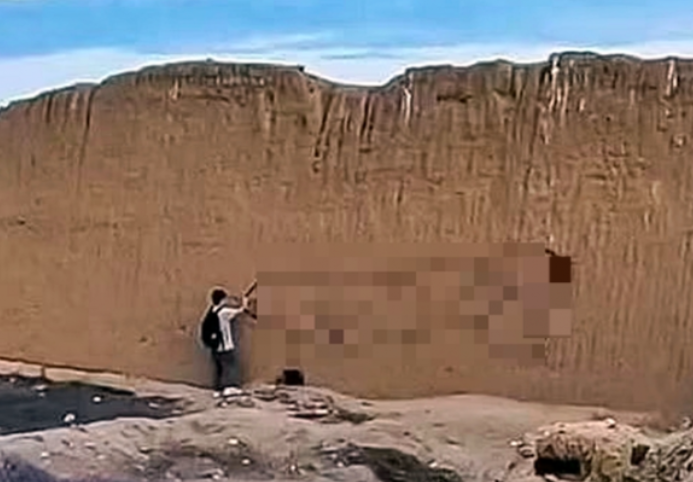 A recent incident occurred at the UNESCO World Cultural Heritage site, the 'Chanchan' archaeological site, where an unidentified tourist drew a large male genitalia on the fortress wall. X (formerly Twitter)
Local media reported that a video showing a person, believed to be male, wearing a bag and drawing the graffiti has been circulating on social networking services (SNS), and that if the perpetrator is caught, they could face up to six years in prison.
The authorities stated, "This is a truly appalling act that demonstrates a severe lack of respect for a cultural heritage site that is over 600 years old," and added, "We are actively cooperating with the police to identify the suspect." They also began restoration work with experts to repair the site as much as possible and are considering strengthening protective measures, such as installing large-scale security fences around the vicinity of the Chanchan archaeological site.
Chanchan, which was designated as a UNESCO World Heritage site in 1986, is an archaeological site where the Peruvian government has been conducting long-term artifact excavation and restoration work, along with Machu Picchu, considered the pinnacle of Inca civilization. At the time, UNESCO described Chanchan as "the representative city of the vanished Chim? Kingdom, comprehensively illustrating 1,100 years of evolution in northern Peru," and called it a "masterpiece of urban planning." In particular, as the world's largest adobe city, or mud-brick city, it is considered to be of immeasurable value. However, Chanchan began to deteriorate due to the activities of tomb raiders and abnormal weather such as heavy rains caused by El Ni?o, and was placed on the list of World Heritage in Danger at the same time as its UNESCO designation. To this day, Peru continues to devote significant efforts to the preservation and restoration of the site.
© The Asia Business Daily(www.asiae.co.kr). All rights reserved.

















