Bank of Korea's "Financial Market Trends for April 2025"
Bank Household Loan Balance Reaches 1,150 Trillion Won... Mortgage Loans Up by 3.7 Trillion Won
Corporate Loans Turn to Increase, Rising by 14.4 Trillion Won
Bank Lending Resumes, Driven by Policy-Based Funds
Last month, bank household loans increased by 4.8 trillion won, marking a significant expansion. This was the result of increased housing transactions following the lifting of the land transaction permit zone in the Gangnam area of Seoul, which, after a time lag, impacted household loans. The highest number of housing transactions occurred in March, and since household loans typically follow with a two to three month lag, the Bank of Korea expects the increase to be even greater this month.
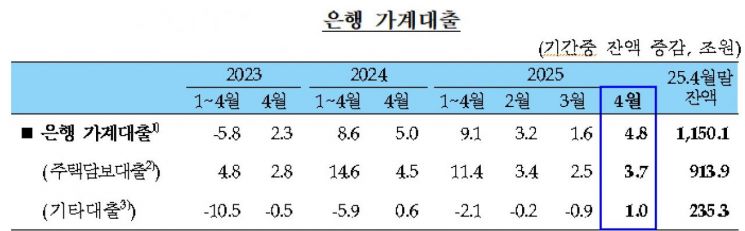
According to the "Financial Market Trends for April 2025" released by the Bank of Korea on May 14, the outstanding balance of bank household loans at the end of last month stood at 1,150.1 trillion won, up by 4.8 trillion won from the end of the previous month. This marks a sharp increase from the 1.4 trillion won rise in March.
Among household loans, mortgage loans increased by 3.7 trillion won to reach 913.9 trillion won. This is an expansion from the 2.5 trillion won increase in February. The growth in mortgage loans reflects the surge in housing transactions that began to be fully reflected in household loans this month, following the lifting of the land transaction permit system in February.
Considering that housing transactions are reflected in household loans with a two to three month time lag, there is a possibility that the increase in May will be even larger. According to the Ministry of Land, Infrastructure and Transport, the number of apartment sales transactions in Seoul was 6,200 in February and 9,300 in March. Park Mincheol, head of the Market Overview Team at the Bank of Korea's Financial Markets Department, stated, "The impact of increased housing transactions in February and March has begun to be fully reflected this month," and added, "We expect this trend to continue for the time being."
Park further explained, "Since the re-designation of the land transaction permit system in April, the volume of housing sales in Seoul appears to be stabilizing, and if this continues, household loan growth is also expected to gradually ease after a time lag." However, he also noted, "So far, the volume of housing transactions remains higher than at the end of last year and the beginning of this year, and with the implementation of the third stage of the Debt Service Ratio (DSR) scheduled for July, there is a possibility of advance demand occurring, so it is difficult to let down our guard."
Jeonse loans, which are included in mortgage loans, increased by 700 billion won compared to the end of the previous month. Other loans turned to an increase of 1 trillion won as seasonal factors such as the inflow of bonuses in the first quarter and the disposal and amortization of non-performing loans at the end of the quarter disappeared. Other loans include general credit loans, credit line loans (overdraft loans), commercial real estate secured loans, deposit and savings secured loans, and stock secured loans.
In April, bank corporate loans also turned to a significant increase. At the end of last month, the outstanding balance of bank corporate loans was 1,338.7 trillion won, up by 14.4 trillion won from the end of the previous month. This contrasts with the 2.1 trillion won decrease in March. The increase was the second largest for April on record, after April 2020 (27.9 trillion won).
Large corporate loans increased by 6.7 trillion won compared to the end of the previous month, due to seasonal working capital demand such as the re-disbursement of funds temporarily repaid for dividend payments and end-of-quarter financial ratio management, as well as some banks handling policy facility loans. Loans to small and medium-sized enterprises increased by 7.6 trillion won, driven by demand for funds related to value-added tax payments and financial support related to U.S. tariff policies.
Park explained, "The increase in corporate loans in April was due to banks resuming lending after not actively extending corporate loans since the end of last year to manage their Common Equity Tier 1 (CET1) ratio, and restarting lending after the first quarter to meet management targets. The increase was also amplified by policy-based financial support."
He added, "While supply has recovered, on the demand side, the need for funds is mainly for dividend payments and value-added tax payments, not for investment purposes, so it is premature to say that corporate demand for investment funds has revived. Going forward, demand for funds to cope with the economic slowdown is expected to increase, but whether demand for investment funds will rise remains to be seen."
Looking at corporate fundraising through direct finance, the net issuance of corporate bonds increased due to falling market interest rates and robust investment demand. The net issuance rose from a 400 billion won increase in March to 1.9 trillion won in April. Commercial paper (CP) and short-term bonds increased by 4.6 trillion won compared to the end of the previous month, as funds temporarily repaid for end-of-quarter financial ratio management were reissued and some companies required working capital.
In April, bank deposits decreased by 25.9 trillion won compared to the end of the previous month. This marks a sharp turnaround from the 12.3 trillion won increase in March. The decline in deposits was due to a 36.8 trillion won outflow from demand deposits in April. Demand deposits dropped significantly as corporate funds were withdrawn for value-added tax payments and dividend distributions, and as local government fiscal execution funds were withdrawn. Time deposits, which had decreased by 12.6 trillion won in March, turned to an increase within a month. However, despite banks' efforts to attract deposits amid loan expansion, the increase was limited to just 500 billion won due to a decrease in corporate deposits resulting from dividend payments.
In contrast, deposits at asset management companies increased by 38.5 trillion won compared to the end of the previous month. This marks a sharp turnaround from the 13.1 trillion won decrease in March. This was mainly due to a 24.1 trillion won increase in money market funds (MMFs). MMFs saw a significant increase in corporate funds in April as funds withdrawn for end-of-quarter financial ratio management flowed back in. Bond funds and equity funds also increased by 7.4 trillion won and 3.5 trillion won, respectively, with the inflow rising compared to the previous month.
© The Asia Business Daily(www.asiae.co.kr). All rights reserved.


















