Exploring Military Applications of Commercial Unmanned Systems
that Are Easily Acquired in Crisis Situations
The Navy announced on May 14 that, starting from May 12, it has been conducting a five-day training exercise to verify the operational feasibility of commercial unmanned systems at the Autonomous Ship Performance Demonstration Center of the Ship and Offshore Plant Research Institute at Ulsan Ilsan Port and in nearby waters.
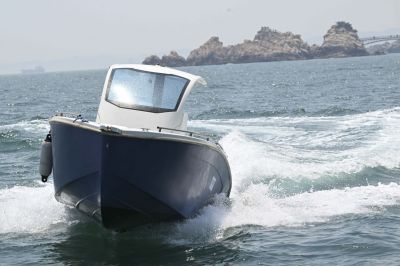
This exercise is designed to explore ways to utilize easily accessible commercial unmanned systems for military purposes during crises such as wartime. The focus is on their application in various areas, including reconnaissance and surveillance, attacks on enemy provocation forces and facilities, and logistical support. This is the first time the Navy has conducted such training, with participation from the Ship and Offshore Plant Research Institute (Autonomous Ship Performance Demonstration Center), private manufacturers of unmanned surface vessels and drones, and others.
The participating assets consist of three unmanned surface vessels, including the 69-ton "Haeyang Nuriho" from the Ship and Offshore Plant Research Institute and the 3-ton AURA unmanned surface vessel developed for high-speed leisure use; ten drones, including fixed-wing drones for tuna school detection used on deep-sea fishing vessels, commercial multicopter drones capable of bomb dropping and cargo transport, and cardboard drones that can be used for suicide missions; and one manned civilian ship serving as a drone carrier.
The exercise began with a fixed-wing drone for tuna school detection taking off from the manned civilian drone carrier to perform reconnaissance and surveillance missions on maritime and land targets. The imagery collected was then transmitted to the Autonomous Ship Performance Demonstration Center, which simulated a command and control center. Next, a cardboard suicide drone struck a simulated enemy maritime target infiltrating the coast. A commercial multicopter launched from the Haeyang Nuriho attacked land targets with water bottles simulating bombs and transported military supplies. The scenario then progressed to the 3-ton AURA unmanned surface vessel conducting reconnaissance, surveillance, and attacks on simulated maritime targets.
Park Sangkyu, Director of Mobilization at Navy Headquarters (Colonel), who planned the exercise, stated, "The acquisition and military utilization of commercial unmanned systems, which can be produced at low cost, with high efficiency, and in large quantities, have a significant impact on victory in modern warfare, as seen in the war in Ukraine. The Navy will continue to verify the operational feasibility of commercial drones and unmanned surface vessels developed and used in the private sector for both wartime and peacetime operations, and will further develop mobilization plans based on these findings."
© The Asia Business Daily(www.asiae.co.kr). All rights reserved.

















