Nvidia to Supply 18,000 Blackwell Chips to Saudi Arabia
AMD Joins Saudi Data Center Project
Musk's Starlink Approved for Use in Saudi Arabia
U.S. semiconductor companies Nvidia and AMD have both secured large-scale investments from Saudi Arabia. Following the announcement of this surprise 'big deal' with Saudi Arabia, the stock prices of both companies rose. As the Trump administration completely overhauls export controls on artificial intelligence (AI) and semiconductors, cooperation on AI between the U.S. and Middle Eastern countries, including Saudi Arabia, is expected to expand further.
Jensen Huang, CEO of Nvidia, announced on May 13 (local time) at the 'Saudi-U.S. Investment Forum' held in Riyadh, Saudi Arabia, that the company had signed a contract with local firm Humain to supply its latest AI chips. This announcement coincided with President Donald Trump's visit to Saudi Arabia.
In his announcement, CEO Huang stated that Nvidia plans to sell more than 18,000 units of its latest AI chip, the GB300 Blackwell chip, to Humain. These chips will be installed in a 500MW (megawatt) data center to be built in Saudi Arabia.
He explained, "Saudi Arabia is a country rich in energy resources," and added, "By leveraging this energy, the country is transforming its systems into AI factories through large-scale Nvidia AI supercomputers."
Humain is an AI-focused company newly established by the Saudi sovereign wealth fund, leading the construction of AI infrastructure and data centers. Tareq Amin, CEO of Humain, announced plans to build data centers with a total capacity of 1.9GW by 2030.
AMD also issued a separate statement, saying, "We plan to provide our semiconductors and software for a data center construction project spanning from Saudi Arabia to the United States," adding that the project is valued at approximately $10 billion (about 13.5 trillion won).
CNBC commented, "As countries around the world compete to secure the latest chips for advanced AI software training and operation, such as ChatGPT, the use of Nvidia chips as a diplomatic bargaining tool by the Trump administration is becoming evident."
On the same day, Elon Musk, CEO of Tesla, also announced that Saudi Arabia had officially approved the use of Starlink's in-flight and maritime services. Starlink is a satellite internet service developed by SpaceX, the aerospace and defense company run by Musk. In addition to Starlink, Musk mentioned plans for the Saudi launch of the autonomous electric vehicle Tesla Robotaxi, stating, "Introducing autonomous vehicles in the Kingdom is a very exciting development." Musk also revealed that he had showcased the humanoid robot 'Optimus,' currently under development by his company, to President Trump and Saudi Crown Prince Mohammed bin Salman.
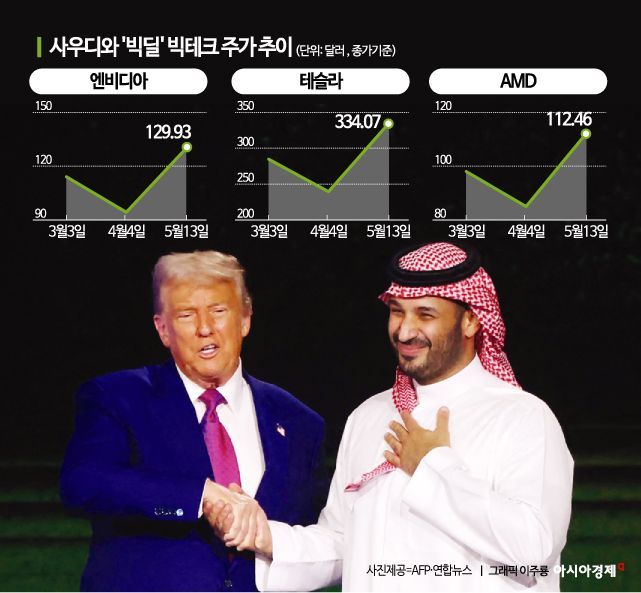
Following the positive news from Saudi Arabia, the stock prices of Nvidia, AMD, and Tesla all closed higher. On May 13, on the New York Stock Exchange, Nvidia rose 5.6% compared to the previous day, while Tesla and AMD climbed 4.9% and 4.0%, respectively.
In addition to individual corporate investments, the White House announced that $600 billion in U.S. investments had been secured from Saudi Arabia, along with a $142 billion arms sales contract.
Looking ahead, cooperation between the U.S. and Middle Eastern countries on AI is expected to become even more active. This is because the Trump administration has announced the complete repeal of the AI semiconductor export controls introduced during the Biden administration and plans to establish a new framework. This move abolishes the so-called 'AI Diffusion Rule,' which had faced strong opposition from U.S. companies and allies. The Trump administration plans to maintain existing restrictions against China while shifting to individual agreements with allied countries. Depending on the terms of the bilateral agreements the Trump administration negotiates with each country in the coming months, there could be significant impacts on the global semiconductor supply chain and corporate strategies.
Bloomberg News analyzed, "This move by the Trump administration is welcome news for countries such as the United Arab Emirates (UAE) and Saudi Arabia, which were previously subject to U.S. regulations," adding, "These countries now have the opportunity to negotiate with the new U.S. administration under better conditions."
© The Asia Business Daily(www.asiae.co.kr). All rights reserved.

















