The new president, who will take office on June 4, is expected to make their diplomatic debut just about ten days after the start of their term. An invitation as an observer to the Group of Seven (G7) summit, which will be held in Canada on June 15, is highly likely. This occasion is also expected to provide a natural opportunity for a face-to-face meeting with U.S. President Donald Trump. As negotiations over tariffs with the United States will be the first test of the new administration's diplomatic capabilities, a whirlwind of diplomatic activity is anticipated immediately after inauguration.
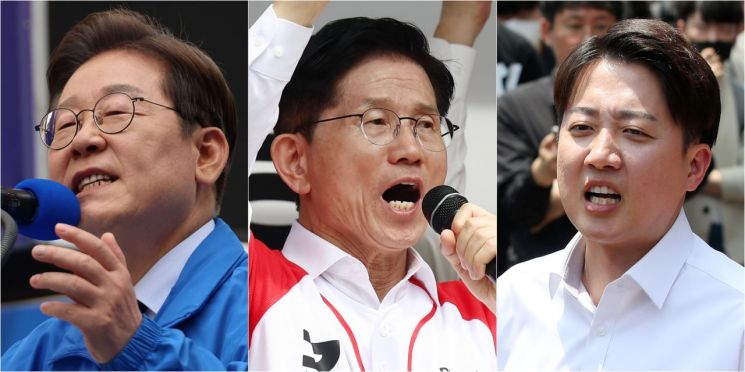 (From left) Lee Jaemyung, Democratic Party presidential candidate; Kim Moonsoo, People Power Party presidential candidate; Lee Junseok, Reform New Party presidential candidate. Yonhap News
According to diplomatic sources on May 14, if the new president is invited to this year’s G7 summit, it will mark the third time in history for a South Korean president to attend the meeting in person, following previous occasions in 2021 and 2023. The G7 is known as the "club of advanced nations" centered around the United States. Canada, which holds the G7 presidency this year, saw Prime Minister Mark Carney take office following the general election in March. Once the new Korean president is elected, there is a possibility that an invitation may be extended through communication between the leaders of Korea and Canada. Previously, Prime Minister Carney invited Ukrainian President Volodymyr Zelensky to the G7 summit following a phone call with him shortly after taking office.
In addition, the North Atlantic Treaty Organization (NATO) summit is scheduled to take place in The Hague, Netherlands, from June 24 to 26. NATO, a military alliance centered around North America and European countries, has consistently invited the four Indo-Pacific countries (IP4)?Korea, Japan, Australia, and New Zealand?in recent years. President Trump is also highly likely to attend this event. If President Trump also attends the Asia-Pacific Economic Cooperation (APEC) summit, which is expected to be held in Gyeongju around October or November this year, the leaders of Korea and the United States would meet at three multilateral forums in a single year.
However, there are a number of important pending issues between Korea and the United States, including tariff negotiations, North Korea policy, and the defense treaty. Therefore, in addition to multilateral diplomatic events, direct communication between the two leaders is also expected to be pursued. Previous presidents, including Park Geunhye, Moon Jaein, and Yoon Sukyeol, prioritized phone calls with the U.S. president on the day of their election or inauguration. In addition, the new president's visit to the United States is also expected to be coordinated. On May 6, Foreign Minister Cho Taeyeol spoke by phone with U.S. Secretary of State Marco Rubio and requested special attention to ensure that, following the June 3 presidential election, Korea’s new administration can quickly settle in and that cooperation between Korea and the United States can continue, including the prompt arrangement of a phone call between the two leaders immediately after the election.
© The Asia Business Daily(www.asiae.co.kr). All rights reserved.

















