April CPI Rises 2.3% from Previous Month, Lowest in Over Four Years
Tariff Impact Remains Limited for Now, Uncertainty Persists
Focus Shifts to PPI and Retail Sales Data on the 15th
The three major indices on the New York Stock Exchange showed mixed movements in early trading on the 13th (local time). Although last month's inflation data came in below expectations, the market showed no clear direction and remained in a wait-and-see mode. Technology stocks, however, are showing strength.
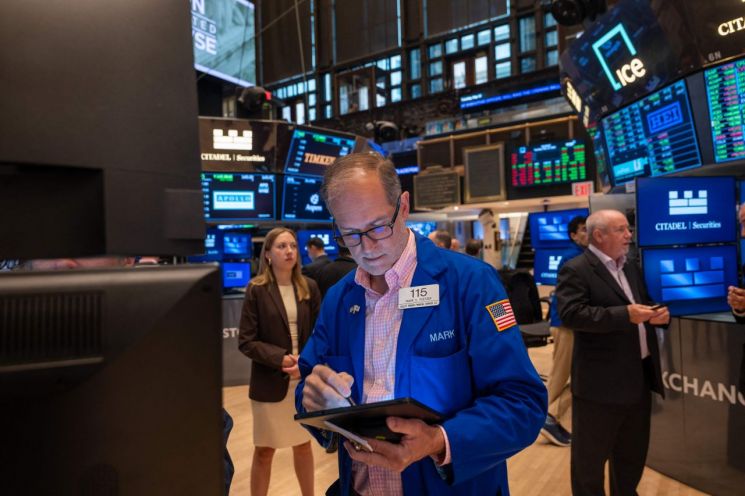
As of 10:31 a.m. on this day at the New York Stock Exchange, the Dow Jones Industrial Average, which is focused on blue-chip stocks, was down 115.13 points (0.27%) from the previous trading day, standing at 42,294.97. The S&P 500 index, which tracks large-cap stocks, was up 41.97 points (0.72%) at 5,886.16, and the tech-heavy Nasdaq index was up 242.29 points (1.3%) at 18,950.63. After a rally the previous day on news of a US-China trade agreement, the New York market is showing a relatively calm reaction today.
The inflationary pressure stemming from tariffs appears to be limited. In April, the US Consumer Price Index (CPI) rose 2.3% year-on-year, marking the lowest level in four years and two months since February 2021. This figure was below both the March reading and market expectations (both at 2.4%). The core CPI, which excludes the volatile energy and food sectors, rose 2.8% year-on-year, matching both the previous month's figure and market expectations (each at 2.8%).
This CPI report is the first to reflect the effect of the 10% base tariff that US President Donald Trump imposed on all trading partners in early April. Companies stockpiled inventory before the tariff hikes, and since the costs have not yet been fully passed on to consumer prices, the direct impact of the tariff policy appears to be limited for now. However, there remains a possibility that prices could rise again depending on how quickly companies deplete their inventories and on the outcome of the tariff negotiations scheduled through July.
Bail Hartman, an analyst at BMO Capital Markets, commented, "This data supports the assumption that core inflation was on a downward trend before the trade war," and analyzed, "It is an encouraging starting point for absorbing the inevitable pass-through of tariffs that could push up consumer prices over the coming months or quarters."
This CPI report, which has eased some inflation concerns, was released just one day after the news of a US-China trade agreement. On May 10 and 11, the two countries held their first official trade talks in Geneva, Switzerland, and agreed to lower their respective tariff rates by 115 percentage points. As a result, the US tariff rate on Chinese goods will drop from 145% to 30%, and China's tariff rate on US goods will fall from 125% to 10%. Both countries will lower tariffs for 90 days and continue further trade negotiations. With the US and China, which had been engaged in a game of chicken over trade, agreeing to sharply reduce tariffs in their first round of talks, optimism is growing about the possibility of additional agreements in the future.
This week, a series of inflation and consumption indicators are also set to be released. On the 15th, the Producer Price Index (PPI) for April and retail sales data, which serve as a backbone for the US economy and account for two-thirds of economic activity, will be announced. As tariffs have started to dampen household and business sentiment, it will be crucial to see whether the effects of tariffs are now being reflected in US inflation and retail sales data.
By stock, Nvidia is up 5.14%. Tesla is up 1.36%, and Apple is up 0.35%. Meta, the parent company of Facebook, and Alphabet, the parent company of Google, are showing gains of 2.18% and 0.97%, respectively.
US Treasury yields are steady. The yield on the 10-year US Treasury, the global benchmark for bond yields, is up 2 basis points (1bp=0.01 percentage point) from the previous session at 4.47%, while the yield on the 2-year US Treasury, which is sensitive to monetary policy, is at the previous day's level of 4.0%.
© The Asia Business Daily(www.asiae.co.kr). All rights reserved.

















