If Businesses Thrive, Jobs Increase and the Middle Class Benefits
Focus on Deregulation, Tax Cuts, and Innovation Support
Challenges Remain for Detailed Policies and Securing Funding
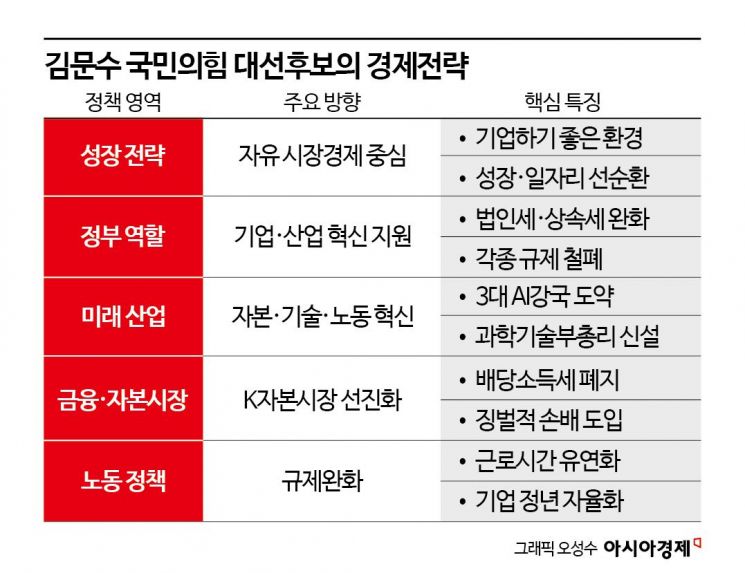
The core of People Power Party presidential candidate Kim Munsu's economic pledges can be summarized as a "free market economy." His main goal is to create an environment where businesses can thrive, thereby increasing jobs and establishing a "virtuous cycle" in which both young people and the middle class benefit from the trickle-down effect. The details of his pledges focus primarily on easing regulations and taxes, as well as supporting business and industrial innovation. This approach is consistent with the pro-business policies traditionally emphasized by the conservative bloc.
Kim's pro-business stance is also evident in his life story, as he transitioned from a labor activist to a right-wing politician. At his presidential campaign launch on April 9, he recalled, "Even while in prison during my labor movement days, I believed capitalism would fail, but the market economy developed dynamically, and Korea achieved both industrialization and democratization." He added, "At the forefront of politics, I have led efforts to defend liberal democracy and the market economy."
His top priority is also reflected in his first major campaign pledge: "A country where it is easy to do business, and job creation." From the party primary stage, Kim promised to establish a chief secretary for business grievances within the presidential office to directly address corporate concerns. While former President Moon Jae-in had a chief secretary for jobs and former President Yoon Suk-yeol had a chief secretary for low birth rates, Kim has positioned the chief secretary for business grievances as his "trademark."
Kim believes that economic efficiency can be maximized only when government intervention is minimized and private sector autonomy is fully guaranteed. This contrasts with the "income-led growth" policy of the Moon Jae-in administration and is similar to the "private sector-led growth" of the Yoon Suk-yeol administration. For this reason, many of his pledges focus on supporting business activities, such as lowering the top rates for corporate and inheritance taxes, improving the 52-hour workweek regulation, expanding nuclear power, and reducing industrial electricity rates.
Kim is also proactive in easing corporate regulations. As governor of Gyeonggi Province, he was a bold advocate for deregulation in the Seoul metropolitan area, even requesting then-President Lee Myung-bak to lift military facility protection zones in northern Gyeonggi. As a presidential candidate, he plans to enact a "Basic Law on Free Economic Innovation" to abolish regulations in new technology and new industry sectors and foster future industries. A member of Kim's campaign explained, "The focus of our pledges is on the economy and youth."
While his "business-centered growth" strategy overlaps with that of his opponent, Democratic Party leader Lee Jaemyung, there are significant differences on key issues. Kim has argued that "successful companies in Korea risk going to jail," insisting that Democratic Party bills such as the Serious Accidents Punishment Act and the Yellow Envelope Act must be revised. At the first central election committee meeting on May 12, he said, "Is making people prosperous not progressive? Is making people poor progressive?" and added, "I want to tear apart this fake progressivism."
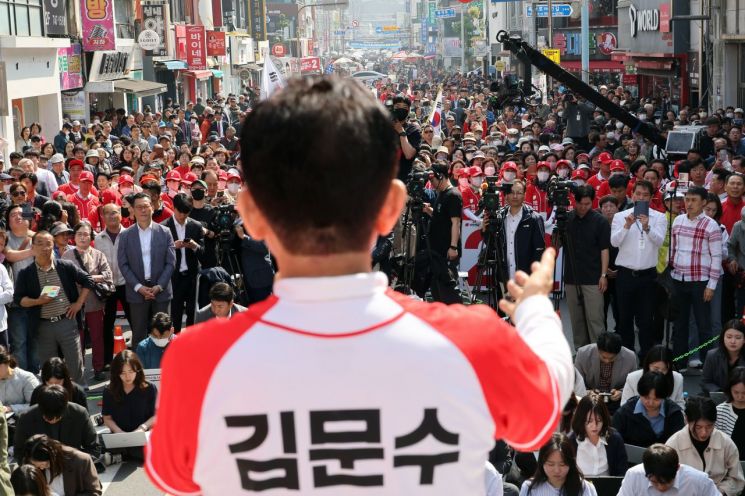 People Power Party presidential candidate Kim Munsu is campaigning on the 14th at Jinju Gwangmi Intersection in Jinju, Gyeongnam. Photo by Yonhap News
Of course, Kim's economic pledges are not solely focused on being pro-business. They are broad in scope, including middle-class tax cuts and asset-building support, the establishment of a support group for small business owners and the self-employed, and expanded housing assistance for young people and newlyweds. On the first day of his campaign, May 12, he visited Garak Market in Seoul and Seomun Market in Daegu, emphasizing, "I will be a president for people's livelihoods and for ordinary citizens." This is also interpreted as an effort to secure middle-class votes and soften his image as a far-right politician.
Regarding Kim's economic pledges, experts point out that the details of the policies and funding plans need further development. Huh Jinwook, a professor of economics at Sookmyung Women's University, said, "It is naturally necessary to support corporate investment and technological advancement to create good jobs, so the direction is correct," but added, "The key will be to work out the details." Professor Huh also noted, "Since pledges requiring both tax cuts and increased fiscal spending are being made at the same time, discussions on securing financial resources must also take place."
© The Asia Business Daily(www.asiae.co.kr). All rights reserved.


















