Nearly 4 Million Foreign Tourists Visit in Q1
Record Annual Arrivals Expected to Surpass 2019
Heavy Concentration of Asian Visitors... Challenges Remain with Low-Cost Cruise Tourism
Urgent Need to Develop New Tourism Programs Utilizing K-Content
With the number of foreign tourists visiting South Korea in the first quarter of this year approaching 4 million, there is growing optimism that the country could set a new all-time record for annual tourist arrivals. However, there were concerns about profitability, as the increase in visitors was largely driven by cruise travelers, who tend to contribute less to overall tourism revenue. Experts point out that, in order to achieve qualitative growth rather than simply expanding visitor numbers, it is urgent to develop additional tourism courses and infrastructure, such as theme-based tours linked to popular content.
According to the Korea Tourism Organization on May 13, the number of foreign tourists visiting South Korea in the first quarter of this year was 3,870,247, up 13.7% (467,374 people) from the same period last year (3,402,873). After peaking at 3,842,246 in 2019, the number of inbound foreign tourists dropped sharply during the COVID-19 pandemic, but began to recover after 2023, reaching 3.4 million last year and climbing to a record 3.87 million in the first quarter of this year.

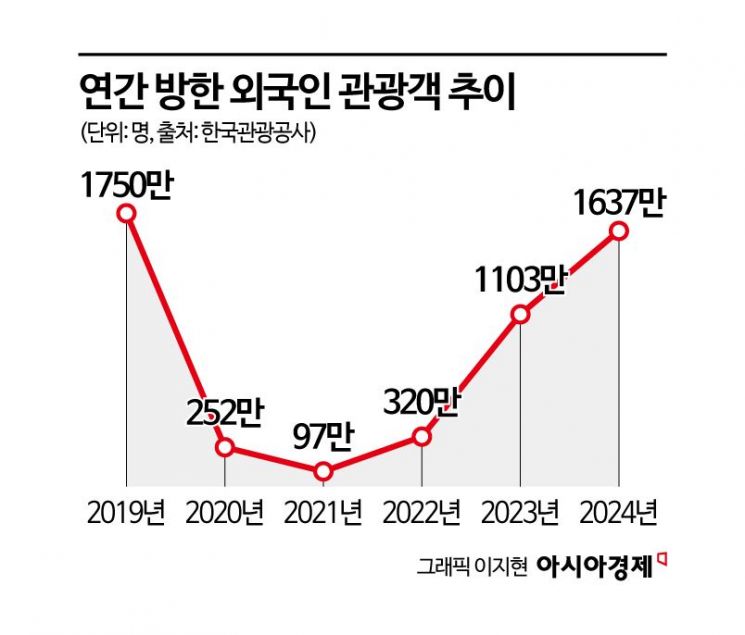
With nearly 4 million foreign tourists visiting South Korea in the first quarter, it is expected that the record for annual inbound foreign tourists could be broken this year. The year with the highest number of foreign visitors to date was 2019, with 17.5 million. Last year, the number had already recovered to 16.37 million, which is 93.5% of the pre-pandemic level in 2019.
By country, Chinese tourists ranked first by a wide margin with 1,122,169 visitors, followed by Japan (782,511), Taiwan (395,466), Vietnam (129,109), the Philippines (125,402), and Hong Kong (118,578). The majority of visitors came from neighboring countries, with Asian visitors accounting for 82.5% (3,193,222) of the total, indicating a strong regional concentration. Outside of Asia, the United States contributed the largest number of visitors with 278,824, making the Americas the next largest region at 9.5% (367,974).
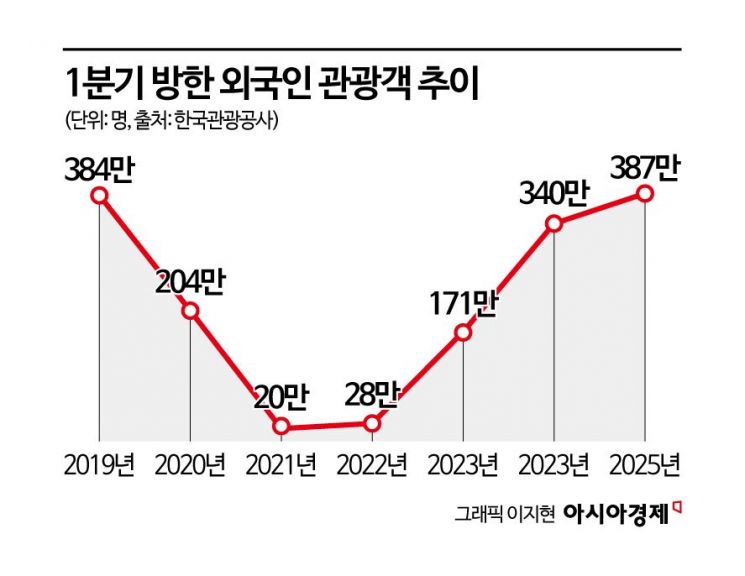
Although the number of foreign tourists is on track to reach an all-time high, a closer look reveals that the situation is not entirely positive. In the first quarter, cruise tourists numbered 287,039, an increase of 47.7% (92,756) from the same period last year (194,238), significantly outpacing the overall growth rate of visitors. Tourists entering the country via cruise ships tend to have shorter stays and spend less, so while they contribute to the increase in visitor numbers, they do not significantly boost actual tourism revenue.
The tourism balance of payments deficit has also not improved significantly. In the first quarter of this year, the tourism deficit stood at $3.2994 billion (approximately 4.476 trillion won), up 3.8% from the same period last year ($3.4301 billion). While tourism revenue increased by 13.7% year-on-year to $3.7761 billion (about 5.352 trillion won), expenditures also rose to $7.0755 billion (about 10.028 trillion won) from $6.7526 billion last year, resulting in a continued large deficit.
Despite the increase in tourist numbers, per capita tourism revenue in the first quarter of this year was $975.7, a 0.1% decrease from the same period last year ($976.4), leaving the challenge of improving profitability unresolved. The decline in per capita spending is believed to be due to an increase in low-cost package tourists and budget-conscious individual travelers who prefer short stays. If low-cost tourism continues, the increase in foreign visitors may not translate into improved perceptions of Korean tourism, and evaluations could continue to deteriorate.
Experts argue that a strategic shift is needed to highlight the unique value of Korean tourism to the world in order to achieve qualitative growth in the tourism industry, rather than focusing solely on visitor numbers. Developing tourism products utilizing K-content is a prime example. Since K-content is cited as a primary reason for visiting Korea, there is a need to develop experiential tourism based on the global popularity of K-content.
Jang Sucheong, a researcher at Yanolja Research, stated, "There are numerous cases where specific regions have gained new value as tourist destinations thanks to K-content," and added, "It is necessary to develop theme-based tourism courses linked to popular content, expand Hallyu experiential programs for fandoms, and activate festivals, performances, and events based on K-content." He explained that K-content is Korea's greatest tourism asset, as it not only embodies the uniqueness of Korean tourism but also attracts foreign tourists most rapidly.
In order to make Korea a destination that tourists want to visit repeatedly, rather than just once, it is necessary to differentiate various tourism elements such as K-food, leisure, and entertainment in addition to K-content, since interests and expectations from tourism vary by country. This calls for customized strategies to meet the needs of tourists from different countries. In addition, continuous improvements to tourism infrastructure, including safety, transportation, and language support, are also essential tasks.
© The Asia Business Daily(www.asiae.co.kr). All rights reserved.



















