Retail Sales Increase in 12 Regions in Q1
Exports Fall 2.1%... U.S. Tariffs Not Yet Reflected
Production Rises 2.4% Driven by Semiconductors and More
After 11 consecutive quarters of decline, nationwide retail sales rebounded in the first quarter. However, experts note that this indicator reflects temporary sales effects in items such as electric vehicles and smartphones, as well as base effects, making it difficult to interpret the results positively. The impact of U.S. tariff policies on exports is expected to be reflected starting in the second quarter.
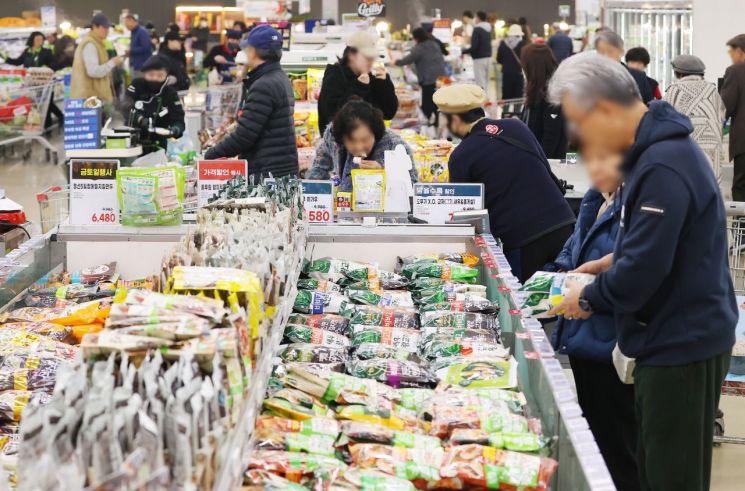
According to the "Regional Economic Trends for Q1 2025" released by Statistics Korea on May 13, nationwide retail sales, which represent goods consumption, remained flat year-on-year in the first quarter. While sales at duty-free shops and supermarkets/general merchandise stores declined, sales at passenger car/fuel retailers and specialty stores increased, resulting in the overall outcome. Nationwide retail sales had posted negative growth for 11 consecutive quarters, from Q2 2022 (-0.2%) to Q4 2024 (-2.0%).
Although this is a rare rebound, Statistics Korea explained that it is difficult to interpret it as a positive economic indicator. A Statistics Korea official stated, "This quarter saw temporary effects from the provision of electric vehicle subsidies and the launch of new smartphone models," adding, "Retail sales in Q1 last year were weak, with most regions experiencing declines, so base effects also played a role."
By region, 12 areas?including Busan (4.7%), South Gyeongsang (4.6%), and Ulsan (3.8%)?saw increases in retail sales due to higher sales at passenger car/fuel retailers, supermarkets/general merchandise stores, and convenience stores. In contrast, five regions?including Jeju (-7.0%), Daejeon (-2.9%), and Seoul (-2.1%)?experienced declines in retail sales due to lower sales at duty-free shops and passenger car/fuel retailers.
Nationwide exports decreased by 2.1% due to declines in exports of other petroleum products, general machinery, and diesel. Jeju (45.3%), North Chungcheong (9.0%), and Daejeon (8.9%) saw increases in exports of other general machinery and memory semiconductors. However, South Jeolla (-19.3%), Daegu (-16.6%), and Sejong (-11.0%) experienced decreases in exports of diesel and other organic and inorganic compounds.
A Statistics Korea official explained, "Although exports declined in the first quarter, this was not due to U.S. tariff policies," citing base effects, a reduction in the number of working days, and a decrease in global demand as reasons. The official added, "Since the relevant (U.S.) tariff policies were announced last month, their impact is expected to appear from the second quarter onward."
Nationwide mining and manufacturing production increased by 2.4% year-on-year. This was influenced by higher production not only of semiconductors and electronic components but also pharmaceuticals. By region, Gangwon (-12.2%), Sejong (-6.6%), and Daegu (-5.2%) saw declines in mining and manufacturing production due to decreases in electricity/gas, food products, and other machinery equipment production. In contrast, Gyeonggi (8.8%), Gwangju (6.0%), and Daejeon (5.7%) posted increases due to higher production of semiconductors/electronic components, electrical equipment, and fabricated metal products.
Nationwide service sector production rose by 0.4% year-on-year, driven by increases in transportation/warehousing and health/welfare services. Daegu (-2.9%), South Gyeongsang (-2.9%), and North Gyeongsang (-2.8%) recorded declines due to decreased production in real estate and other areas, while Sejong (4.0%), Seoul (1.2%), and Incheon (0.8%) saw increases in arts/sports/leisure, real estate, and health/welfare services.
Nationwide construction orders fell by 7.7% due to declines in orders for machinery installation and power generation/transmission. Sejong (361.7%), North Chungcheong (266.1%), and Seoul (86.0%) recorded increases due to higher orders for housing, while Gwangju (-88.9%), South Gyeongsang (-69.3%), and South Jeolla (-63.9%) experienced declines in orders for housing, offices/shops, and power generation/transmission.
The nationwide employment rate rose by 0.2 percentage points to 61.8%, with increases among those in their 30s, 40s, and those aged 60 and older. By region, Gwangju (-1.2 percentage points), Seoul (-1.1 percentage points), and North Jeolla (-0.8 percentage points) saw declines, while South Chungcheong (1.9 percentage points), Gangwon (1.3 percentage points), and North Chungcheong (1.2 percentage points) recorded increases in employment rates.
Nationwide prices rose by 2.1% due to increases in the cost of personal services excluding dining out and dining out itself. Jeju (1.6%), Ulsan (1.9%), and Daejeon (2.0%) saw lower increases than the national average, while Sejong (2.6%), Gangwon (2.3%), and North Jeolla (2.3%) recorded higher increases due to rising costs of personal services excluding dining out.
Looking at net population migration by region, seven areas?including Incheon (11,091 people), Seoul (6,129 people), and Gyeonggi (5,588 people)?saw net inflows. In contrast, 10 regions?including Gwangju (-4,945 people), South Gyeongsang (-4,729 people), and North Gyeongsang (-3,524 people)?experienced net outflows.
© The Asia Business Daily(www.asiae.co.kr). All rights reserved.

















