Lee Jaemyung: "Establishing Regional Doctors and New Medical Schools"
Kim Moonsu: "Rebuilding the Medical System Within Six Months"
Lee Junseok: "Enhancing Expertise by Separating the Ministry of Health"
With the official campaign for the 21st presidential election underway and each candidate unveiling their healthcare policy pledges, there is growing attention on how the candidates plan to resolve the medical-government conflict that has persisted for over a year. Lee Jaemyung, the Democratic Party candidate, has pledged to pursue medical reform through a public deliberation committee involving citizen participation. Meanwhile, Kim Moonsu, the People Power Party candidate, has presented a blueprint to completely re-examine the Yoon Suk-yeol administration's medical reform and to establish a consultative body centered on field experts.
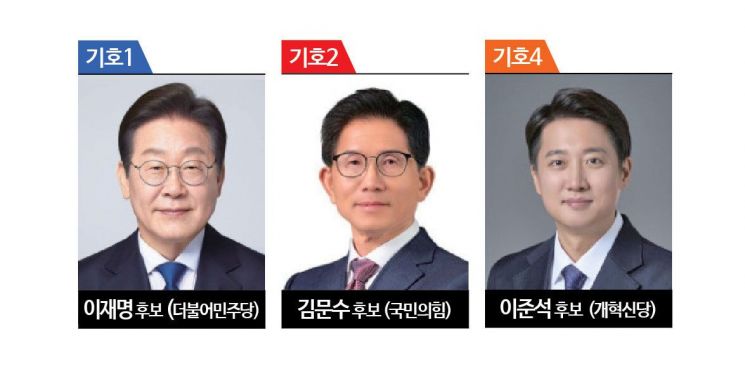
According to political and medical circles on May 13, the presidential candidates have refrained from directly addressing the issue of increasing medical school admissions?a core issue of the current administration’s medical reform. Nevertheless, they have shared a common stance of advancing medical reform through a process of public debate involving citizens, medical students, and field experts.
First, candidate Lee Jaemyung has put forward the slogan of "real medical reform" based on public participation. The core of his plan is to establish regional medical schools and a public medical academy to secure local, essential, and public healthcare personnel.
To this end, he has proposed the establishment of a citizen-participatory medical reform public deliberation committee. This is intended to guarantee public participation in policy decision-making and realize the public nature of healthcare.
Jeong Eun-kyeong, chief campaign manager of the Democratic Party, also stated in a broadcast interview the previous day, "The problem with the Yoon administration was that it tried to resolve medical issues solely by increasing medical school admissions," adding, "We need to consider issues such as hospital beds and the medical delivery system when deciding on the medical school quota."
Candidate Lee Jaemyung has also pledged to establish a sufficient compensation system for essential medical services, strengthen national responsibility for medical accidents, and institutionalize telemedicine?measures that were pursued in the previous administration's medical reform process. He has also emphasized solving the so-called "emergency room merry-go-round" by establishing a rapid transfer, acceptance, and referral system for emergency patients, as well as setting up an emergency medical system centered on treatment rights and a 24-hour specialist response system for severe and emergency cases.
Regarding the financially unstable National Health Insurance, he plans to provide stable government funding and rationally reform the medical service fee compensation system. He also intends to alleviate the burden of rare and intractable diseases and strengthen national responsibility for childhood obesity and pediatric diabetes.
Candidate Kim Moonsu, while avoiding direct mention of increasing medical school admissions, has pledged to completely re-examine the medical reform pursued by the Yoon administration and to rebuild the collapsed medical system within six months.
Unlike Lee Jaemyung, who emphasizes guaranteeing 'public' participation in improving the medical system, Kim Moonsu has promised to establish a presidential Future Medical Committee to guarantee the participation of medical students and to form a consultative body centered on field experts, thus appealing to medical organizations. In a statement released on May 7, he also mentioned, "If necessary, we will reorganize government agencies and hold those responsible accountable to restore trust between the medical community and the public."
Among Kim Moonsu's pledges, notable proposals include expanding health insurance coverage for the freezing and preservation of reproductive cells for infertility, supporting fertility testing and infertility treatment costs, and increasing support for prenatal checkups and childbirth expenses. He also pledged to introduce mandatory public disclosure of postpartum care center evaluations, expand mother and child health-type health centers, increase national support for vaccinations, and strengthen the national responsibility system for dementia care.
Candidate Lee Junseok has pledged, as part of a government reorganization, to separate the Ministry of Health from the Ministry of Health and Welfare to enhance expertise in the healthcare sector. The separation of the Ministry of Health has been a consistent demand of the medical community and was also included in the recent policy proposals submitted by the Korean Medical Association for the presidential election.
© The Asia Business Daily(www.asiae.co.kr). All rights reserved.
!["The Woman Who Threw Herself into the Water Clutching a Stolen Dior Bag"...A Grotesque Success Story That Shakes the Korean Psyche [Slate]](https://cwcontent.asiae.co.kr/asiaresize/183/2026021902243444107_1771435474.jpg)
















