Riyadh Saudi-U.S. Investment Forum
Major Global CEOs Gather, Including BlackRock, Palantir, and Citigroup
Key Issues: Gaza War, Nuclear Conflict
On May 13 (local time), U.S. President Donald Trump will begin a tour of three countries in the Persian Gulf region, starting with Saudi Arabia and continuing to Qatar and the United Arab Emirates (UAE). This move is seen as an effort to strengthen economic and security cooperation with the United States' major allies in the Middle East. As this trip coincides with global issues such as the Israel-Gaza war, escalating tensions with Iran, nuclear policy, and artificial intelligence (AI), it is expected to become a turning point for U.S. Middle East policy.
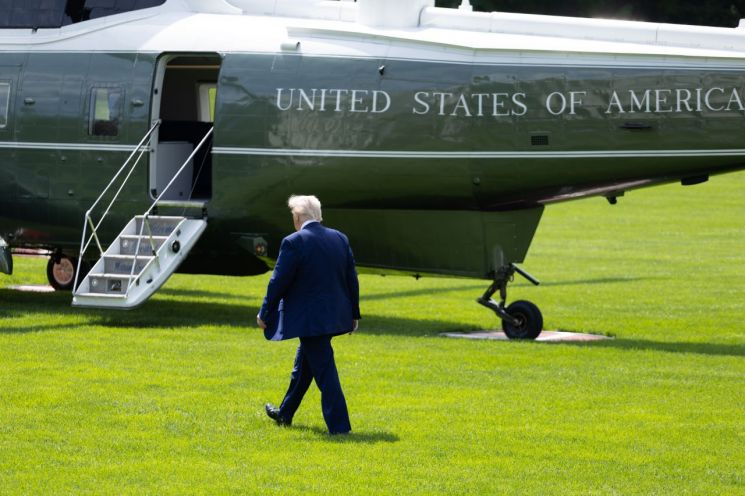
According to Reuters, President Trump will visit Saudi Arabia, Qatar, and the UAE in succession starting today. This is his first official overseas trip since taking office in January. Secretary of Defense Pete Hegseth and Secretary of Commerce Howard Lutnick will accompany him on this Middle East trip. Secretary of State and National Security Advisor Marco Rubio is scheduled to join the delegation locally.
This trip is characterized more as investment diplomacy rather than a simple diplomatic visit. President Trump explained his choice of Saudi Arabia as the first major overseas destination of his term by stating, "As was the case during my first term in 2017, massive investment commitments determined the priorities." In fact, during President Trump's previous term, Saudi Arabia signed investment and arms purchase agreements with the U.S. worth hundreds of billions of dollars. Similar large-scale economic cooperation is expected to be resumed during this visit.
To attract oil money, the heads of major U.S. global corporations are also gathering in Riyadh. The 'Saudi-U.S. Investment Forum' held in Riyadh today will be attended by a large number of global business leaders, including Larry Fink, CEO of BlackRock, Alex Karp, CEO of Palantir, as well as executives from Citigroup, IBM, Qualcomm, Alphabet, and Franklin Templeton. David Sacks, the White House's policy advisor for AI and virtual assets, will also be accompanying the delegation.
Large-scale investment announcements are expected to focus on technology, AI, and energy sectors. Some countries have already unveiled their investment packages. During this trip, Saudi Arabia has pledged to invest $600 billion in the U.S. over four years, the UAE has committed to $1.4 trillion over ten years, and Qatar is also expected to announce investment plans worth hundreds of billions of dollars. The New York Times (NYT) reported that President Trump told his aides, "I want an economic deal worth more than $1 trillion (about 1,400 trillion won)."
Monica Malik, Chief Economist at Abu Dhabi Commercial Bank (ADCB), said in an interview with CNBC, "We expect to see a series of investment announcements between the U.S. and Gulf countries," adding, "There is potential for expansion not only in AI, energy, and aluminum, but also in the semiconductor sector."
Thus, cooperation between the U.S. and the Middle East, previously limited to the energy sector, is now expanding into technology fields. U.S. business media outlet CNBC noted, "This trip is expected to be a litmus test for a 'new partnership' that combines advanced technology, energy, and geopolitics between the U.S. and Gulf countries, going beyond a simple diplomatic event."
To attract oil money, President Trump also issued an executive order easing restrictions on arms exports ahead of his Middle East tour. The Financial Times (FT) reported, "This is a move welcomed by Gulf countries, which are the largest importers of U.S.-made weapons."
Another major issue during this trip is expected to be nuclear cooperation. Saudi Arabia has been demanding U.S. support for the development of its civilian nuclear program, with normalization of diplomatic relations with Israel as a precondition. CNBC reported, "There is speculation that this requirement may be eased as a result of President Trump's visit."
The war between Israel and Hamas is also expected to be a key agenda item. President Trump has declared his commitment to ending the war and is actively engaging in ceasefire negotiations. However, he recently sparked backlash in the Arab world by referring to Gaza as "important real estate" and suggesting that the U.S. could directly control it.
The conflict in Gaza appears to be intensifying. The U.S. recently proposed a 21-day cessation of hostilities and the release of some hostages, but Israel is instead expanding its military operations into the southern Rafah region of Gaza. The major diplomatic achievement President Trump hopes for?normalization of diplomatic relations between Saudi Arabia and Israel?seems unlikely to be realized. Middle East expert Ali Shihabi commented, "Saudi Arabia wants to focus on economic cooperation between the two countries during this visit," and assessed, "There is currently no progress in normalization with Israel."
The FT reported, "Experts predict that while the Gaza situation cannot be completely ignored, the main focus of this trip will be on economic cooperation," and interpreted, "President Trump appears to be aiming to once again showcase 'transactional diplomacy,' centered on arms exports and large-scale investment commitments."
© The Asia Business Daily(www.asiae.co.kr). All rights reserved.

















