Although the government designated May 15 last year as the national commemorative day "Sejong the Great's Birth Day," public awareness of this day remains low.
The Ministry of Culture, Sports and Tourism, together with the National Institute of Korean Language, conducted an online survey from April 29 to May 5 to celebrate the first "Sejong the Great's Birth Day" since its designation as a national commemorative day last year. The survey gathered public opinions on King Sejong's birthday and his achievements, and the results were announced on May 13.
According to the survey, 76.3% of respondents said they did not know when Sejong the Great's Birth Day is or what its relationship is with Teachers' Day. The percentage of people who said they knew about Sejong the Great's Birth Day was highest among those in their 60s at 31.5%, and lowest among teenagers at 16.7%. The majority responded that they only recognized May 15 as Teachers' Day.
According to records from the National Archives and other sources, Teachers' Day originated in 1958 at a girls' high school in Chungnam Province, where students cared for their ailing teachers as a volunteer activity. In 1964, May 26 was commemorated as "Eunsa's Day," and from 1965, teachers' organizations led the movement to honor true teachers by designating May 15, Sejong the Great's Birth Day, as Teachers' Day. Last year, the government added further significance to May 15, previously only regarded as Teachers' Day, by designating it as the national commemorative day "Sejong the Great's Birth Day" to honor King Sejong's achievements.
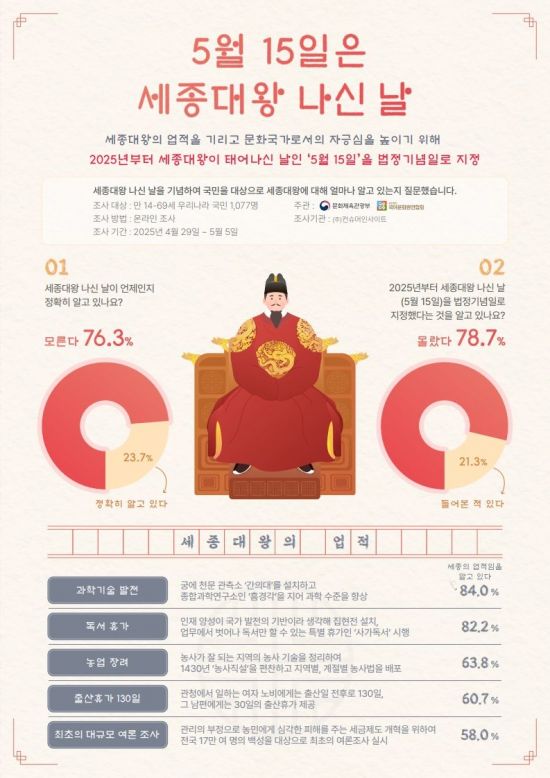
The survey also examined public awareness of King Sejong's achievements, including agricultural promotion, maternity leave, talent cultivation, the first public opinion survey, and advancements in science.
In 1426, King Sejong extended maternity leave for female slaves working in government offices from 7 days to 100 days. In 1430, he added 30 more days for the month of childbirth, totaling 130 days of maternity leave. In 1434, he even granted 30 days of leave to the husbands of women who gave birth, focusing on welfare policies for the people. When asked about awareness of these maternity leave policies, 60.7% of respondents correctly identified them as King Sejong's achievements, while 39.3% mistakenly attributed them to other kings such as King Jeongjo or King Yeongjo.
Additionally, from March 5 to August 10, 1430, King Sejong conducted the first-ever public opinion survey, asking approximately 170,000 people nationwide for their views on the rice paddy and field taxation system. The survey results showed 98,657 in favor and 74,148 opposed. Regarding awareness of this achievement, 58% said they knew about it, while 42% said they did not. By age group, those in their 50s and 60s had an average awareness rate of 66.2%, while only 36.3% of teenagers recognized it as one of King Sejong's achievements.
Furthermore, regarding King Sejong's achievements: 63.8% of respondents were aware of his agricultural promotion policies, such as compiling the "Nongsajikseol" and systematically informing the public about regional farming techniques and seasonal crop cultivation methods. For talent cultivation policies, such as establishing the Jiphyeonjeon and granting "Saga Dokseo," a special leave for capable scholars to devote themselves solely to reading, 82.2% were aware. For policies that advanced scientific standards, such as installing the astronomical observatory Ganui-dae, the comprehensive scientific research center Heumgyeonggak, and creating the calendar "Chiljeongsan" to calculate celestial movements, 84.0% were aware.
The Ministry of Culture, Sports and Tourism stated that the survey was conducted with a sample of 1,077 participants, distributed by gender, age, and region in proportion to demographic statistics.
Minister Yoo In-chon said, "It is truly admirable that King Sejong granted 130 days of maternity leave to female government slaves and conducted a large-scale public opinion survey on land taxation systems, all out of love for his people. I hope that, as a result of this survey, King Sejong's achievements will become more widely known, and that May 15, 'Sejong the Great's Birth Day,' will become a day for the entire nation to celebrate and honor together."
© The Asia Business Daily(www.asiae.co.kr). All rights reserved.

















