'3RINCs 2025' International Academic Conference
500 Experts from 20 Countries Attend
First Participation by the Domestic Cement Industry
The domestic cement industry has argued that combustible waste should be used as an alternative raw material to bituminous coal in order to achieve the globally critical goal of carbon reduction. In particular, the industry emphasized that government policies such as increasing landfill taxes on municipal waste and prohibiting the direct incineration of household waste are necessary to ensure stable sourcing of alternative materials.
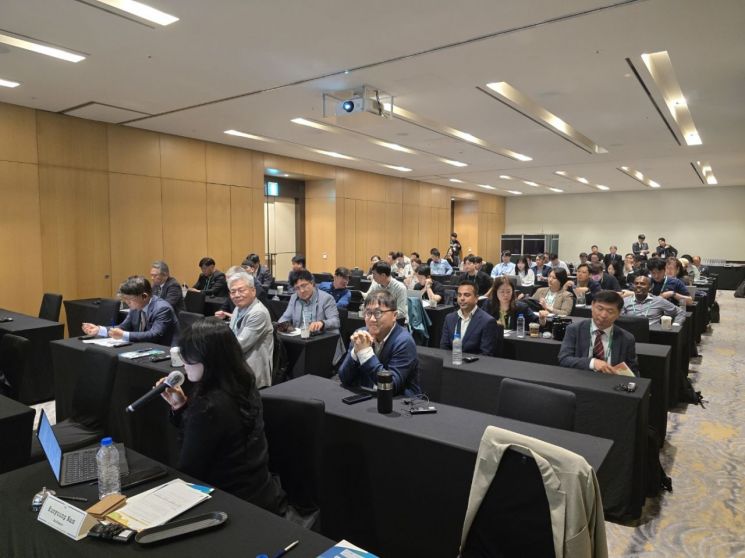 On the 12th, the '3RINCs 2025' international conference is being held at Jeju Shinhwa World. Provided by Korea Cement Association
Carbon reduction cannot be delayed... Cement industry participates for the first time
The Korea Cement Association attended the '3RINCs 2025' international academic conference held on May 12 at Jeju Shinhwa World. 3RINCs is an international conference jointly organized by the Korea Society of Waste Management, the Japan Society of Material Cycles and Waste Management (JSMCWM), and the Solid Waste Association of Thailand (SWAT), where experts from various countries discuss directions for promoting waste resource circulation to reduce greenhouse gases. This year’s conference, held for the first time in a decade since 2015, was attended by more than 500 experts in the field of waste resource circulation from 20 countries including Korea, China, Japan, and Australia, as well as representatives from the domestic cement industry.
Of particular note, this year marked the first time the domestic cement industry participated in the conference, drawing significant attention. This is due to the increasing importance of carbon reduction in the domestic cement sector as global environmental regulations tighten. At the cement session, eight panelists?including Kim Jinhyo, attorney at Bae, Kim & Lee LLC; Camilla, Ph.D. at Royal Melbourne Institute of Technology (RMIT); Hong Suyeol, Director of the Resource Circulation Social Economy Research Institute; and Bae Jaekeun, professor at Seoul National University of Science and Technology?presented on the status of carbon neutrality in the Korean cement industry and strategies for using alternative raw materials.
Kim Seokwan, president of the Korea Society of Waste Management, stated, "The domestic cement industry has participated in the stable use of waste as fuel in the cement manufacturing process, drawing on decades of experience in maintaining high-quality cement." He added, "In particular, the effectiveness of alternative fuels has been greatly improved by applying technologies such as oxy-fuel combustion in cement kilns." He continued, "Through this conference, I expect that the domestic cement industry, which has sufficient capabilities, will meet high expectations as an important player in the field of resource circulation and reaffirm its responsibility as a key industry."
"Ban direct landfill of combustible waste and increase landfill taxes"
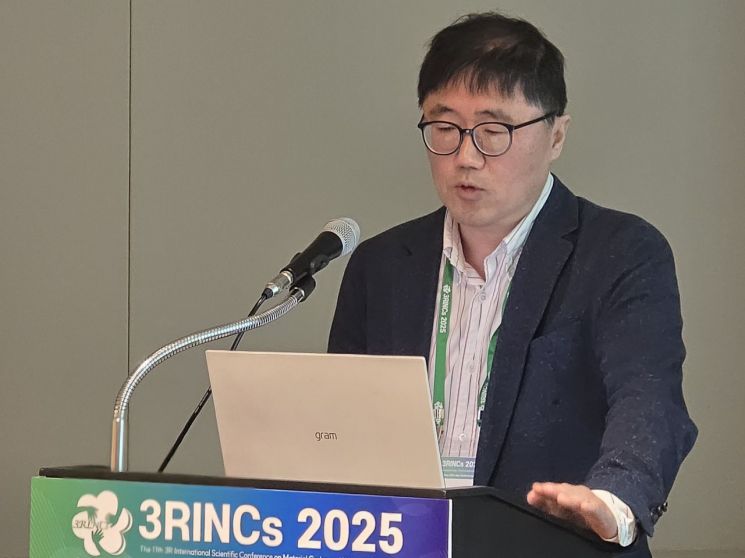 Hong Suyeol, Director of the Resource Circulation Social Economy Research Institute, is presenting at the '3RINCs 2025' International Academic Conference held on the 12th. Provided by Korea Cement Association
The main topic of the conference was the stable sourcing of combustible waste as an alternative raw material. Hong Suyeol emphasized that the role of domestic cement production facilities must be expanded to handle the rapidly increasing volume of combustible waste each year. According to research presented by Hong, the volume of combustible waste generated in 2022 was approximately 41 million tons, of which 3.2 million tons were landfilled. With the ban on landfilling combustible waste in the Seoul metropolitan area starting next year, it is expected that more than 3 million tons of additional waste will enter the market. Hong argued that the role of the domestic cement industry is essential to process this waste in a stable manner.
Hong further noted, "Plans to expand public incineration facilities by local governments are being delayed due to opposition from local residents, and the actual operation of these facilities is also uncertain." He added, "Although private incineration plants are being proposed as an alternative, they cannot process landfilled municipal waste, so it is difficult to find a solution without involving the cement industry."
There was also a suggestion that economic measures, such as raising the landfill tax on municipal waste to European levels, should be implemented. Hong stated, "Korea's landfill tax for municipal waste is only 15,000 won per ton, which is extremely low compared to other countries." He continued, "The next administration must push for an increase in the landfill tax on municipal waste, and at the same time, measures such as banning the direct incineration of household waste should also be pursued."
However, there is strong opposition from the incineration industry regarding the recycling of combustible waste by the cement sector, and difficulties are expected. Hong commented, "From a third-party perspective, the opposition from the incineration industry only increases public anxiety about burning waste for energy and does not provide any other social benefit." He concluded, "The industry should work together to conduct campaigns to alleviate public concerns."
© The Asia Business Daily(www.asiae.co.kr). All rights reserved.


















