British Marine Engineering Startup "Deep"
Secretly Designing and Developing Underwater Habitation Spaces
A Single Billionaire Pledges 180 Billion Won Investment
"As Important as Space"... Korea Also Developing Undersea Base
"Initially, we will create a habitable space at a depth of 80 meters, and ultimately at 200 meters below the sea."
Deep, a startup founded in 2023 in the small British city of Bristol, has announced its goal to begin full-scale underwater city development by proving its "underwater habitation" technology operating at a depth of 80 meters by 2027. To design underwater living spaces, Deep has established centers in various locations, including the UK and the US, where it can conduct testing and research and development (R&D), and has hired 190 employees.
The goal: Habitable space at a depth of 200 meters
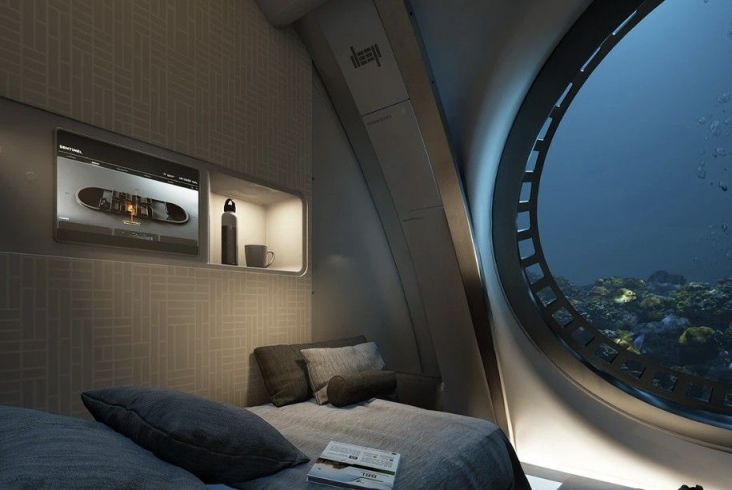 Expected image of the Deep's 200m deep-sea habitation module. Screenshot from Deep's official website.
Although Deep has recently begun to reveal its true nature by sharing research results in international academic journals, much about its corporate operations remains shrouded in secrecy. The company's Chief Operating Officer (COO) and official spokesperson is an engineer named Mike Shackelford. However, all costs for Deep's expert staff, advanced equipment, and testing centers are covered by a single anonymous billionaire investor. This billionaire, who is passionate about underwater exploration and development, has pledged to invest 100 million pounds (approximately 186 billion won) in Deep, but has never revealed their identity in public.
Testing at 80 meters by 2027... Massive robotic facilities completed
According to the Guardian and other sources, Deep is currently considered to possess the world's most advanced facilities in the field of underwater environment design. The company has converted a flooded quarry into an 80-meter-deep underwater environment testing facility, where it plans to install humanity's first-ever "underwater habitation" by 2027. If the test is successful, modular homes will be built on the 200-meter-deep seabed. Each module can accommodate six adults and can be connected by pipes to create a large living zone.
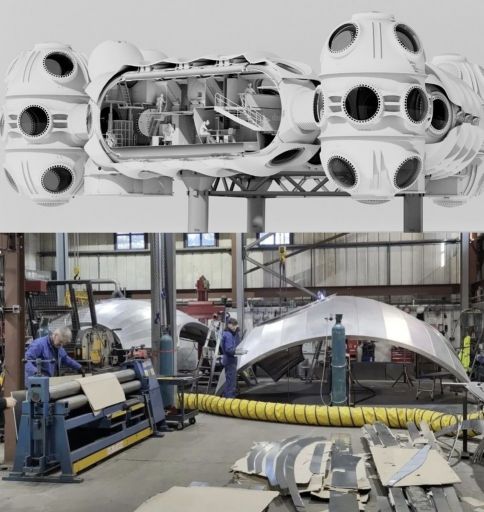
Typically, the 200-meter depth is an environment accessible only to military submarines. This is due to the immense water pressure and low temperatures that threaten both the inside and outside of any structure. For this reason, submarines use thick special alloys for their hulls to withstand high pressure and protect the interior. Deep's modular habitation units are also manufactured with special alloy hulls, using the WAAM (Wire Arc Additive Manufacturing) method, which involves weaving metal with a 3D printer and instantly welding it with a hot gas torch. Deep's manufacturing center has 20 robotic production lines, each 6.1 meters in diameter and 3.2 meters high, capable of automating this process. According to Deep, this WAAM facility is the largest of its kind in the world.

To continuously withstand the water pressure and low temperatures at 200 meters and provide a stable environment for humans, the module's hydraulic, electrical control, and monitoring systems must be designed and manufactured with absolute precision. For this reason, the test module scheduled for completion in 2027 will check all risks and variables during a 28-day operational period. Deep's goal is to create a semi-permanent habitation base that can operate indefinitely through ongoing maintenance.
Underwater exploration as difficult as space... Korea is also taking on the challenge
After the French underwater explorer Jacques-Yves Cousteau conducted the world's first underwater house experiment at a depth of 120 meters in the 1960s, there was a global boom in deep-sea exploration and underwater habitation development, but interest quickly faded. In an interview with the Guardian in February, COO Shackelford explained, "In the 1960s, there was a passion to make underwater living a reality, but by the 1980s, that passion had shifted to space development."
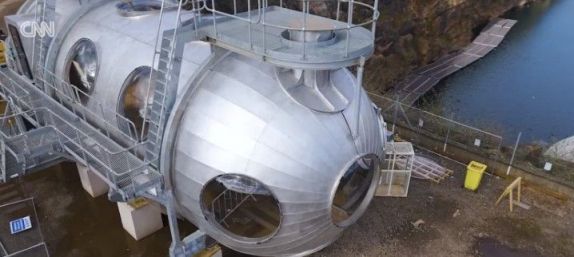 Prototype module of Deep, preparing for underwater environment testing at 80m depth in 2027. CNN YouTube capture
COO Shackelford said, "Breaking through the atmosphere and going into space is difficult, but once you are up there, it is a relatively mild environment. In contrast, while it is easy to sink to the bottom of the ocean, everything in the underwater environment is trying to destroy terrestrial life," describing the challenges of underwater exploration.
The 2023 accident involving the submersible of US private underwater exploration company OceanGate Expeditions, which exploded while searching for the wreck of the Titanic, starkly illustrates these dangers. This is why every single product and even the smallest component used in Deep's modular facilities and submersibles undergoes internationally certified safety evaluations. The personnel who will reside in the test facility for 28 days are also required to complete military-grade training lasting at least one year and up to 18 months.
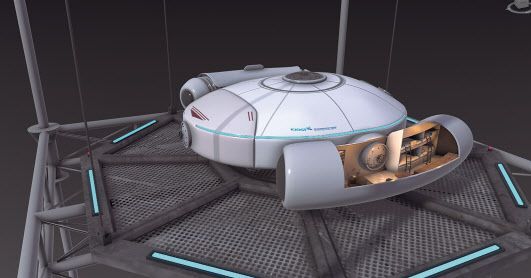 Korea Ocean Science and Technology Institute's Korean-style underwater platform. Korea Ocean Science and Technology Institute
Meanwhile, Korea is also pursuing the construction of an underwater base off the coast of Ulsan, led by the Korea Ocean Science and Technology Institute (KIOST). This project, involving 23 organizations including Hyundai Engineering & Construction, Lotte Engineering & Construction, OceanSpace, and the Korea Aerospace Research Institute, aims for completion in 2027. The base is designed to allow three researchers to stay for up to 28 days in a 30-meter-deep underwater environment.
© The Asia Business Daily(www.asiae.co.kr). All rights reserved.
![Clutching a Stolen Dior Bag, Saying "I Hate Being Poor but Real"... The Grotesque Con of a "Human Knockoff" [Slate]](https://cwcontent.asiae.co.kr/asiaresize/183/2026021902243444107_1771435474.jpg)


















