Introduction of Three Deputy Prime Ministers for Security, Strategy, and Social Affairs
Junseok Lee, the presidential candidate of the Reformist Party, announced on May 12 his first major campaign pledge, stating, "I will reorganize and reduce the current 19 government ministries to 13."
Through an explanatory material outlining his top 10 campaign pledges released the same day, Lee explained, "To create a government that reduces presidential power and works efficiently, I will minimize overlapping responsibilities and administrative silos among ministries, thereby operating an efficient and specialized government." The core of his plan is to establish a policy of a small, task-oriented government, and to foster a culture that prioritizes actual performance and expertise over ministry names, with the government taking the lead in this change.
Specifically, he proposed introducing a three-deputy prime minister system, covering security, strategy, and social affairs. He plans to merge the Ministry of Education and the Ministry of Science and ICT into a single Ministry of Education and Science. The Ministry of Unification would be abolished, and its functions would be integrated into the Ministry of Foreign Affairs, creating a new Ministry of Foreign Affairs and Unification. The Ministry of Gender Equality and Family would also be abolished, with its responsibilities transferred to the Ministry of Health and Welfare and the Ministry of the Interior and Safety.
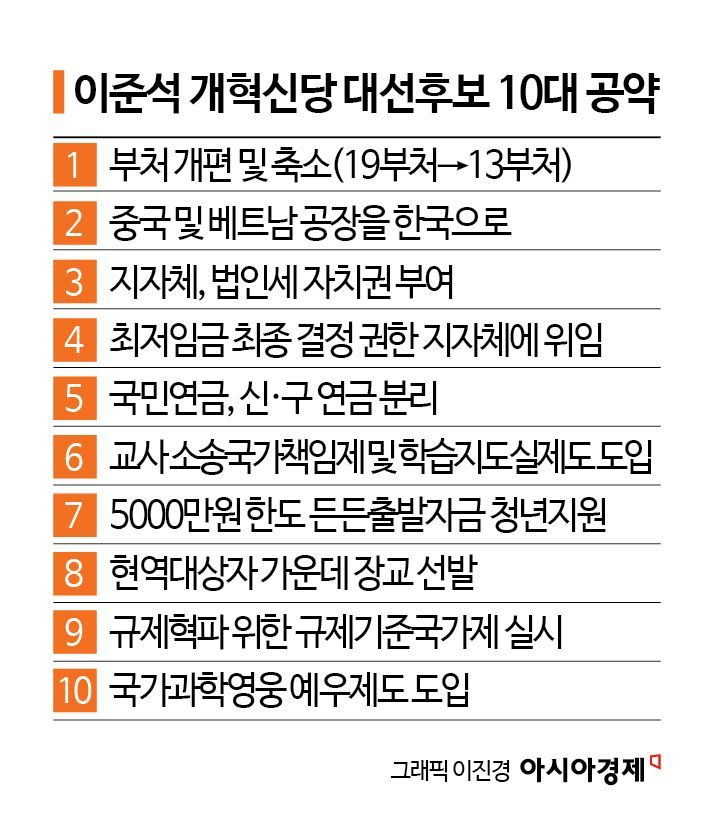
He also presented an industrial policy pledge to revitalize local economies and address the rust belt issue by promoting reshoring?encouraging domestic companies that have moved overseas to return to key domestic industrial complexes.
He announced plans to expand local governments' authority over corporate taxation, allowing them to autonomously set and manage local corporate income tax rates to attract businesses to their regions. In the labor sector, he pledged to allow local governments to adjust the minimum wage?within a 30% range?based on the base minimum wage set by the central government's Minimum Wage Committee.
As a social welfare pledge, Lee proposed a structural reform of the National Pension System by separating the finances of the new and old pension schemes and introducing a defined contribution system for the new pension, thereby establishing a pension system where "you receive at least as much as you contribute."
For education policy, he pledged to introduce a national responsibility system for teachers' lawsuits, in which the Office of Education would directly represent teachers in civil and criminal cases related to their duties, and to assign dedicated lawyers for this purpose. He also announced plans to deploy student life support officers in classrooms to immediately respond to disruptions and problematic behavior, linking guidance and counseling for students exhibiting such behaviors.
For young people, he introduced a financial support pledge. Individuals aged 19 to 34 would be eligible for a loan product offering up to 5 million won per quarter, with a total limit of 50 million won, at a fixed annual interest rate of 1.7%, with no restrictions on usage. In the defense sector, he pledged to provide all conscripts with four weeks of integrated basic military training, after which outstanding trainees would be selected as officer and noncommissioned officer candidates based on training performance, physical fitness, character, and interview evaluations.
To boost industry, he pledged to introduce a regulatory benchmark country system, a special permit system that applies the regulatory standards of advanced countries domestically to eliminate unnecessary regulations and enhance competitiveness. He also promised to establish a Regulatory Tribunal under the Prime Minister to centralize regulatory responses.
As a measure to foster scientific and technological talent, he proposed a pension system for outstanding researchers. He also revealed a plan to grant scientists and engineers who meet certain criteria fast-track immigration clearance benefits at the level of diplomats as a form of recognition.
© The Asia Business Daily(www.asiae.co.kr). All rights reserved.


















