Shifted to Conservatism After the Collapse of Communism
Spent Over a Decade as a Political Outsider
Rose to Ministerial Position After the Launch of the Yoon Administration
Stood Out During the December 3 Martial Law Situation
Kim Moonsoo, the presidential candidate for the People Power Party, has drawn a political trajectory that crosses both the left and right, from being a first-generation labor activist to becoming a leading figure in the conservative camp. Although he experienced nearly a decade of political stagnation, he emerged as the final presidential candidate by raising his profile during the impeachment crisis of former President Yoon Sukyeol.
Kim is a former labor activist who served as a union leader after working for more than seven years at clothing factories around Cheonggyecheon in Seoul. Due to his involvement in pro-democracy and labor movements, he was expelled twice from Seoul National University and even served time in prison. In the 1990s, the collapse of communist states prompted him to shift to a conservative stance. In 1994, at the recommendation of then-President Kim Youngsam, he joined the Democratic Liberal Party, the predecessor of the People Power Party, thus transforming into a politician. He was subsequently elected three consecutive times in Sosa, Bucheon, Gyeonggi Province, and gained administrative experience as a two-term governor of Gyeonggi Province.
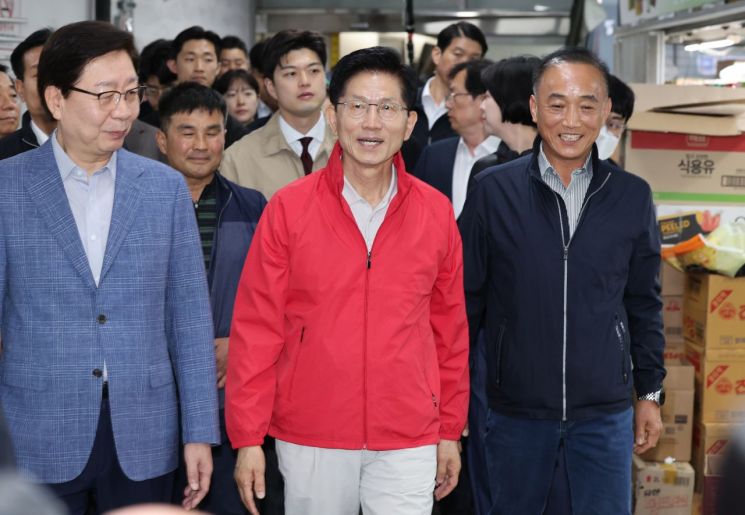
His political journey has not always been smooth. In the 2016 general election, he ran in Suseong-gap, Daegu, but lost, and he was also defeated in the 2018 Seoul mayoral election. The following year, he co-founded the Christian Liberty Unification Party with Pastor Jeon Kwanghoon of Sarang Jeil Church, becoming known as an 'asphalt conservative' figure.
Kim's political standing changed after the launch of the Yoon Sukyeol administration. Ending more than a decade as a political outsider, he successively took on the roles of chairperson of the Economic, Social and Labor Council?a minister-level position?and Minister of Employment and Labor.
During the 12·3 martial law situation, he stood out as a representative conservative politician. After martial law was lifted, during an urgent parliamentary inquiry, he earned the nickname 'Stubborn Moonsoo' by being the only one to refuse a group apology demanded by Seo Youngkyo, a Democratic Party lawmaker, from the cabinet ministers.
Having barely made it to the starting line of the presidential race, Kim is expected to stake his campaign on an anti-Lee Jaemyung front. His strategy is to reach out to figures such as former Prime Minister Han Ducksoo and Lee Junseok, the presidential candidate of the Reform New Party, in an attempt to form a big-tent coalition once again.
In terms of policy, he has put forward pro-business and youth-oriented pledges as his main weapons. His first pledge is to make Korea 'a country where it is easy to do business.' With the policy philosophy of 'not giving cash, but enabling people to earn,' he has sought to differentiate himself from his opponent. Specific pledges include: ▲ lowering the maximum corporate tax rate from 24% to 21% ▲ reducing the maximum inheritance tax rate from 50% to 30% ▲ increasing flexibility in working hours ▲ and allowing companies to set their own retirement age policies.
© The Asia Business Daily(www.asiae.co.kr). All rights reserved.
![Clutching a Stolen Dior Bag, Saying "I Hate Being Poor but Real"... The Grotesque Con of a "Human Knockoff" [Slate]](https://cwcontent.asiae.co.kr/asiaresize/183/2026021902243444107_1771435474.jpg)
















