Ban on Direct Landfilling of Municipal Solid Waste in the Seoul Metropolitan Area
Originally Scheduled for Next Year, Now Delayed by at Least Two Years Due to Shortage of Incineration Facilities
Local Governments Say, "A Five-Year Grace Period Is Needed"
The government is expected to set a grace period of at least two years for the ban on direct landfilling of municipal solid waste. As originally planned, starting next year, it will be prohibited to bury waste contained in standard volume-based garbage bags in the Seoul metropolitan area. However, the government has determined that a grace period until the end of 2027 is necessary to prevent confusion caused by a shortage of incineration facilities.
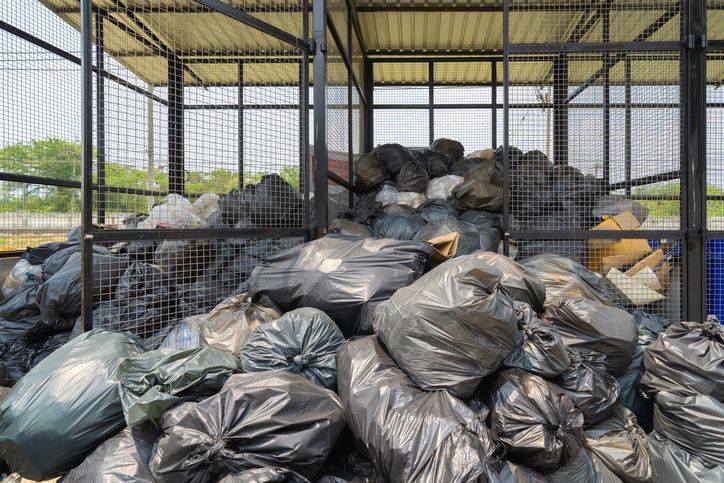
According to an Asia Economy report compiled on May 12, the Ministry of Environment is strongly considering postponing the ban on direct landfilling of municipal solid waste in the Seoul metropolitan area?which was scheduled to take effect next year?by at least two years. The ban on direct landfilling of municipal solid waste refers to a policy that prohibits burying household waste in standard volume-based garbage bags without first sorting or incinerating it. Once the measure is implemented, only incineration ash will be allowed to be buried after burning the waste at incineration plants. The policy will first be enforced in the Seoul metropolitan area in 2026 and then expanded nationwide in 2030.
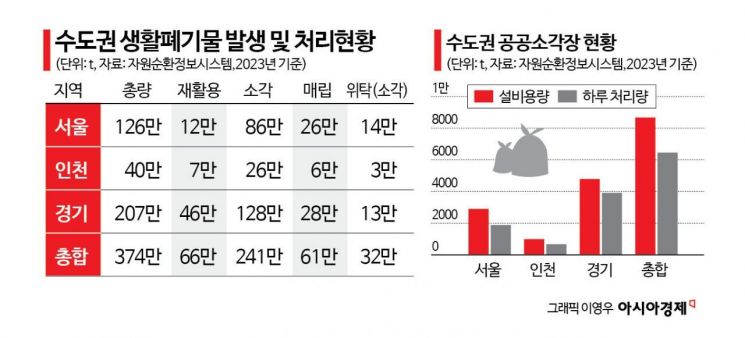
The problem lies in the sheer volume of waste generated in the Seoul metropolitan area. According to the Ministry of Environment's Resource Circulation Information System, in 2023, an average of 10,257 tons of waste per day was disposed of in the Seoul metropolitan area using standard volume-based garbage bags. Of this, only 1,817 tons were recycled, while the rest was either incinerated (5,745 tons) or landfilled (1,692 tons). The remaining waste that could not be processed was handled by outsourcing to private companies (881 tons). For the direct landfilling ban to be successfully implemented, public incineration plants must be able to process the 2,573 tons of waste that are currently either buried or sent out of the area.
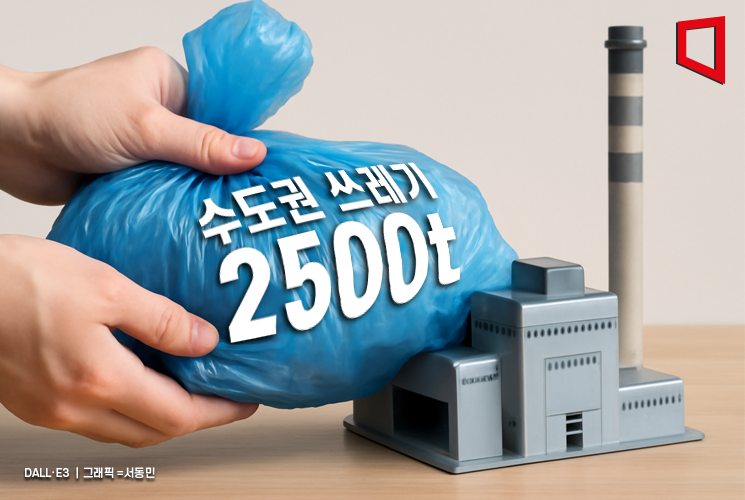
However, the capacity of public incineration plants in the Seoul metropolitan area is severely lacking. The facility capacity of public incineration plants capable of burning municipal solid waste in the region is about 8,667 tons. However, considering the aging of facilities and calorific value conditions, the actual daily processing capacity of public incineration plants decreases. In fact, in 2023, the daily processing volume of public incineration plants was only 6,458 tons. It will be difficult to handle the additional 2,500 tons of waste that will result from the implementation of the direct landfilling ban.
Local governments in the Seoul metropolitan area: "A two-year grace period is not enough... Postpone for five years"
Waste that cannot be processed must be sent to private incineration plants, but this is also not a simple solution. The processing cost at public incineration plants is set at around 70,000 to 140,000 won per ton. In contrast, the processing cost at private incineration plants can reach up to 300,000 won per ton. The farther the incineration plant, the higher the additional labor and transportation costs. There are also concerns that if waste is concentrated in private incineration plants, operators may raise their prices by up to three times. These costs will ultimately be borne by residents of the Seoul metropolitan area.
The Ministry of Environment also believes that a grace period is unavoidable. Forcing implementation could result in a waste crisis similar to those in the past. Previously, when the use of landfill sites in the Seoul metropolitan area was nearing its end and China tightened its waste import regulations, domestic recycling companies accumulated waste stockpiles. To prevent administrative confusion surrounding waste management, the Ministry of Environment plans to postpone implementation until the end of 2027, when a significant number of incineration plants in the Seoul metropolitan area are expected to be completed.
Local governments in the Seoul metropolitan area insist that, at a minimum, implementation should be delayed by five years, as is the case in other regions, or at least until all incineration plants are completed. An official in charge of waste management in the Seoul metropolitan area stated, "It is a form of reverse discrimination to implement the policy earlier than in other regions simply because more people live here," emphasizing that "a two-year grace period is not enough to prevent confusion." Another local official said, "Even if the construction of incineration plants proceeds without any issues, they will only be completed by the end of 2027," adding, "It is uncertain whether a two-year grace period will be sufficient."
However, the Ministry of Environment maintains that it is impossible to implement the policy on the same timeline as other regions, despite such requests from local governments. A Ministry of Environment official explained, "Seoul, Gyeonggi, and Incheon have received more central government support because the direct landfilling ban was scheduled to be implemented earlier," adding, "It is difficult to now implement it at the same time as other regions." Another official from the Ministry of Environment said, "If the policy is postponed by as much as five years, there may be criticism that the government lacks commitment to advancing waste management policies," and hinted, "Such a lengthy grace period will not be granted."
The Ministry of Environment is also considering introducing a type of penalty system along with the grace period. If incineration capacity is not secured during the grace period, a surcharge will be imposed to encourage the rapid construction of incineration plants.
© The Asia Business Daily(www.asiae.co.kr). All rights reserved.



















