Oh Sehoon Reviews Comprehensive Flood and Storm Safety Measures
Focused Management of Low-Lying Areas Including Underpasses and Walking Paths
Additional "Rainwater Bowls" to Prevent Water Accumulation in Streams
Cooperative Response with City-Metropolitan Meteorological Administration Hotline
The Seoul Metropolitan Government will introduce the nation's first "semi-basement flood warning system" in areas densely populated with semi-basement homes. This system uses radar sensors equipped with water level monitoring devices to detect real-time water levels and issue alerts. The aim is to proactively prevent recurring flood damage in low-lying areas each year.
On May 12, Oh Sehoon, the mayor of Seoul, announced the "2025 Flood and Storm Safety Measures," which focus on these climate disaster response strategies, at Seoul City Hall. He stated that the measures will be fully implemented starting May 15.
This year, the city will focus on managing low-lying areas such as semi-basement homes at risk of flooding, underpasses, and riverside walking paths. The city will collect real-time water level data for "flood-prone low-lying areas" using rain gauges and road water level meters installed throughout Seoul. Based on this data, the city will issue flood risk alerts and warnings. When an alert or warning is issued, each district office will send disaster text messages to residents regarding the flood warning.
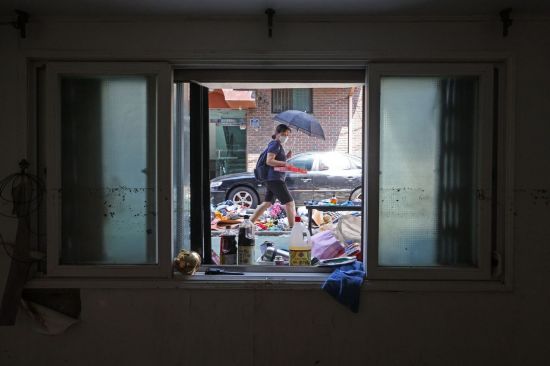
In particular, the city will pilot the nation's first "semi-basement flood warning system" in 15 alleyways in districts with high concentrations of semi-basement homes, such as Gwanak-gu, Dongjak-gu, and Yeongdeungpo-gu. Existing observation equipment, such as road water level meters, required large installation spaces and were mainly limited to main roads. However, the new radar sensor technology can be installed in narrow spaces, such as on streetlights and utility poles, making it possible to precisely monitor water level changes in areas densely populated with semi-basement homes.
The city has also established a system in which a designated "accompanying partner" visits each semi-basement household with persons with disabilities, elderly residents, or children when a flood warning is issued. The partner checks for risk factors and assists with evacuation. Seoul first introduced the accompanying partner system in 2023, and this year, a total of 2,887 partners have been matched with 1,130 households considered vulnerable to disasters.
The 98 "underground underpasses" at risk of flooding have been designated as priority management sites and will be immediately closed if water levels exceed 10 centimeters. Riverside walking paths, which can quickly flood and pose isolation risks during rainfall, will also have entry and exit barriers and automatic alert systems activated at the preliminary warning stage.
The 492 "landslide-prone areas" will have landslide alerts and warnings issued based on forecast information provided by the Korea Forest Service (2 to 48 hours in advance) following situation assessment meetings. The city will also operate a pre-evacuation system for residents in vulnerable areas. A total of 92 members of the on-site landslide prevention team, along with approximately 400 support personnel including care officials and on-site managers (such as neighborhood heads), will be mobilized.
The city will secure a total of 12 "rainwater bowls" to prevent rainwater from concentrating in urban streams. Priority will be given to parks located in the mid- and upper-stream areas of local rivers, and the city estimates that up to 757,000 tons of rainwater can be stored through this initiative. In addition, the city will conduct joint disaster safety response drills with relevant agencies to test disaster response capabilities for various damage scenarios. A dedicated "hotline" for real-time one-on-one communication with the Metropolitan Meteorological Administration has also been established.
Meanwhile, Seoul continues to expand large-scale disaster prevention facilities in major flood-prone areas. Within this year, construction will begin on "deep rainwater drainage tunnels" in the Gangnam Station, Dorimcheon, and Gwanghwamun areas to store and drain rainwater during heavy downpours. The city also plans to build or expand nine rainwater pumping stations and three rainwater storage tanks in phases by 2030.
© The Asia Business Daily(www.asiae.co.kr). All rights reserved.
![Clutching a Stolen Dior Bag, Saying "I Hate Being Poor but Real"... The Grotesque Con of a "Human Knockoff" [Slate]](https://cwcontent.asiae.co.kr/asiaresize/183/2026021902243444107_1771435474.jpg)
















