Besant: "Significant Progress... Details to Be Announced on the 12th"
He Lifeng Also Says Talks Were "Constructive"... Joint Statement Expected
US and China: Focus on Scale of Triple-Digit Tariff Reductions
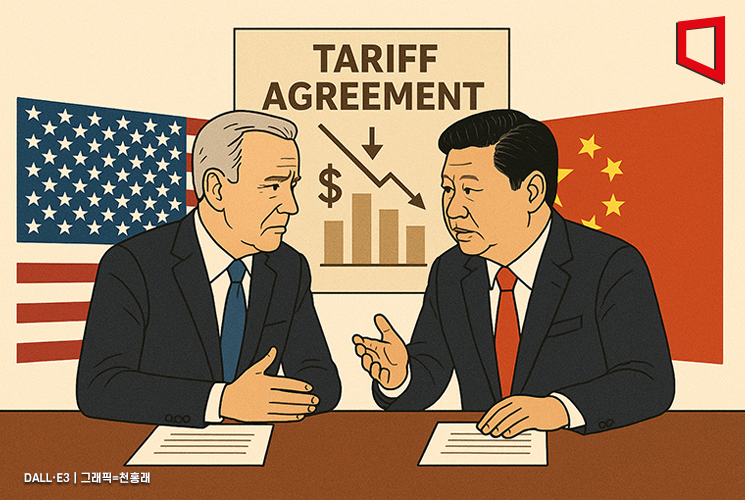
The United States and China announced on May 11 (local time) that they had made "significant progress" after their first official bilateral trade negotiations, which took place over two days in Geneva, Switzerland. Both sides agreed to establish a new framework for further negotiations. Contrary to expectations that the talks might amount to little more than a preliminary exchange, both the U.S. and China stated that substantial progress had been made. This raises attention as to whether the two countries have reached concrete agreements on key issues such as reducing the triple-digit tariff rates?which have effectively severed trade?and cracking down on fentanyl.
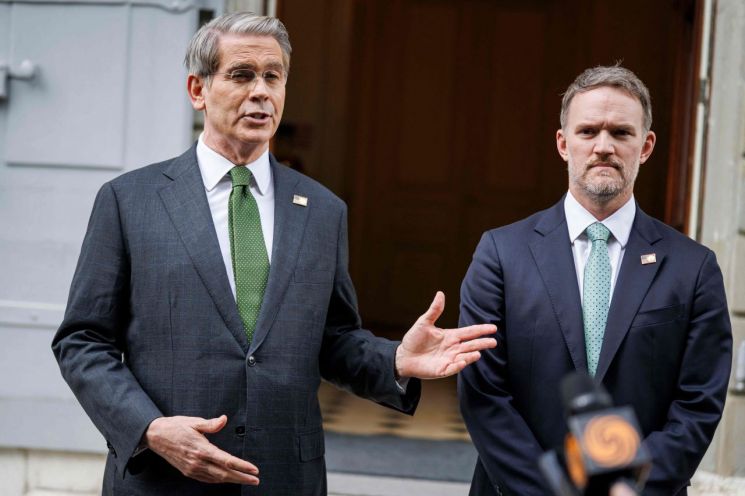
U.S. Treasury Secretary Scott Besant met with reporters in Geneva, Switzerland, after concluding trade talks with China, stating, "I can say the talks were productive," and added, "We will announce the details tomorrow (the 12th)." Jamison Greer, the U.S. Trade Representative (USTR) who also participated in the negotiations, said, "It is important to understand how quickly we can reach an agreement," and explained, "The differences may not have been as large as expected. There was a lot of groundwork."
He Lifeng, China's Vice Premier in charge of economic affairs, also spoke with reporters, describing the talks as "constructive" and stating that "significant progress was made." He characterized the meeting as "an important first step" toward resolving differences.
The U.S. and China refrained from disclosing details of the agreements reached and instead decided to issue a joint statement on the 12th. Vice Premier He explained that the two countries had created a new consultative framework to continue negotiations in the future.
This meeting marked the first official negotiations between the U.S. and China since both countries imposed tariffs of 145% and 125%, respectively, on each other's goods following the inauguration of President Donald Trump, effectively engaging in a tariff war that amounted to a near-severance of trade. Amid growing concerns in the U.S. that the heavy tariffs on Chinese goods could trigger supply chain shocks, inflation, and economic slowdown similar to those experienced during the COVID-19 pandemic, President Donald Trump has repeatedly emphasized his willingness to engage in dialogue with China. On the U.S. side, Secretary Besant and Representative Greer participated in the talks, while on the Chinese side, Vice Premier He and Li Chenggang, Vice Minister of Commerce and Chief International Trade Negotiator, took part. The two sides held an eight-hour marathon negotiation on the 10th, followed by another three and a half hours of talks on the 11th.
With expectations that the U.S. and China may have reached a consensus on reducing the triple-digit tariffs, attention is now focused on how much the tariff rates will be lowered immediately. President Trump raised the cumulative tariff rate on Chinese goods to 145% during his second term and, the previous day, suggested 80% as an appropriate rate. If the two countries have agreed to lower tariffs, this could be interpreted as a signal that they intend to partially resolve the extreme trade conflict and gradually move toward normalizing future trade relations. Previously, local media reported that the U.S. government would propose lowering tariffs on Chinese goods to the 50% range. Secretary Besant has also repeatedly argued that the current level of U.S.-China tariffs is "not sustainable for either side" and that "both sides should reduce tariffs in a reciprocal manner."
In addition, there is speculation that the two sides may have discussed issues such as fentanyl crackdowns, rare earth export bans, measures to open the Chinese market, as well as the possibility of an official phone call or summit between the leaders of the U.S. and China.
The White House also assessed that progress had been made in the negotiations. Kevin Hassett, Chairman of the White House National Economic Council (NEC), said in an interview with Fox News that China had shown enthusiasm for recalibrating trade relations with the U.S., explaining, "China is very eager to normalize the situation and cooperate."
President Trump posted on his social networking service (SNS) Truth Social the previous day, stating, "Today's talks with China were very good," and "Many things were discussed and many agreements were reached." He went on to say that there was a "comprehensive reset negotiation" conducted in a "friendly yet constructive manner," emphasizing, "I want to see China open its market to American companies."
© The Asia Business Daily(www.asiae.co.kr). All rights reserved.


















