Representative Meeting Plans to Submit Agenda After Review Process
Internal Vote Extended, Quorum of 26 Members Reached
An extraordinary session of the National Judges' Representative Meeting, convened to discuss the ongoing controversy inside and outside the judiciary over the Supreme Court appeal proceedings in the case of Lee Jaemyung, the presidential candidate of the Democratic Party of Korea, regarding his violation of the Public Official Election Act, will be held on the 26th.
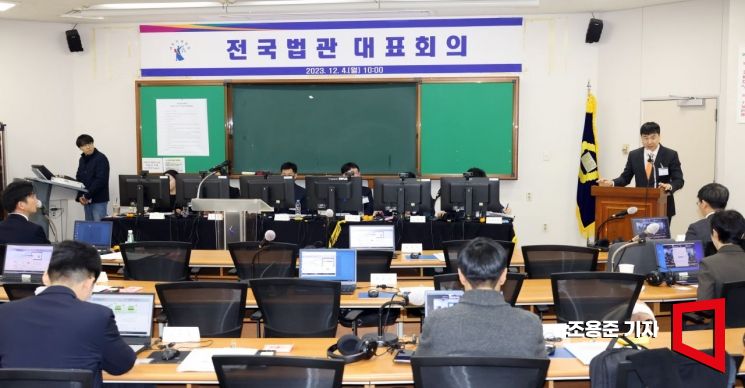 Judges attending the National Judges' Representative Meeting held at the Judicial Research and Training Institute in Goyang, Gyeonggi Province, on the 4th are holding a meeting. At this meeting, agenda items for discussing precautions and guidelines regarding judges' use of social networking services (SNS) were discussed. Photo by Jo Yongjun jun21@
On the 9th, the National Judges' Representative Meeting announced that it would hold an extraordinary session for 2025 from 10 a.m. to 12 p.m. on the 26th in Lecture Room 13 at the Judicial Research and Training Institute in Goyang, Gyeonggi Province. The decision to convene the extraordinary session was made after a vote held from the 8th until the morning of the 9th, in which the quorum of 26 votes in favor was met. It is reported that there were 70 votes against. The meeting will be held both in-person and online.
At the extraordinary session, agenda items to be submitted later will be discussed, focusing on concerns about judicial trust and threats to judicial independence triggered by the Supreme Court ruling on Lee's case. Agenda items supported by at least four members by May 19, which is seven days before the meeting, may be submitted. During the meeting, if nine other members agree, an agenda item may also be proposed on the spot.
Previously, the National Judges' Representative Meeting stated, "The extraordinary session will be convened because more than one-fifth of the members requested it, citing the need to discuss and clarify the court's position on suspicions regarding the political neutrality of the judiciary and the erosion of trust in the judiciary." Regarding the decision to set the meeting date for the 26th, the meeting explained, "This timing reflects the notice period for convening and the preparation period required for submitting agenda items as stipulated by the rules and internal regulations." The meeting also stated, "Given the seriousness of the issue, the representatives will thoroughly and carefully review the matters before submitting agenda items during this period."
The Judges' Representative Meeting is a body where representative judges elected from courts at various levels gather to express opinions or make recommendations on judicial administration and judicial independence. The meeting can be convened at the discretion of the chairperson or at the request of at least one-fifth (26 members) of the representatives. An internal vote was held the previous day to decide whether to convene the meeting, but no conclusion was reached, so opinions were collected until the morning of the 9th, and the decision to convene was made when more than one-fifth of the members agreed.
The agenda has not yet been finalized. The Judges' Representative Meeting stated, "Agenda items supported by at least four members, excluding the proposer, by the 19th, which is seven days before the meeting, will be submitted." The meeting also explained, "Agenda items may also be proposed on the spot if nine other members agree, and the agenda submission process is currently underway."
There is a possibility that the meeting may be continued. The Judges' Representative Meeting stated, "If an agenda item is submitted, a vote for or against may be held. If the meeting continues for a long time and there is not enough time, or if a representative requests a continuation for further review, the meeting may be extended."
The Judges' Representative Meeting was established on a temporary basis in 2017 to address the controversy over the abuse of judicial administrative authority. Each representative judge may express opinions or make recommendations regarding judicial administration and judicial independence, and, if necessary, may request explanations and the submission of materials from those in charge of judicial administration.
© The Asia Business Daily(www.asiae.co.kr). All rights reserved.

















