Cumulative Decline Rate Second Only to Daegu
Jeonse Prices Also Turn Downward... Only Nam-gu Sees an Increase
With the early presidential election approaching, housing prices are showing signs of rebounding in areas such as the Seoul metropolitan area and Sejong, but Gwangju remains stuck in a downward trend. Apartment sale prices in Gwangju have continued to decline for 72 consecutive weeks, and jeonse prices have also reverted to a downward trajectory.
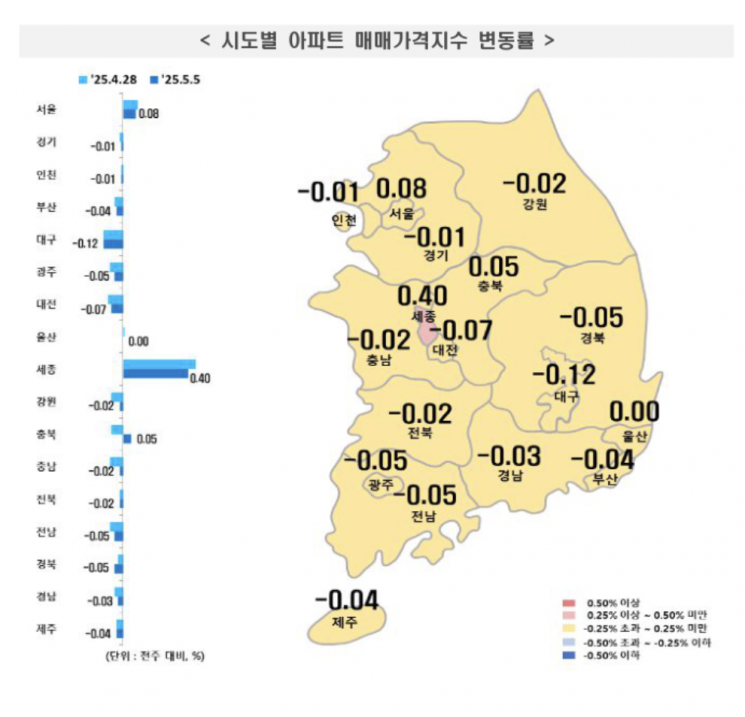
According to the "Apartment Price Trends for the First Week of May" released by the Korea Real Estate Board on May 9, apartment sale prices in Gwangju fell by 0.05% compared to the previous week. This marks the 72nd consecutive week of decline since the third week of December last year. During the same period, Jeonnam also saw a decrease of 0.05%.
The national average was -0.01%, with the decline narrowing compared to the previous week (-0.02%). The Seoul metropolitan area rose by 0.02%, and Seoul itself increased by 0.08%, continuing the rebound trend. Some regional areas, such as Sejong (0.4%) and Chungbuk (0.05%), also shifted to an upward trend. In contrast, Gwangju continued to rank among the areas with the steepest declines.
Gwangju's cumulative annual sale price change rate was -0.44% in 2024 and -1.01% so far this year, recording the second largest drop after Daegu (-2.02%). Jeonnam also remained weak, recording -0.74% so far this year.
All five districts in Gwangju saw sale prices fall this week. The largest drop was in Dong-gu (-0.13%), followed by Seo-gu and Nam-gu (both -0.07%), Gwangsan-gu (-0.04%), and Buk-gu (-0.03%).
Specifically, older complexes in Hwajeong-dong and Geumho-dong in Seo-gu, small and medium-sized or outlying complexes in Sansu-dong and Gyerim-dong in Dong-gu, and areas such as Bongseon-dong and Juwol-dong in Nam-gu led the decline.
Jeonse prices for apartments in Gwangju, which had risen by 0.01% the previous week, turned downward again this week to -0.01%. By district, Dong-gu (-0.05%), Gwangsan-gu (-0.03%), and Buk-gu and Seo-gu (both -0.01%) recorded declines, while Nam-gu stood in contrast with an increase of 0.08%.
In Jeonnam, the rate of decline narrowed from -0.07% to -0.02%.
© The Asia Business Daily(www.asiae.co.kr). All rights reserved.

















