Average Monthly Food Expenses Reach 860,000 Won in 2024... Up 4.4% from Previous Year
Engel's Coefficient at 29.7%... Upward Trend Continues
Slight Income Growth... Rising Food and Dining-Out Costs Drive Increase
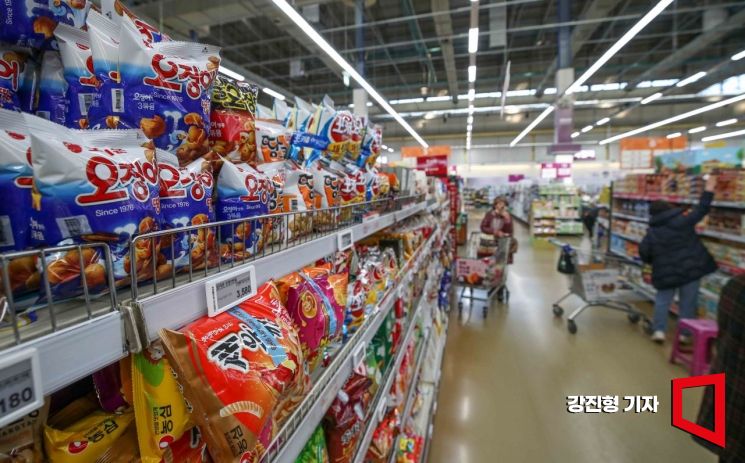
Last year, household food expenses in South Korea nearly reached 900,000 won. As spending on food increased, the Engel's coefficient?the proportion of food expenses in total income?also rose to nearly 30%.
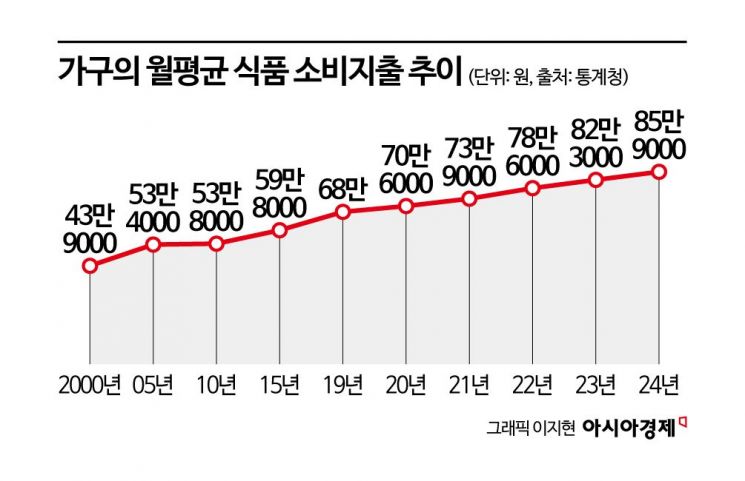
According to the Household Income and Expenditure Survey released by Statistics Korea on May 10, the average monthly food consumption expenditure per household in South Korea last year was 859,181 won, up 4.4% from the previous year. This figure is nearly 1 percentage point higher than the overall average monthly consumption expenditure growth rate per household, which was 3.5% during the same period. This indicates that food spending increased more than overall consumption.
The average monthly food expenditure per household in South Korea has been rising rapidly since the COVID-19 pandemic. In 2019, the amount was 680,000 won, surpassing 700,000 won for the first time in 2020, when the pandemic began in earnest. In 2023, it exceeded 800,000 won, and last year it surpassed 850,000 won, approaching the 900,000 won mark.
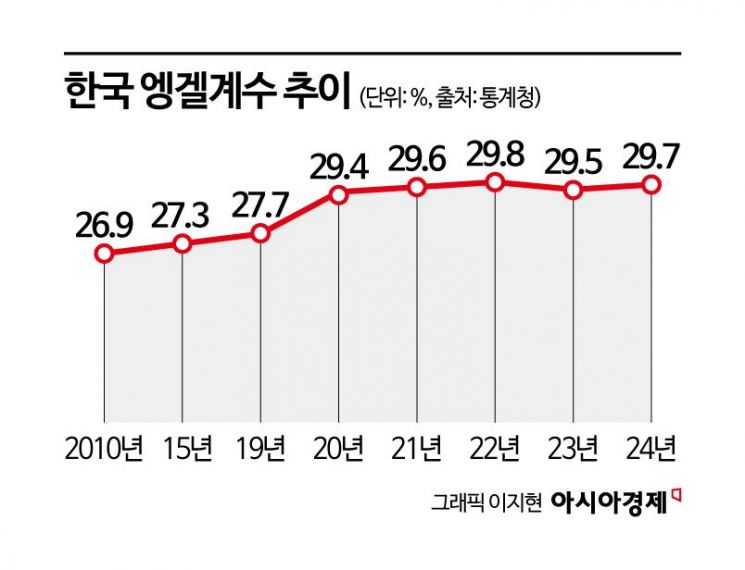
As spending on food increased, the Engel's coefficient also rose. Last year, South Korea's Engel's coefficient was 29.7%, a slight increase from 29.5% the previous year. Since 2010, when it was 26.9%, the coefficient has shown a continuous upward trend. In particular, it rose sharply to 29.4% in 2020 during the pandemic, continued to rise to 29.8% in 2022, and then slightly decreased to 29.5% in 2023, before rebounding again last year.
The Engel's coefficient refers to the proportion of household consumption expenditure spent on food and non-alcoholic beverages. Generally, the higher the income, the lower the Engel's coefficient, and the lower the income, the higher the coefficient. At the national level, countries with higher income levels tend to have lower Engel's coefficients.
Recently, South Korea's Engel's coefficient has been steadily rising. This trend is attributed to a significant increase in food and dining-out prices, while income growth has been sluggish. In short, it is becoming more difficult for people to make ends meet than before. South Korea's Engel's coefficient is also higher than that of Japan. According to Japan's Ministry of Internal Affairs and Communications, Japan's Engel's coefficient was 28.3% last year, the highest in 43 years since 1981. However, South Korea's coefficient was even higher.
The rise in South Korea's Engel's coefficient is also influenced by the increased frequency and cost of dining out. In fact, last year, the proportion of dining-out expenses among household food consumption expenditures reached 49.9%, nearly half. As the share of dining-out expenses increased, the actual amount spent on dining out rose to 429,000 won, up 5.2% from 408,000 won the previous year. In contrast, the share of fresh food fell by 0.3 percentage points to 22.4%, while the share of processed food remained almost unchanged at 27.6%, compared to 27.7% the previous year.
By household size, the increase among single-person households was particularly notable. For single-person households, spending on fresh food rose by 5.6% compared to the previous year, while expenditures on processed food and dining out increased by 5.5% and 5.2%, respectively, showing a higher rate of increase than multi-person households. There were also significant differences in the composition of average monthly food consumption expenditure by age group among single-person households. Last year, single-person households in their 20s and 30s spent 73.0% of their food budget on dining out, with processed food and fresh food accounting for 20.6% and 6.4%, respectively. In contrast, among single-person households aged 60 and older, the proportion of dining-out expenses increased by 1.4 percentage points from the previous year but was only 33.8%, less than half that of those in their 20s and 30s. The shares of fresh food and processed food were 35.9% and 30.3%, respectively.
© The Asia Business Daily(www.asiae.co.kr). All rights reserved.



















