Strengthening the Global Security Supply Chain through U.S. Ammunition Production
Hanwha Global Defense Expected to Serve as Defense Control Tower
Stringent Export Regulations Pose Major Hurdle
Hanwha Aerospace's plan to localize its ammunition value chain in the United States is expected to draw attention not only as a means of securing a production base, but also as a key part of the global security supply chain. In particular, given the importance of supply stability for military supplies during wartime or conflict, establishing a production system within the United States also signifies an enhanced status as a "defense partner of allied nations."
This plan includes establishing the entire ammunition production process locally, covering high-risk base materials such as nitroglycerin, as well as gunpowder, shells, and fuzes. Until now, most domestic defense companies have produced finished products in Korea and exported them. However, this time, the approach is different in that the entire value chain, from raw material procurement to supply, will be localized.
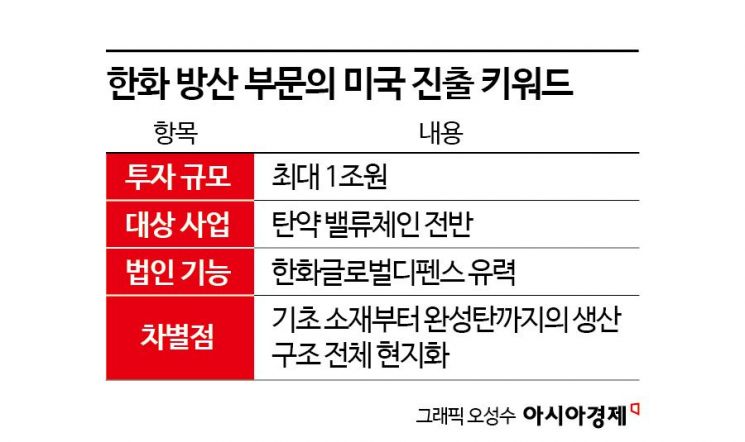
If Hanwha builds an ammunition plant in the United States, it is expected to elevate its status from a simple supplier to a strategic partner in the defense sector. Hanwha is also making its presence felt in the Korean shipbuilding industry, which is of great interest to the United States, through Hanwha Ocean and other affiliates.
Since the outbreak of the Russia-Ukraine war, demand for ammunition in the United States has surged, prompting efforts to expand production infrastructure. In particular, reducing dependence on imports of high-risk materials such as nitroglycerin and securing a stable internal procurement system has emerged as one of the core tasks in U.S. military strategy.
Hanwha's strategic U.S. entity, Hanwha Global Defense, is seen as an organizational response to these changes. Overseeing Hanwha Aerospace, Hanwha Ocean, and Hanwha Systems, this entity is based in Washington, D.C., and plays a comprehensive role in establishing global defense strategies, identifying partnerships, and supporting contract bids. Notably, if Hanwha's local ammunition production strategy materializes in the future, this entity is expected to serve as the control tower for actual investment and operations.
Industry observers suggest that Hanwha Global Defense could become a key platform in the U.S. market going forward. In particular, the United States often requires foreign defense contractors to have a local entity or workforce when participating in contracts. An industry official stated, "If certain processes, from base materials to assembly, are established in the United States, it could align with U.S. policies aimed at achieving independence in the ammunition supply chain," adding, "This could lay the groundwork for strategic advantage in the future local procurement market."
However, Hanwha faces significant legal hurdles to realize its localization strategy. This is because ammunition is classified as a representative strategic material and a security-sensitive item. In Korea, transferring ammunition-related technologies and equipment overseas is subject to the Defense Acquisition Program Act and the Act on Prevention of Divulgence and Protection of Industrial Technology. In particular, design or process technologies for high-risk explosive materials such as nitroglycerin could be classified as national core technologies, requiring export permits and technology transfer reviews by the Ministry of Trade, Industry and Energy or the Defense Acquisition Program Administration.

The United States also enforces strict regulations. To produce ammunition or its raw materials within the U.S., companies must meet multiple licensing requirements, including those from the Department of Defense (DOD) and the International Traffic in Arms Regulations (ITAR). However, both inside and outside the industry, it is believed that Hanwha has already conducted basic legal reviews and policy risk analyses internally, as it has begun reviewing the project.
Some analysts suggest that Hanwha's latest move could have a long-term impact on its corporate structure in the defense sector. Global defense conglomerates have organically linked the establishment of local joint ventures, acquisition of production facilities, and technology licensing agreements to meet procurement standards in each country. For Hanwha to establish itself as a sustainable defense company in the global market, it needs not only technological competitiveness but also comprehensive capabilities, including regulatory compliance and production system design.
An industry official commented, "Ammunition is a representative regulation-sensitive item," adding, "Hanwha's localization plan appears to be a preemptive measure to secure its status as a national-level contractor, rather than simply aiming to increase short-term sales."
© The Asia Business Daily(www.asiae.co.kr). All rights reserved.
![From Bar Hostess to Organ Seller to High Society... The Grotesque Con of a "Human Counterfeit" [Slate]](https://cwcontent.asiae.co.kr/asiaresize/183/2026021902243444107_1771435474.jpg)

















