LNG Carriage Rate by Domestic Shipping Companies Remains at 38.2%
Efforts Underway to Institutionalize a Carriage Rate of Over 70%
Effectiveness of Alaska LNG Project with the US Deemed Premature
The proportion of liquefied natural gas (LNG) transported by domestic shipping companies remains in the 30% range, prompting calls for increased support to expand the use of domestic vessels in transporting this critical imported energy source. However, there is a lukewarm response regarding whether the Alaska LNG development project, considered as a potential bargaining chip in tariff negotiations with the United States, could serve as an alternative.
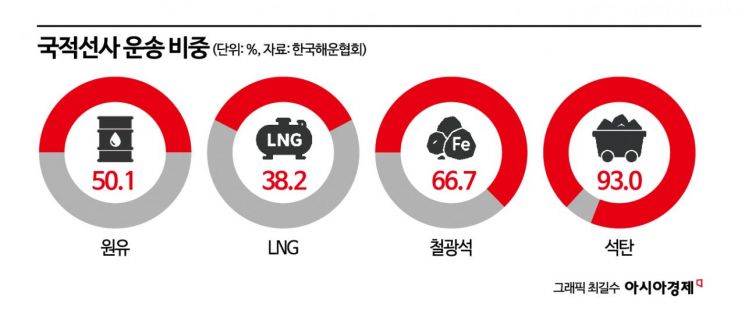
According to the "Policy Tasks for the Development of the Korean Shipping Industry," submitted by the Korea Shipowners' Association to the National Assembly on May 9, the LNG carriage rate by domestic shipping companies stood at 38.2% in 2023, which is significantly lower compared to crude oil (50.1%), iron ore (66.7%), and coal (93.0%). This shows a stark contrast to the reality that 99.7% of import and export cargo volume is transported by sea, and that 100% of core energy imports rely on maritime transport.
Industry experts explain that this is because Korea Gas Corporation applies the Delivered Ex Ship (DES) condition, rather than the Free On Board (FOB) condition, when importing LNG. Under FOB, the importing country designates the shipping company, whereas under DES, the exporting country holds this authority.
Lee Hochun, head of the Shipping Research Division at the Korea Maritime Institute (KMI), stated, "A large portion of LNG is imported from Qatar, and the application of DES at the time of contract has had an impact," adding, "Since FOB is recognized as a liability, Korea Gas Corporation, which is subject to management evaluations, is not actively pursuing it."
The Korea Shipowners' Association has submitted proposals to both ruling and opposition parties ahead of the presidential election, including the expansion of policies requiring domestic cargo to be transported by domestic vessels. The intent is to maintain a stable supply chain by securing and maintaining fleets for core energy transportation. In international cases, for example, the United States mandates the use of domestic vessels for government agency and aid cargo, while Japan gives preferential points to domestic shipping companies when government agencies procure strategic materials.
Kim Kyunghoon, director at the Korea Shipowners' Association, said, "More than 70% of core energy transportation should be handled by domestic vessels," adding, "A bill to institutionalize this was previously proposed but was scrapped when the session ended. We are working to have it reintroduced."
There are also assessments that it remains uncertain whether participation in the Alaska LNG development project, which is under pressure during tariff negotiations with the United States, will help increase the carriage rate of domestic shipping companies.
An industry official commented, "From an investment perspective, the project appears to have low profitability. If it were highly profitable, private companies would have already requested to lead the development." The official also added, "Since there is no concrete substance yet, it is too early to assess its effectiveness."
If the project becomes more concrete and domestic companies participate from development through to transportation, it could be positive in terms of diversifying LNG import sources. However, there are suggestions that skillful negotiation will be needed, as it is uncertain what price will be set. The fact that the United States Trade Representative (USTR) has mandated that, starting in three years, a portion of LNG exports must be transported on U.S.-built vessels to encourage their construction is also a factor.
Director Lee stated, "I understand that building LNG carriers is not an easy task," but added, "If the project is successfully pursued, the best approach would be to apply the FOB condition at the time of contract or to specify in the contract that a certain proportion of transportation must be handled by domestic shipping companies."
© The Asia Business Daily(www.asiae.co.kr). All rights reserved.

















