KRW 33.4 Billion Invested, Completion by Year-End
High-Speed Evaluation System for Used Battery Analysis Introduced
Assessment of Remaining Battery Performance and Safety
Determining Reuse, Recycling, and Remanufacturing Potential
An "Inline Automatic Evaluation Center" aimed at realizing a circular economy for electric vehicle batteries will be established in Pohang.
On May 8, Pohang City held a groundbreaking ceremony for the "Inline Automatic Evaluation Center for Used Electric Vehicle Batteries" at the Blue Valley National Industrial Complex and began building a demonstration base for rapid evaluation of electric vehicle batteries.
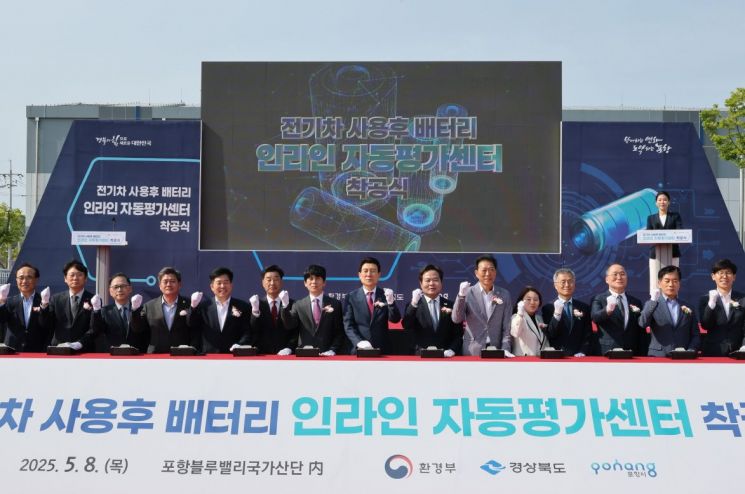 Pohang City held a groundbreaking ceremony for the Inline Automatic Evaluation Center for Used Electric Vehicle Batteries at the Blue Valley National Industrial Complex on the 8th and took a commemorative photo. Photo by Pohang City
Approximately 200 people attended the event, including Lee Kangdeok, Mayor of Pohang, Ahn Sechang, Director General of Climate and Carbon Policy at the Ministry of Environment, Kim Hakhong, Vice Governor for Administrative Affairs of North Gyeongsang Province, Kim Ilman, Chairman of Pohang City Council, as well as representatives from industry, academia, research institutes, and local residents.
The center, which broke ground this time, is a key infrastructure for the safe management and recycling of used batteries, which are rapidly increasing due to the expansion of electric vehicle adoption. The project is being jointly promoted by Pohang City, the Ministry of Environment, and North Gyeongsang Province.
A total of 33.4 billion KRW (10 billion KRW from the national government and 23.4 billion KRW from local governments) will be invested, with completion targeted for the end of this year. Once completed, the center will introduce a high-speed evaluation system capable of analyzing up to 150 used batteries per day and more than 30,000 batteries per year.
In particular, the center will be equipped with the ability to precisely diagnose the performance and remaining lifespan of battery modules and packs, allowing for the determination of whether each battery can be reused, recycled, or remanufactured according to its grade.
The city expects that the groundbreaking of this center will serve as an opportunity to strengthen the national competitiveness of the electric vehicle battery circular economy industry and contribute to carbon neutrality and the creation of a sustainable industrial ecosystem.
As the adoption of electric vehicles is rapidly expanding, the safe management and recycling of used batteries has emerged as an urgent issue not only for the industry but also at the government level.
Since being designated as a "Next-Generation Battery Recycling Regulation-Free Zone" in 2019, Pohang City has continuously worked to build battery circular economy infrastructure, including operating a comprehensive secondary battery management center and establishing a resource circulation cluster.
In June, the Ministry of Environment's "Electric Vehicle Battery Resource Circulation Cluster" is scheduled for completion. Centered around this, Pohang plans to actively identify follow-up projects to foster collaboration among local companies, universities, and research institutes, enabling the city to grow as a hub for the circular economy in Korea.
Mayor Lee Kangdeok stated, "This groundbreaking is significant as it establishes an automated foundation in Pohang for quickly and precisely evaluating the performance of used batteries," adding, "We will provide active support to ensure the center becomes the core of the national battery circular economy industry."
© The Asia Business Daily(www.asiae.co.kr). All rights reserved.

















