Submission of Statement:
"No Threat to U.S. National Security"
The Korea International Trade Association (KITA) has submitted an official statement in response to the United States' investigation into national security threats posed by imported semiconductors and pharmaceuticals under Section 232 of the Trade Expansion Act. KITA requested that tariffs not be imposed, arguing that Korean semiconductors and pharmaceuticals do not pose a risk to U.S. national security.
On May 8, KITA announced that it had submitted a statement reflecting the views of the Korean trade industry to the U.S. Department of Commerce on May 7 (local time) regarding the U.S. national security threat investigation based on the Trade Expansion Act. The Trump administration officially launched a national security threat investigation under Section 232 of the Trade Expansion Act into imported semiconductors and pharmaceuticals last month. The stakeholder comment period concluded the previous day.
The Trade Expansion Act grants the President the authority to restrict imports of certain items through measures such as tariffs if those imports are deemed to threaten national security. The current semiconductor-related investigation covers substrates, bare wafers, legacy semiconductors, leading-edge semiconductors, microelectronics, and semiconductor manufacturing equipment parts.
The pharmaceutical investigation covers finished pharmaceuticals, active pharmaceutical ingredients (APIs) and other key ingredients, as well as medical countermeasures for public health emergencies, including vaccines and antibiotics.
In its statement, KITA argued that Korean exports of semiconductors and pharmaceuticals do not threaten U.S. national security and should therefore be excluded from the scope of Section 232 measures.
KITA emphasized that most Korean semiconductor exports to the U.S. are general-purpose memory semiconductors, and that the U.S. enjoys a trade surplus with Korea by exporting high-value-added products such as semiconductor equipment. In fact, last year, U.S. exports of semiconductor equipment to Korea amounted to $3.93 billion, accounting for 20.1% of total U.S. exports of such equipment. The U.S. recorded a $2.9 billion trade surplus with Korea in this sector.
KITA also conveyed concerns that these measures could discourage investment by Korean semiconductor materials and equipment companies in the United States. It cited projections that Korean companies will account for 37% of semiconductor facility investment (CAPEX) in the U.S. from 2024 to 2032. KITA explained that if tariffs are imposed, the cost of U.S.-made semiconductors would rise and the procurement of key materials and equipment could become less reliable, potentially reducing Korean companies' investments.
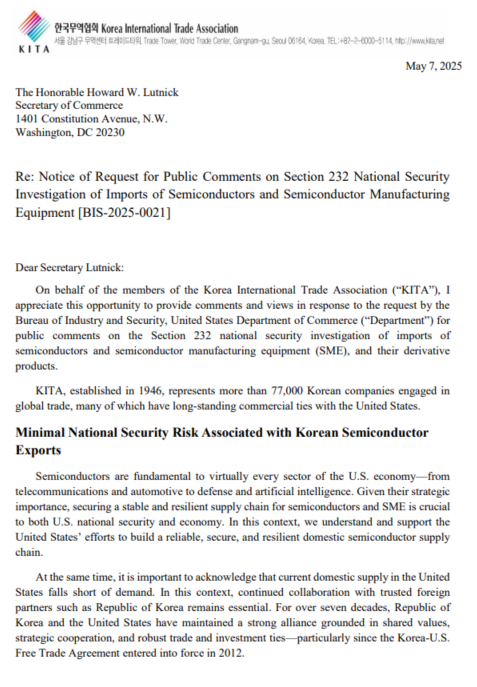 Comments submitted by the Korea International Trade Association to the U.S. Department of Commerce regarding the import semiconductor investigation under the U.S. Trade Expansion Act. Korea International Trade Association
Additionally, KITA requested that the scope of semiconductor-derived products, which currently includes a wide range such as smartphones, laptops, and display modules, be narrowed. KITA also urged that, for items such as semiconductor wafers and smartphones mentioned as subjects of critical mineral-related investigations, tariffs should be adjusted to avoid double taxation, considering the burden on the industry.
Regarding pharmaceuticals, KITA explained that Korean biopharmaceutical companies are enhancing access to medicines in the U.S. by supplying affordable pharmaceuticals. KITA also emphasized that Korean firms either produce finished pharmaceuticals based on U.S. APIs or manufacture on behalf of U.S. companies, thus engaging in active cooperation with American firms.
Accordingly, KITA requested tariff exemptions for: finished pharmaceuticals produced by processing U.S.-made APIs; affordable biosimilars and generic drugs that improve access to medicines in the U.S.; and biopharmaceuticals that U.S. biopharmaceutical companies have contracted Korean firms to manufacture.
Cho Sungdae, head of KITA's Trade Law and Policy Response Team, stated, "Uniform tariff measures by the U.S. that do not take into account the specific circumstances of each product and company can cause significant side effects." He added, "We will continue to communicate the burdens these trade measures place on Korean companies and will make every effort to mitigate tariff measures through consultations with key stakeholders."
© The Asia Business Daily(www.asiae.co.kr). All rights reserved.


















