Korea Chamber of Commerce and Industry Meeting
"The Era of Government-Led Growth Is Over"
"The Private Sector as the Leading Pioneer"
Lee Jae-myung, the Democratic Party presidential candidate, stated at the "Presidential Candidate Invitational Meeting with the Heads of Five Economic Organizations" held at the International Conference Hall of the Korea Chamber of Commerce and Industry in Jung-gu, Seoul, on the 8th, "What we must do going forward is to revive the livelihoods of the people and the economy, and at the center of that are businesses."
In his opening remarks, Lee said, "No matter how bad the global economic situation may be, I believe that if our country's businesses combine their capabilities, capital, and technology, we can create new hope to overcome the crisis."
Lee suggested, "The era in which the government sets and leads the agenda for economic and industrial issues, as in the past, is over. If the private sector leads with expertise and capability, and the government reliably supports as a 'facilitator,' we will be able to overcome the current economic difficulties."
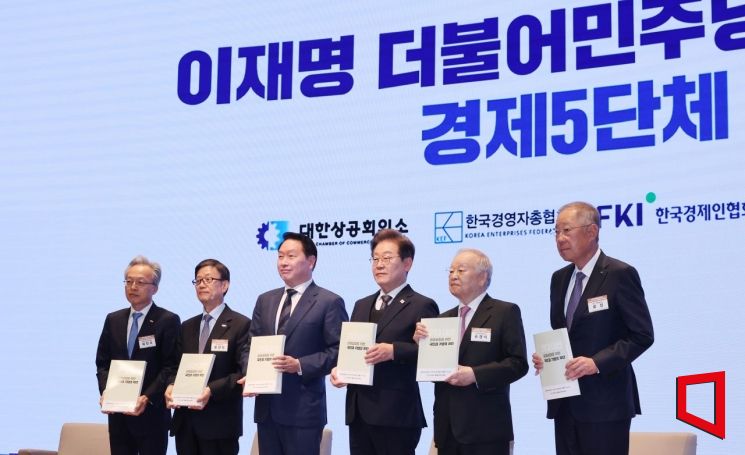 Lee Jae-myung, the Democratic Party presidential candidate, is attending a meeting with the heads of five economic organizations at the Korea Chamber of Commerce and Industry in Jung-gu, Seoul, on the morning of the 8th, holding a policy proposal booklet and taking a commemorative photo together. (From left) Choi Jin-sik, chairman of the Korea Federation of Medium-Sized Enterprises; Yoon Jin-sik, chairman of the Korea International Trade Association; Choi Tae-won, chairman of the Korea Chamber of Commerce and Industry; candidate Lee; Sohn Kyung-shik, chairman of the Korea Employers Federation; Ryu Jin, chairman of the Korea Economic Federation. Photo by the National Assembly Press Photographers Group
Choi Tae-won, chairman of the Korea Chamber of Commerce and Industry, said, "Warning lights are flashing for the Korean economy, and we urgently need a new growth model that goes beyond the past methods of growth. I have high expectations for candidate Lee, who proposes to create a prosperous Korea with a new growth model. Please create a new future for Korea through continuous communication and dialogue."
It is noteworthy that Lee, having escaped the so-called "judicial risk" after the postponement of the retrial date in his Public Official Election Act case, chose his first external schedule to be a meeting with the heads of the five economic organizations. This move emphasizes the economy and signals an effort to broaden his appeal to moderate voters. Previously, immediately after being nominated as a presidential candidate, Lee also held a meeting on AI semiconductors, reinforcing his image as an "economic president."
Attending the meeting as heads of economic organizations were Choi Tae-won, Sohn Kyung-shik, chairman of the Korea Employers Federation, Ryu Jin, chairman of the Korea Economic Federation, Yoon Jin-sik, chairman of the Korea International Trade Association, and Choi Jin-sik, chairman of the Korea Federation of Medium-Sized Enterprises. From Lee's side, Lee Han-joo, head of the General Policy Headquarters, Jin Sung-joon, head of the Policy Headquarters, Cho Seung-rae, head of the Public Relations Team, Kim Won-i, Democratic Party secretary of the National Assembly's Industry, Trade, and Energy Committee, Kang Jun-hyun, Democratic Party secretary of the Political Affairs Committee, and Jung Tae-ho, Democratic Party secretary of the Planning and Finance Committee, were present.
On this day, the five economic organizations conveyed their concerns to Lee regarding the reduction of working hours and the extension of the retirement age, requesting flexible policies that reflect business realities. They delivered a "Presidential Policy Proposal Book," which includes 14 tasks across four major areas: AI, new industries, trade, and labor, emphasizing the need for feasible system design.
Sohn Kyung-shik pointed out the rigidity of the current labor system. He said, "The 4.5-day workweek and the 52-hour workweek system limit flexibility in industrial sites and especially burden the competitiveness of high-tech industries. Restrictions on overtime on a weekly basis make it difficult to respond to rapidly changing environments." Regarding the extension of the retirement age, he noted, "Since the legal retirement age was set at 60, early retirements have increased and youth hiring has shrunk," stressing the need for more flexible approaches such as reemployment rather than uniform extensions.
Subsequent remarks also included suggestions for restoring the foundation for economic growth. Choi Tae-won expressed concern about the entrenchment of low growth and said that new growth strategies through expansion and cooperation are necessary. Ryu Jin, chairman of the Korea Economic Federation, mentioned the weakening competitiveness of key industries and requested government support for future industries such as aerospace, robotics, and defense.
The issue of business succession was also raised. Choi Jin-sik argued, "The top inheritance and gift tax rate of 60% makes it difficult for businesses to continue operating," and called for adjustment to the OECD average level. Regarding changes in the trade environment, Yoon Jin-sik, chairman of the Korea International Trade Association, mentioned damages to exporters caused by U.S. tariff policies and emphasized the urgent need for the government to respond strategically and expand financial support for small and medium-sized enterprises.
This meeting was an occasion for the business community to call for a shift in major policy directions regarding labor, taxation, trade, and other key areas. Companies consistently requested realistic solutions with flexibility and effectiveness.
Previously, immediately after the 12·12 emergency martial law incident last year, Lee also held an emergency meeting at the National Assembly with Sohn Kyung-shik, Kim Ki-moon, Song Chi-young, and others to discuss economic issues.
In the afternoon, Lee will visit the Korea Federation of SMEs in Yeouido, Seoul, to attend a livelihood policy agreement ceremony hosted by the Central Election Committee's Vocational Headquarters, and will also participate in an "Economic YouTube Alliance Talk Show."
Starting the next day, Lee will resume his regional tour, the "Third Neighborhood Listening Tour," to continue his economic outreach. On the 9th, he will visit Gyeongju and Yeongcheon in North Gyeongsang Province, and on the 10th, he will visit Changnyeong and Haman in South Gyeongsang Province, regions considered challenging for the Democratic Party in Yeongnam. Having started the Neighborhood Listening Tour in Gangwon Province on the 1st of this month, Lee has since visited northern Gyeonggi, North Jeolla, South Chungcheong, and other regions, thoroughly gauging local public sentiment.
© The Asia Business Daily(www.asiae.co.kr). All rights reserved.

















