"Economy at the Edge of a Cliff... This Is Not a Temporary Phenomenon but a Weakening of Competitiveness"
"No New Growth Engines... Core Industries Are Aging"
"Because investment risks are high, it is difficult for companies to handle this on their own. The government needs to directly support infrastructure and ease the investment burden through tax improvements, just as is done in the United States, China, and Japan."
The business community has emphasized that the government must take direct action to foster advanced industries and carry out structural reforms for industries in crisis. They argue that the government should lead efforts to nurture new industries such as aerospace, next-generation ships, and defense, as well as to restructure specific sectors like petrochemicals.
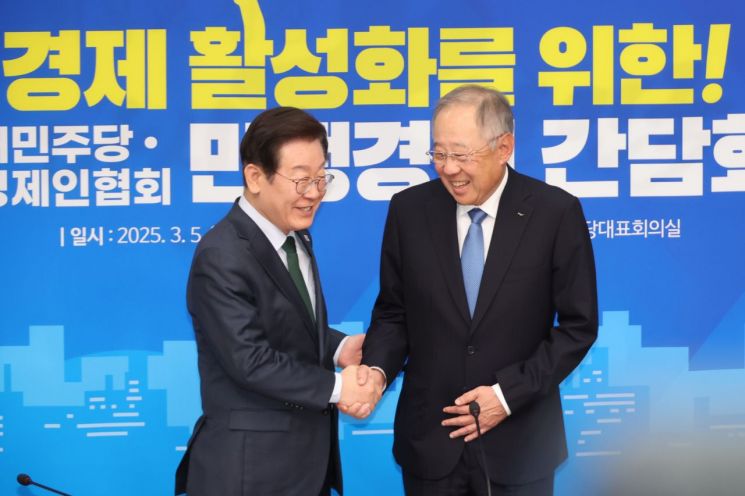
On May 8, at a policy meeting between Lee Jaemyung, the Democratic Party’s presidential candidate, and the heads of the five major economic organizations held at the Korea Chamber of Commerce and Industry in Jung-gu, Seoul, Ryu Jin, chairman of the Federation of Korean Industries, stated, "Our economy is standing at the edge of a cliff." He added, "The problem is not a temporary phenomenon, but rather a weakening of industrial competitiveness." Ryu identified the first reason as the lack of new growth engines, and the second as the aging of key industries. He stressed, "Over the past 20 years, while the United States and China have been fostering new industries, the growth plates of Korean manufacturing have closed. Most of our core industries have been overtaken by China and are now in crisis, while petrochemicals and steel are at a crossroads between survival and extinction." He cited the creation of new growth engines led by the state as the top priority, specifically mentioning aerospace, robotics, bio, next-generation ships, and defense industries as relevant fields.
As Ryu pointed out, major countries such as the United States and China have been fostering key industries like semiconductors, artificial intelligence (AI), and batteries mainly through direct subsidies. In particular, China has designated fields such as aerospace and bio as part of its ten strategic industries under "Made in China 2025," pouring astronomical amounts of support into them. The United States, since the election of President Donald Trump, has also maintained a strong protectionist reshoring policy focused on manufacturing.
Ryu also called for support for the structural reform of crisis industries such as petrochemicals. He argued, "Tax benefits should be granted for the disposal of excess production facilities to induce restructuring." He added, "Support should be provided for the creation of test-bed complexes to reduce the burden of research and development, and investment in facilities should be strengthened." He further emphasized the need for policy financing, such as liquidity support, and temporary electricity rate reductions for industrial crisis regions. In October of last year, electricity rates for industrial customers with large capacity were raised by 10.2%, from 165.8 won to 182.7 won per kWh. In the petrochemical industry, which is a representative energy-intensive sector, electricity costs account for about 3.2% of production costs. An industry official explained, "Petrochemicals have low profit margins, so even a small increase in electricity rates has a significant impact."
© The Asia Business Daily(www.asiae.co.kr). All rights reserved.

















