On April 23, a citizen reported spotting two otters at Gusu Bridge
From April 23 to 28, one whooper swan observed between Gusu Bridge and in front of Ulsan Station
The city of Ulsan announced that both the otter and the whooper swan, which are designated as natural monuments and endangered wild species, have been observed in succession at Gusu Bridge and near Ulsan Station, located in the upper reaches of the Taehwa River.
At 10 a.m. on April 23, Song Ingwi (male, 55), a resident of Daun-dong, Jung-gu, discovered an otter while passing by Gusu Bridge in Eonyang-eup, Ulju-gun, and captured it on video.
The video vividly depicts two otters active both in the water and on the rocks.
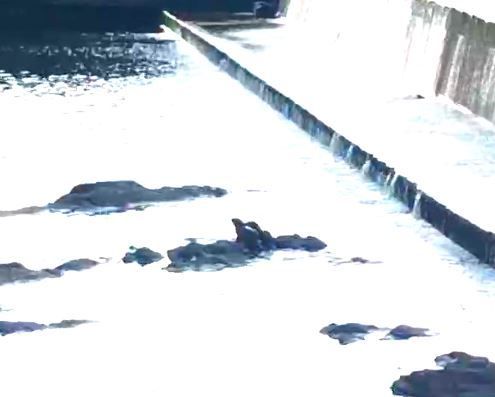
Song stated, "I also saw otters last month, and local residents have mentioned that otters have been appearing in the area. I decided to report this to the city of Ulsan because the city seems to be actively engaged in wildlife protection these days. I wanted to let people know that otters live here so that more citizens can be aware and participate in their protection."
Han Sanghoon, a researcher at the Korea Institute of Wild Animal Research who viewed the video, said, "It is difficult to estimate their size, but they appear to be young otters that became independent this year. It seems they are staying in the area due to the abundance of food."
The otter is both a natural monument and a Class I endangered wild animal, and is protected as such. It is a large mustelid mammal and is nocturnal. Its legs are short and its toes are webbed, making it well-adapted for moving between rivers and land.
Otters mainly eat fish, but their developed canine teeth allow them to also eat amphibians and crustaceans. Mating occurs between January and February, and the gestation period is 60 to 70 days. Up to four offspring can be born at a time.
In the Taehwa River, otters have been confirmed to inhabit areas such as Bancheon in Eonyang, the reservoir within UNIST, Berikkeut in Jung-gu, Taehwaru, and Myeongjeongcheon. Last year, they were also captured on observation cameras at Hwaya River in Onyang.
In addition, another natural monument and winter migratory bird, a single whooper swan, was observed feeding as it moved from Gusu Bridge to the stream in front of Ulsan Station between April 23 and 28. This observation was made by Hong Seungmin, the owner of Jjaekjjaek Rest Area, citizen biologist Yoon Giduk, and Kim Jeongsun, a Ulsan bird correspondent.
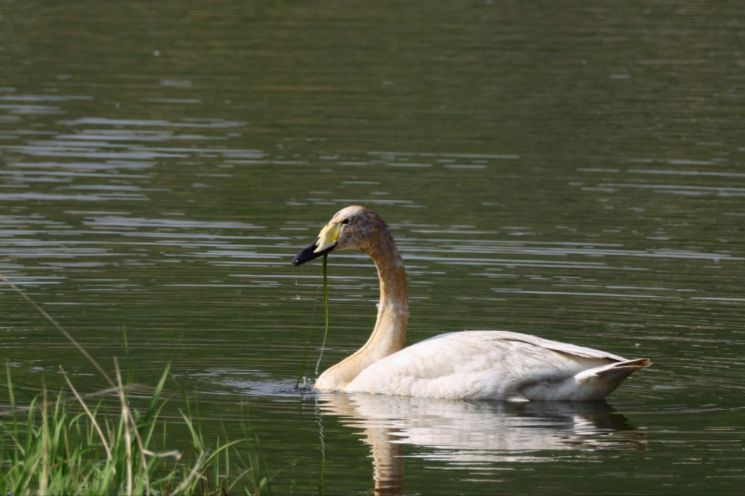
Hong Seungmin, the first to spot the bird, commented, "Whooper swans come to Ulsan to overwinter, but it is unusual for a young bird with brown coloring around its neck to appear during the northward migration period."
The whooper swan is also a natural monument and is protected as a Class II endangered wild animal. It is a species that visits the Taehwa River every year and was also observed at the Taehwa River estuary in November and December last year.
The whooper swan, a member of the Anatidae family, genus Cygnus, is a winter migratory bird that arrives in early November and can be observed until late March. It is herbivorous, diving to reach underwater plants, using its long neck and broad, flat bill to cut and eat roots and stems, as well as snails, clams, seaweed, and small fish.
The body is entirely white, the tip of the bill is black, and the base is yellow. The yellow area is broad and triangular at the tip. It can be distinguished from the Bewick's swan, which has a smaller, rounder yellow area compared to the black.
Among swan species, the whooper swan has the largest wintering population, but its numbers are declining.
An official from Ulsan City stated, "Taking this as an opportunity, we will expand wildlife monitoring, which has been focused on the mid and lower reaches of the Taehwa River, to the upper reaches as well. We will continue to promote habitat protection activities together with citizens."
© The Asia Business Daily(www.asiae.co.kr). All rights reserved.
![Clutching a Stolen Dior Bag, Saying "I Hate Being Poor but Real"... The Grotesque Con of a "Human Knockoff" [Slate]](https://cwcontent.asiae.co.kr/asiaresize/183/2026021902243444107_1771435474.jpg)

















