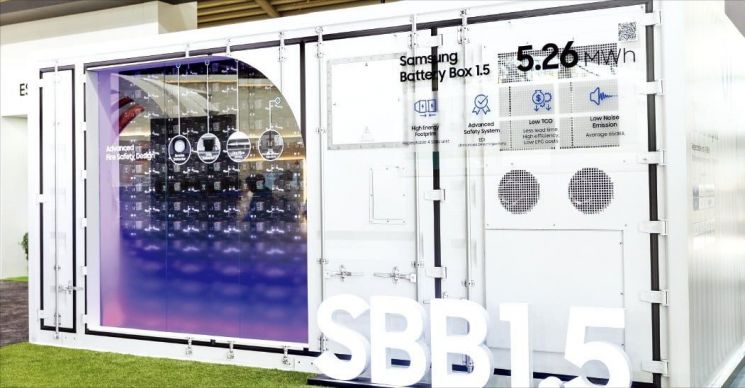
Korea Electrical Safety Corporation (President Nam Hwayoung) will collaborate with Samsung SDI to develop next-generation battery energy storage systems (BESS) that can be safely used even in extreme environments.
On May 8, Korea Electrical Safety Corporation announced that it has been selected as the lead organization for the national research project titled "Development of High-Reliability Verification and Safety Technology for Next-Generation BESS in Response to Extreme Environments," which aims to develop BESS safety technology. This project, which will run until the end of 2028, will include participation from Korea Electrical Safety Corporation, Samsung SDI, Datz Energy, Inzi E-Solution, and Jeonbuk National University.
The Electrical Safety Research Institute of Korea Electrical Safety Corporation stated that it has designed the world’s first next-generation BESS safety technology that can be used safely in extreme environments ranging from -40°C to 80°C. The institute participated in a public call for proposals to commercialize this technology and successfully secured a national research project worth 38.6 billion KRW this year.
BESS refers to a system that stores energy in batteries for use when needed. Typically, it is used in conjunction with power generation systems to store electricity and enhance the stability of power supply when demand surges or when generation is insufficient. BESS can maximize the utilization of renewable energy sources, such as solar and wind power, whose output varies depending on weather conditions.
In this project, Korea Electrical Safety Corporation will work with Samsung SDI to develop a high-reliability, high-safety next-generation BESS standard model that can operate in extreme environments. By 2028, they plan to develop a prototype of the standard model featuring low energy loss rates, self-diagnosis, and self-recovery functions.
© The Asia Business Daily(www.asiae.co.kr). All rights reserved.

















