Market Share of Top 3 Korean Companies Drops by 4.5%p
Chinese CATL and BYD Maintain Leading Positions
Despite the temporary demand stagnation in the electric vehicle (EV) market, known as the "EV chasm," global battery usage for electric vehicles has continued to grow steadily, while Chinese battery manufacturers have expanded their market share. In contrast, the combined market share of the three major Korean battery companies (LG Energy Solution, Samsung SDI, and SK On) has slightly declined as they lost ground to Chinese competitors.
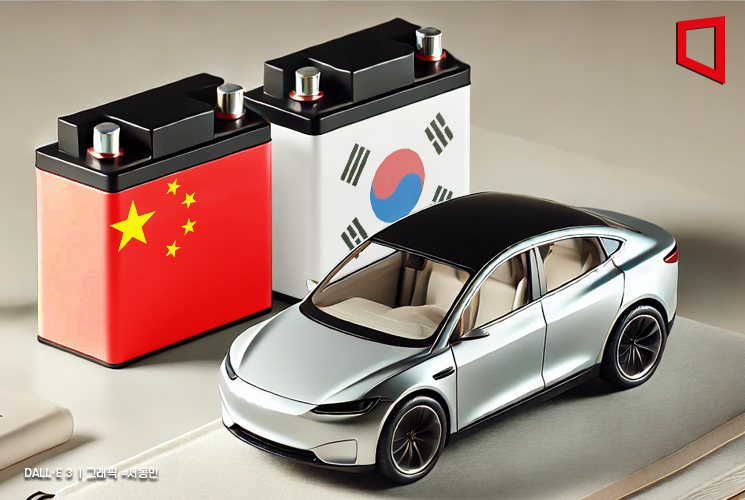
According to energy market research firm SNE Research on May 7, the total battery usage installed in battery electric vehicles (EVs), plug-in hybrid vehicles (PHEVs), and hybrid electric vehicles (HEVs) registered worldwide from January to March 2025 was 221.8 gigawatt-hours (GWh), representing a 38.8% increase compared to the same period last year.
During this period, among the three major Korean battery makers, only Samsung SDI saw a decrease in battery usage. Samsung SDI recorded 7.3 GWh, a 17.2% decrease year-on-year. Samsung SDI supplies batteries for models such as the BMW i4, i5, iX, and Rivian R1S and R1T.
SNE Research explained, "The decline for Samsung SDI was primarily due to reduced battery demand from major automaker clients in the European and North American markets. In addition, the launch of the Standard Range trim of Rivian vehicles equipped with lithium iron phosphate (LFP) batteries from another supplier also had a negative impact on Samsung SDI's battery usage."
During the same period, LG Energy Solution's battery usage increased by 15.1% to 23.8 GWh, while SK On recorded 10.5 GWh, achieving the highest growth rate (35.6%) among the three Korean companies.
Despite some increases in battery usage, the combined market share of the three Korean battery makers fell by 4.5 percentage points year-on-year to 18.7%.
LG Energy Solution and Samsung SDI each saw their market share decrease by 2.2 percentage points, while SK On's share declined by 0.1 percentage points. As a result, they ranked third (10.7%), seventh (3.3%), and fourth (4.7%) in global market share, respectively.
Chinese companies showed remarkable performance. Contemporary Amperex Technology Co. Limited (CATL) consolidated its position as the global leader with 84.9 GWh, a 40.2% increase year-on-year. CATL's market share stood at 38.3%.
During the same period, BYD ranked second with a 16.7% market share, achieving battery usage of 37.0 GWh, a 62.0% increase year-on-year. This year, BYD is targeting sales of 6 million new vehicles and is accelerating efforts to expand its market share, not only in the Chinese domestic market but also in Asia?including Korea?and Europe.
Additionally, Chinese companies CALB (8.6 GWh, 3.9% market share) and Gotion (7.7 GWh, 3.5% market share) also saw significant growth, increasing by 31.5% and 86.6% year-on-year, respectively.
Japan's Panasonic recorded 7.2 GWh, a 6.3% decrease year-on-year, due to declining sales of Tesla Model 3 and Model Y vehicles.
An SNE Research representative stated, "After President Trump returned to office, the United States formalized strong tariff policies on Chinese batteries and raw materials, once again heightening tensions in the global supply chain. The Korean battery industry must seek new growth strategies in a complex environment that includes strengthened U.S. protectionism, tougher environmental regulations in Europe, and price pressure from China."
© The Asia Business Daily(www.asiae.co.kr). All rights reserved.

















